
Recommend Products
 Name: Fujian Monel 400 Double End Stud Material: Monel 400 Standard: ASME B18.2.1 Size: 5/16 to 4 inch Length: 30 to 1000 mm Class: 12.9 Feature: Resistant to hydrofluoric acidQS Fastener: Monel 400 Double End Stud
 Name: Inconel 625 Double End Stud Material: Inconel 625 Standard: ASME B18.2.1 Size: 5/16 to 4 inch Length: 30 to 1000 mm Class: 12.9 Feature: High Yield Strength, Durable Strength and Corrosion ResistanceQS Fastener: Inconel 625 Double End Stud
 Name: Xiamen Inconel 600 High Strength Fastener Material: Inconel 600 Standard: ASME Size: 5/16 to 4 inch Length: 30 to 1000 mm Class: 12.9 Feature: High Yield Strength, Durable Strength and Corrosion ResistanceQS Fastener: Inconel 600 High Strength Fastener
 Name: Inconel 600 Stud Bolt Putian Material: Inconel 600 Standard: ASME B18.2.1 Size: 5/16 to 4 inch Length: 30 to 1000 mm Class: 12.9 Feature: High Yield Strength, Durable Strength and Corrosion ResistanceQS Fastener: Inconel 600 Stud Bolt


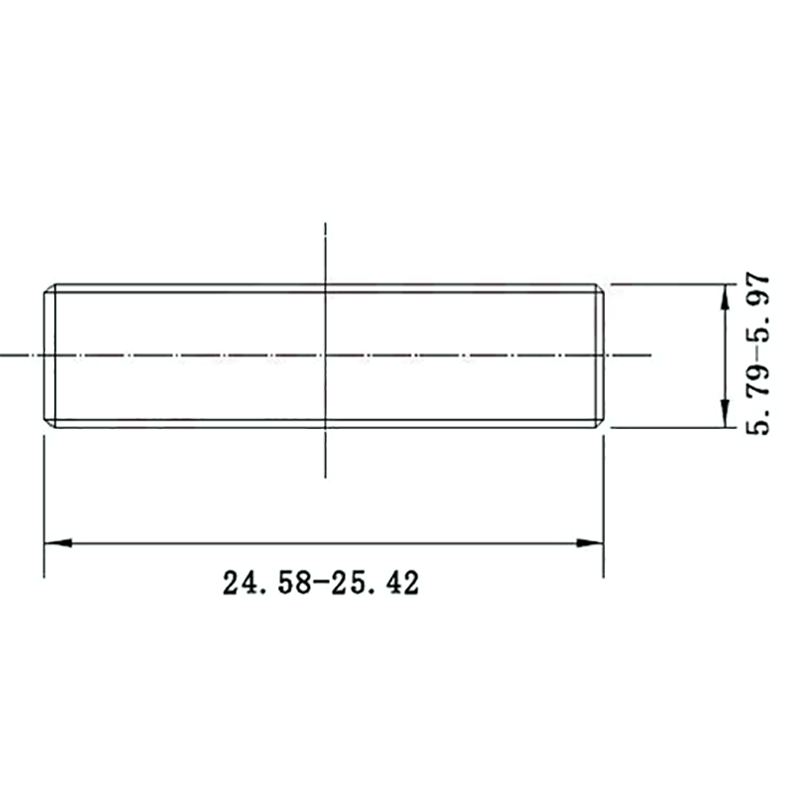
M6 DIN976 Stud Bolt
QS Fastener: M6 DIN976 Stud Bolt
Name: M6 DIN976 Stud Bolt
Standard: DIN976
Material: SS304
Size: M6-1
Lenght: 25
Surface: Natural color
Standard: DIN976
Material: SS304
Size: M6-1
Lenght: 25
Surface: Natural color
Quantity
M6 DIN976 Stud Bolt is precision-forged from SS304 stainless steel and supplied with a natural finish, offering excellent corrosion resistance and high strength. Overall length 25 mm, thread M6 × 1 mm coarse pitch, fully compliant with DIN976. Ideal for harsh environments such as chemical plants, food equipment and marine applications. Ample stock ensures zero project delays.
M6 DIN976 Stud Bolt belongs to the austenitic stainless-steel fastener family. Its corrosion resistance depends primarily on the base material and surface condition. Taking AISI 304 (06Cr19Ni10) as an example, the microstructure is single-phase austenite with Cr ≥ 18 %, Ni ≥ 8 %, and a passive Cr₂O₃ film about 2–5 nm thick. Under continuous salt-spray per ISO 9227 (5 % NaCl, 35 °C, pH 6.5–7.2), the critical chloride-ion concentration for bare material is roughly 0.03 mol/L. The natural passivity-breakdown time T₀ in the neutral salt-spray test (NSS) can be estimated by
T₀ ≈ k · (Ra)^–0.5 · (Cr_eq)²,
where k is a process coefficient (0.8–1.2 h·μm^0.5), Ra is surface roughness (mirror Ra ≤ 0.2 μm, turned Ra 0.8–1.6 μm, hot-forged Ra 3–6 μm), and Cr_eq is the effective chromium equivalent. Empirical data show:
- The head of M6 DIN976 Stud Bolt after cold heading has Ra ≈ 1.0 μm, giving T₀ ≈ 48 h;
T₀ ≈ k · (Ra)^–0.5 · (Cr_eq)²,
where k is a process coefficient (0.8–1.2 h·μm^0.5), Ra is surface roughness (mirror Ra ≤ 0.2 μm, turned Ra 0.8–1.6 μm, hot-forged Ra 3–6 μm), and Cr_eq is the effective chromium equivalent. Empirical data show:
- The head of M6 DIN976 Stud Bolt after cold heading has Ra ≈ 1.0 μm, giving T₀ ≈ 48 h;
- The nut of M6 DIN976 Stud Bolt after tapping and deburring has Ra ≈ 0.6 μm, and its closed geometry reduces Cl⁻ deposition, yielding T₀ ≈ 96 h.
If Ra > 2 μm, the defect density in the passive film rises exponentially, and the local pitting potential E_pit can drop from +0.25 VSCE to –0.10 VSCE, cutting salt-spray life to < 24 h.
Qishine applies a composite treatment to M6 DIN976 Stud Bolt:
① Electro-polishing lowers Ra to ≤ 0.1 μm and removes micro-cracks;
① Electro-polishing lowers Ra to ≤ 0.1 μm and removes micro-cracks;
② Low-temperature vacuum nitriding-oxidation forms an S-phase + Cr₂N diffusion layer with hardness HV0.1 1200–1400, together with a Cr₂O₃/Fe₃O₄ duplex film 0.5–1.0 μm thick;
③ A fluorozirconate-silane hybrid sealant, dry-film thickness 0.3 μm, contact angle > 110°, reduces the chloride-ion permeability by two orders of magnitude.
Testing per GB/T 10125 NSS confirms:
- Standard M6 DIN976 Stud Bolt ≥ 1000 h (ISO 9227 rating ≤ 10 % red rust);
- Standard M6 DIN976 Stud Bolt ≥ 1000 h (ISO 9227 rating ≤ 10 % red rust);
- M6 DIN976 Stud Bolt flat spring washer, due to edge stress concentration after stamping (local Ra 0.3–0.4 μm), ≥ 500 h;
- M6 DIN976 Stud Bolt carriage bolt head with R-corner cold deformation > 30 % and residual tensile stress > +200 MPa may suffer transgranular stress-corrosion cracking, reaching only 300–400 h; additional shot-blasting + secondary sealing is required.
In summary, the salt-spray life of M6 DIN976 Stud Bolt is governed by material, surface roughness, residual stress and seal integrity. Qishine’s process, by reducing Ra, introducing dense multilayer films and relieving stress, can improve the salt-spray performance of 304 fasteners by more than twenty-fold; nevertheless, geometric discontinuities still need individual assessment.
Send Message
