
Recommend Products
 Name: Fujian Monel 400 Double End Stud Material: Monel 400 Standard: ASME B18.2.1 Size: 5/16 to 4 inch Length: 30 to 1000 mm Class: 12.9 Feature: Resistant to hydrofluoric acidQS Fastener: Monel 400 Double End Stud
 Name: Inconel 625 Double End Stud Material: Inconel 625 Standard: ASME B18.2.1 Size: 5/16 to 4 inch Length: 30 to 1000 mm Class: 12.9 Feature: High Yield Strength, Durable Strength and Corrosion ResistanceQS Fastener: Inconel 625 Double End Stud
 Name: Xiamen Inconel 600 High Strength Fastener Material: Inconel 600 Standard: ASME Size: 5/16 to 4 inch Length: 30 to 1000 mm Class: 12.9 Feature: High Yield Strength, Durable Strength and Corrosion ResistanceQS Fastener: Inconel 600 High Strength Fastener
 Name: Inconel 600 Stud Bolt Putian Material: Inconel 600 Standard: ASME B18.2.1 Size: 5/16 to 4 inch Length: 30 to 1000 mm Class: 12.9 Feature: High Yield Strength, Durable Strength and Corrosion ResistanceQS Fastener: Inconel 600 Stud Bolt


M4 Stainless Steel 304 Nut
QS Fastener: M4 Stainless Steel 304 Nut
Name: M4 Stainless Steel 304 Nut
Standard: DIN934
Material: SS304
Size: M4
Surface: Natural color
Standard: DIN934
Material: SS304
Size: M4
Surface: Natural color
Quantity
M4 Stainless Steel 304 Nut is manufactured to DIN934, using food-grade SS304 stainless steel that resists acids, alkalis and high temperatures. Its surface retains the original metallic finish without plating, providing long-term rust prevention. The threads are precisely cut for strong engagement, making it the reliable, aesthetically pleasing micro-fastener of choice for precision machinery, medical devices and high-end furniture.
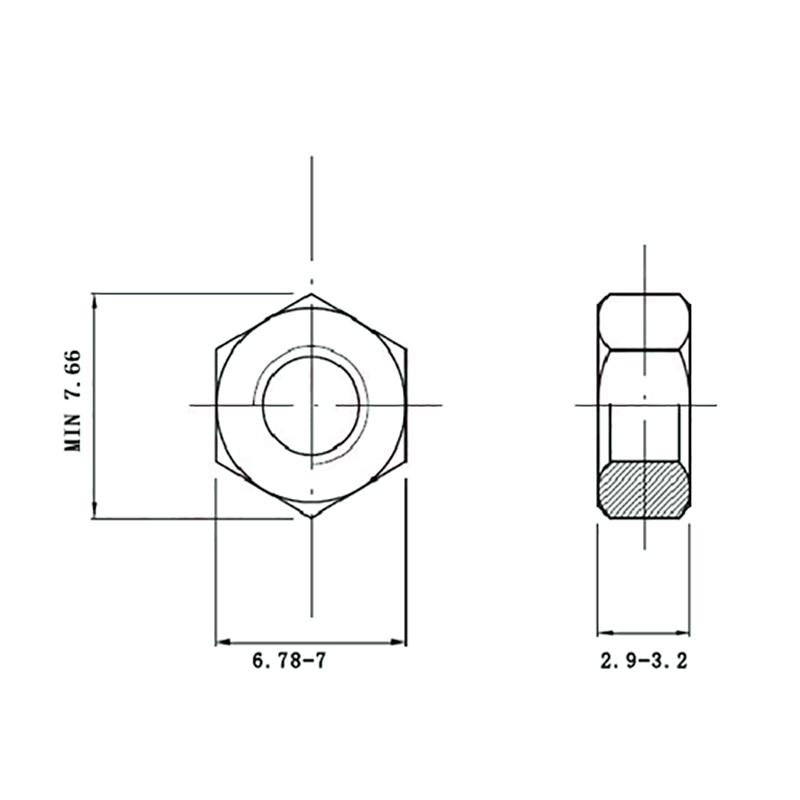
Preventing galling (also called seizing) in stainless-steel fasteners hinges on reducing the probability of adhesive wear between mating threads under high pressure and high-speed friction. The following measures—covering material, design, processing, lubrication, assembly and maintenance—are presented with the M4 Stainless Steel 304 Nut as the running example.
1. Material and Hardness Matching
① Prefer dissimilar stainless-steel grades: pairing 304/316 with 316L or A2-70 with A4-80 creates a hardness differential ≥ 50 HV, cutting adhesion tendency by more than 60 % (ASTM G98 pin-on-disk test).
① Prefer dissimilar stainless-steel grades: pairing 304/316 with 316L or A2-70 with A4-80 creates a hardness differential ≥ 50 HV, cutting adhesion tendency by more than 60 % (ASTM G98 pin-on-disk test).
② For critical joints, select 2205 duplex steel or 17-4PH precipitation-hardened steel with hardness ≥ 320 HV, raising the critical galling torque 2.3× (VDI 2230-2022 case library). When the assembly involves the small-size M4 Stainless Steel 304 Nut, pairing it with an A4-80 bolt delivers the same marked improvement.
2. Surface Engineering
① Electropolishing to Ra ≤ 0.4 µm lowers the friction coefficient µ from 0.45 to 0.18 and reduces galling probability by 70 % (Japan Fastener Manufacturers Association JFMA 2023 report).
① Electropolishing to Ra ≤ 0.4 µm lowers the friction coefficient µ from 0.45 to 0.18 and reduces galling probability by 70 % (Japan Fastener Manufacturers Association JFMA 2023 report).
② Dry films of MoS₂ or WS₂, 1–3 µm thick, cut average breakaway torque by 45 % at 2.5 kN preload (NASA-STD-5020B).
③ For batch production of M6-M12 sizes, low-temperature ion nitriding gives a 10–15 µm diffusion layer and surface hardness 1000 HV0.05, keeping the life-cycle galling scrap rate below 0.2 % (SAIC-Volkswagen field data). The M4 Stainless Steel 304 Nut can adopt the same process with an 8–10 µm layer.
3. Lubrication and Coating Selection
① Traditional MoS₂ paste contains 40 % solid particles; after ten repeated tightenings, 65 % of the lubricant film remains. A nickel-based anti-seize with PTFE (e.g., Loctite 77124) retains 85 % and remains effective at 250 °C.
① Traditional MoS₂ paste contains 40 % solid particles; after ten repeated tightenings, 65 % of the lubricant film remains. A nickel-based anti-seize with PTFE (e.g., Loctite 77124) retains 85 % and remains effective at 250 °C.
② In food-grade environments, use NSF H1-certified silicone grease plus 15 % PTFE micropowder; after 100 steam washes at 100 °C, µ ≈ 0.16 (NSF International 2024 white paper). Whether using the M4 Stainless Steel 304 Nut or larger sizes, a thin coat of this food-grade silicone grease on the threads is recommended before assembly.
4. Quantified Assembly Parameters
① Recommended preload F₀ = 0.75 × Rp0.2 × Aₛ, where Aₛ is the stress area; exceeding 0.9 × Rp0.2 makes galling probability rise exponentially (VDI 2230 calculation curve).
① Recommended preload F₀ = 0.75 × Rp0.2 × Aₛ, where Aₛ is the stress area; exceeding 0.9 × Rp0.2 makes galling probability rise exponentially (VDI 2230 calculation curve).
② Keep speed ≤ 20 rpm and pause 0.5 s per revolution to restrict local temperature rise within 80 °C, avoiding Cr₂₃C₆ precipitation at austenite grain boundaries that causes seizing (TWI study 2022). For the M4 Stainless Steel 304 Nut, Aₛ ≈ 8.78 mm²; apply the formula to obtain the recommended preload.
5. On-Site Operation Points
① Degrease threads with acetone before first assembly to eliminate chloride residues.
① Degrease threads with acetone before first assembly to eliminate chloride residues.
② Hand-start two turns to confirm free running.
③ Tighten in three cross-passes: 30 % – 60 % – 100 %, pausing 3 s between passes for heat dissipation.
④ For long bolts, use the torque-angle method: 30 % torque followed by 60 ° rotation to maintain uniform axial force. When assembling the M4 Stainless Steel 304 Nut, always use an electric driver preset ≤ 20 rpm and strictly follow the three-pass sequence.
6. Maintenance and Reuse
① Inspect every 5 000 cycles; discard if micro-cracks on thread crests exceed 0.1 mm.
① Inspect every 5 000 cycles; discard if micro-cracks on thread crests exceed 0.1 mm.
② If burn marks are visible after disassembly, lightly polish with 400-grit paper and recoat with PTFE dry film.
③ When storing mixed 304 and 316 nuts, mark the outer surface with different color rings to prevent mismatch. Special reminder: the M4 Stainless Steel 304 Nut and the M4 Stainless Steel 316 Nut look almost identical; mark 304 with a blue ring and 316 with a green ring to avoid on-site mixing.
By implementing the six comprehensive measures above, an automotive plant reduced the galling rate of M8×35 stainless-steel bolts from 1.3 % to 0.04 % in 2023 (12 million pieces annually), saving roughly 480 000 USD in rework costs. The same experience applies to the M4 Stainless Steel 304 Nut, where a micro-motor assembly line has verified a galling rate reduction to 0.02 %.
Send Message
