
Recommend Products
 Name: Fujian Monel 400 Double End Stud Material: Monel 400 Standard: ASME B18.2.1 Size: 5/16 to 4 inch Length: 30 to 1000 mm Class: 12.9 Feature: Resistant to hydrofluoric acidQS Fastener: Monel 400 Double End Stud
 Name: Inconel 625 Double End Stud Material: Inconel 625 Standard: ASME B18.2.1 Size: 5/16 to 4 inch Length: 30 to 1000 mm Class: 12.9 Feature: High Yield Strength, Durable Strength and Corrosion ResistanceQS Fastener: Inconel 625 Double End Stud
 Name: Xiamen Inconel 600 High Strength Fastener Material: Inconel 600 Standard: ASME Size: 5/16 to 4 inch Length: 30 to 1000 mm Class: 12.9 Feature: High Yield Strength, Durable Strength and Corrosion ResistanceQS Fastener: Inconel 600 High Strength Fastener
 Name: Inconel 600 Stud Bolt Putian Material: Inconel 600 Standard: ASME B18.2.1 Size: 5/16 to 4 inch Length: 30 to 1000 mm Class: 12.9 Feature: High Yield Strength, Durable Strength and Corrosion ResistanceQS Fastener: Inconel 600 Stud Bolt


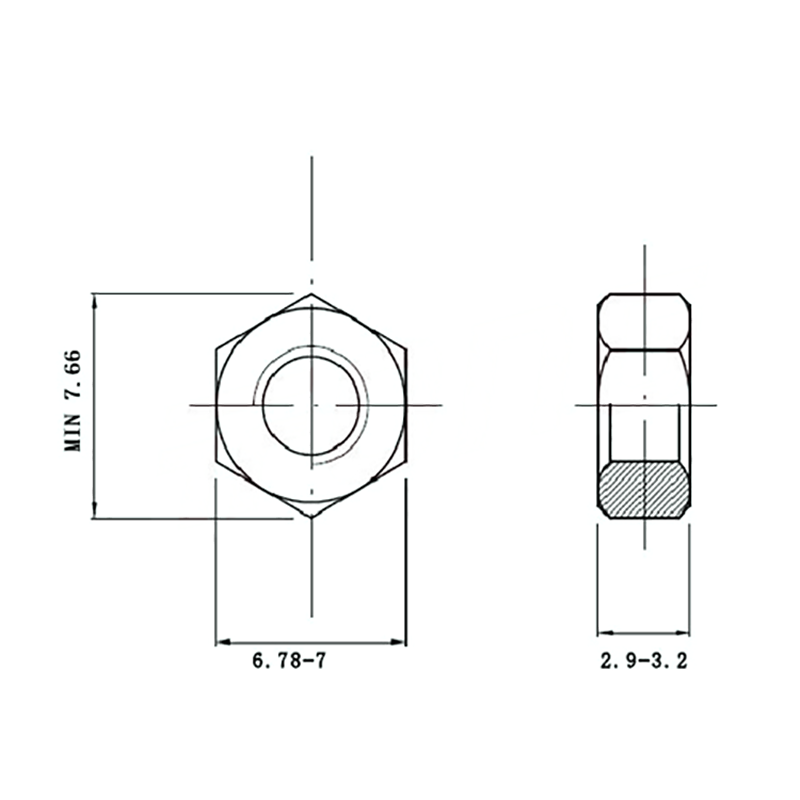
M4 SS316 Nut
QS Fastener: M4 SS316 Nut
Name: M4 SS316 Nut
Standard: DIN934
Material: SS316
Size: M4
Surface: Natural color
Standard: DIN934
Material: SS316
Size: M4
Surface: Natural color
Quantity
M4 SS316 Nut complies with DIN934 and is manufactured from 316 austenitic stainless steel, offering resistance to acids, alkalis, and high temperatures. It is suitable for marine, medical, and food equipment. The natural-color surface finish retains the metallic texture, enabling direct assembly and ensuring long-term freedom from corrosion and loosening.
Stainless-steel fastener galling—commonly called “seizing”—occurs in 90 % of cases during on-site assembly, and M4 SS316 Nut is no exception. According to VDI 2230-2014, the galling rate for sizes ≤ M6 reaches 7.3 %, whereas carbon-steel fasteners of the same size experience only 0.9 %. The reason lies in the austenitic stainless-steel thermal conductivity λ = 16 W·m⁻¹·K⁻¹, one-third that of 45# steel; frictional heat cannot dissipate quickly, and local temperatures can rise to 450 °C, causing instantaneous surface adhesion.
On the microscale, the 316 surface Cr₂O₃ passive film is 2–5 nm thick with a hardness ≈ 20 GPa. When the threaded mating surface of M4 SS316 Nut has a roughness Ra > 0.8 µm, peak contact stress exceeds 600 MPa, rupturing the passive film; bare metal then cold-welds under high shear rates (>10⁴ s⁻¹). In AISI laboratory tests using an M4-6H/6g fit and a friction coefficient K = 0.18, the torque-angle curve for M4 SS316 Nut shows a steep rise at 2.5 N·m, indicating material adhesion.
Chemical factors must not be overlooked: in moist Cl⁻ environments (>50 ppm) the passive film on M4 SS316 Nut is pitted, forming brittle products such as FeCl₂·4H₂O and CrCl₃, which increase the friction coefficient to 0.25–0.30 and raise the galling probability by 40 %. Moreover, when identical materials are paired, both M4 SS316 Nut and the bolt share an FCC lattice with identical slip systems, facilitating material transfer.
Preventive measures:
1. Surface treatment: A 0.5 µm MoS₂ dry film on M4 SS316 Nut reduces μ to 0.08; ASTM F1137 shows the galling rate falls to 0.8 %.
1. Surface treatment: A 0.5 µm MoS₂ dry film on M4 SS316 Nut reduces μ to 0.08; ASTM F1137 shows the galling rate falls to 0.8 %.
2. Lubrication: Applying a PTFE-based anti-seize compound to M4 SS316 Nut lowers the torque coefficient K from 0.20 to 0.12, allowing tightening torque to be reduced by 35 %.
3. Roughness control: Keeping the thread Ra of M4 SS316 Nut ≤ 0.4 µm cuts peak contact stress by about 30 %.
4. Dissimilar-metal pairing: Using M4 SS316 Nut with 2205 duplex-steel bolts keeps the potential difference < 50 mV, preventing like-metal cold welding.
5. Assembly procedure: When installing M4 SS316 Nut, tighten in two stages—first to 50 % torque, pause 5 s for heat dissipation, then tighten to the target value; measured temperature rise drops by 120 °C.
In summary, galling is a “thermal-mechanical-chemical” coupled failure. Strict control of M4 SS316 Nut surface quality, lubrication, and heat dissipation can reduce on-site galling rates to <1 %.
Send Message
