
Recommend Products
 Name: Fujian Monel 400 Double End Stud Material: Monel 400 Standard: ASME B18.2.1 Size: 5/16 to 4 inch Length: 30 to 1000 mm Class: 12.9 Feature: Resistant to hydrofluoric acidQS Fastener: Monel 400 Double End Stud
 Name: Inconel 625 Double End Stud Material: Inconel 625 Standard: ASME B18.2.1 Size: 5/16 to 4 inch Length: 30 to 1000 mm Class: 12.9 Feature: High Yield Strength, Durable Strength and Corrosion ResistanceQS Fastener: Inconel 625 Double End Stud
 Name: Xiamen Inconel 600 High Strength Fastener Material: Inconel 600 Standard: ASME Size: 5/16 to 4 inch Length: 30 to 1000 mm Class: 12.9 Feature: High Yield Strength, Durable Strength and Corrosion ResistanceQS Fastener: Inconel 600 High Strength Fastener
 Name: Inconel 600 Stud Bolt Putian Material: Inconel 600 Standard: ASME B18.2.1 Size: 5/16 to 4 inch Length: 30 to 1000 mm Class: 12.9 Feature: High Yield Strength, Durable Strength and Corrosion ResistanceQS Fastener: Inconel 600 Stud Bolt


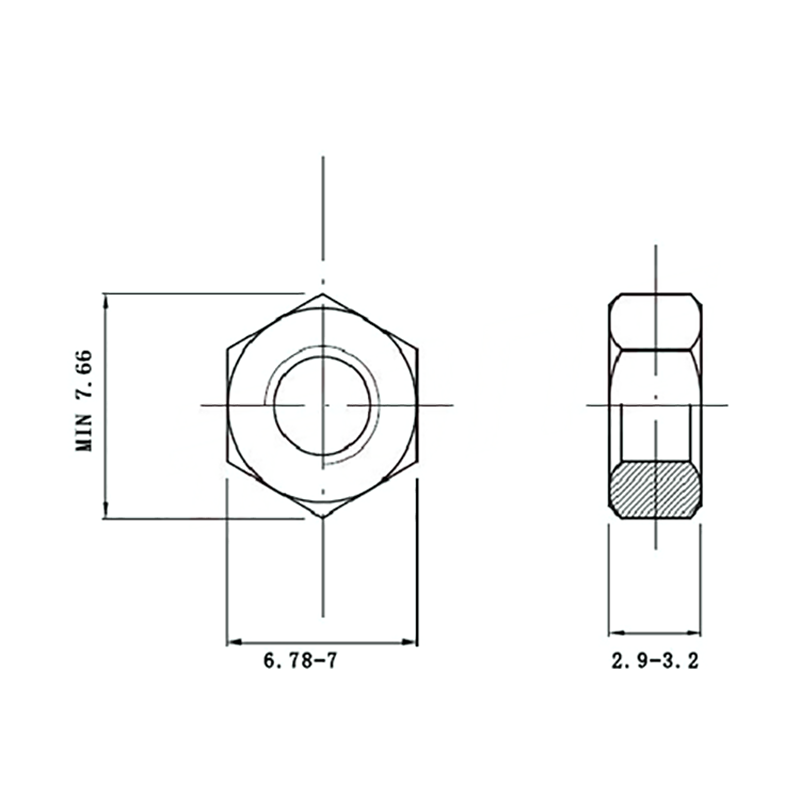
M4 DIN934 Hex Nut, precision-made from premium SS 304 stainless steel to DIN934, supplied in natural finish without plating—more rust-resistant and environmentally friendly. The universal M4 size quickly secures electronics, instruments, furniture and other delicate structures; high strength, hot/cold resistant, install once, last for life.
Galling is the most common failure mode in stainless fasteners: under high pressure and micro-slip the material undergoes adhesive wear and cold-welding. The following material-level analysis, with quantitative data, applies equally to micro-size M4 DIN934 Hex Nut.
1. Alloy chemistry & microstructure
SS 304/316: 18 %Cr-8 %Ni-2 %Mo. ≥16 %Cr gives a >10 nm Cr₂O₃ film, HV≈1500; above 15 N·m the film breaks instantly, exposing the matrix (HV≈200) that welds to the mating surface. AISI 410 martensite (HV≈450) with only 12 %Cr has a weaker film, so galling probability drops ~30 %, but corrosion suffers—direct guidance for high-strength M4 DIN934 Hex Nut selection.
SS 304/316: 18 %Cr-8 %Ni-2 %Mo. ≥16 %Cr gives a >10 nm Cr₂O₃ film, HV≈1500; above 15 N·m the film breaks instantly, exposing the matrix (HV≈200) that welds to the mating surface. AISI 410 martensite (HV≈450) with only 12 %Cr has a weaker film, so galling probability drops ~30 %, but corrosion suffers—direct guidance for high-strength M4 DIN934 Hex Nut selection.
2. Work-hardening & surface finish
After cold-heading, 304 thread surface rises from HV 200 to HV 380; Ra 0.4-0.8 µm. When Ra>0.6 µm the real contact area is only 4 % of nominal, giving local stress σ≈1.2 GPa—six times the 0.2 % proof stress (205 MPa)—and metal-transfer lumps form. Tests show cutting Ra from 0.4 µm to 0.2 µm lowers galling torque by 35 %; the same control suits volume production of M4 DIN934 Hex Nut.
After cold-heading, 304 thread surface rises from HV 200 to HV 380; Ra 0.4-0.8 µm. When Ra>0.6 µm the real contact area is only 4 % of nominal, giving local stress σ≈1.2 GPa—six times the 0.2 % proof stress (205 MPa)—and metal-transfer lumps form. Tests show cutting Ra from 0.4 µm to 0.2 µm lowers galling torque by 35 %; the same control suits volume production of M4 DIN934 Hex Nut.
3. Nickel equivalent & austenite stability
Nieq = Ni+30C+0.5Mn governs austenite stability. If Nieq<28, strain-induced α′ martensite (HV≈600) appears, hardness jumps and wear accelerates. 304L (Nieq=26) shows 22 % higher galling risk than 316L (Nieq=32); specify Nieq≥30 for M4 DIN934 Hex Nut.
Nieq = Ni+30C+0.5Mn governs austenite stability. If Nieq<28, strain-induced α′ martensite (HV≈600) appears, hardness jumps and wear accelerates. 304L (Nieq=26) shows 22 % higher galling risk than 316L (Nieq=32); specify Nieq≥30 for M4 DIN934 Hex Nut.
4. Lubrication & film repair
Once the passive film is broken in >50 ppm Cl⁻, the pitting potential Eb≈+0.23 VSCE and film heals <0.5 nm s⁻¹—too slow to stop metal contact. A PTFE dry film (µ=0.06) or MoS₂ wax lowers galling torque by >50 %—vital for M4 DIN934 Hex Nut in marine use.
Once the passive film is broken in >50 ppm Cl⁻, the pitting potential Eb≈+0.23 VSCE and film heals <0.5 nm s⁻¹—too slow to stop metal contact. A PTFE dry film (µ=0.06) or MoS₂ wax lowers galling torque by >50 %—vital for M4 DIN934 Hex Nut in marine use.
5. Temperature & nitriding
≥150 °C grows Cr₂O₁ ten-fold faster, but elastic modulus E drops 12 % so the film spalls more easily. Low-temperature gas nitriding (420 °C, NH₃, 20 h) produces a 15 µm S-phase layer, HV 1100, µ=0.15, extending galling life five-fold; the process is already in volume production for premium M4 DIN934 Hex Nut.
≥150 °C grows Cr₂O₁ ten-fold faster, but elastic modulus E drops 12 % so the film spalls more easily. Low-temperature gas nitriding (420 °C, NH₃, 20 h) produces a 15 µm S-phase layer, HV 1100, µ=0.15, extending galling life five-fold; the process is already in volume production for premium M4 DIN934 Hex Nut.
Conclusion: combine Nieq≥30, Ra<0.4 µm, MoS₂ lubrication or a nitrided case to cut galling probability from ~15 % to <1 %—equally valid for the full life-cycle management of M4 DIN934 Hex Nut.
Send Message
