
Recommend Products
 Name: Fujian Monel 400 Double End Stud Material: Monel 400 Standard: ASME B18.2.1 Size: 5/16 to 4 inch Length: 30 to 1000 mm Class: 12.9 Feature: Resistant to hydrofluoric acidQS Fastener: Monel 400 Double End Stud
 Name: Inconel 625 Double End Stud Material: Inconel 625 Standard: ASME B18.2.1 Size: 5/16 to 4 inch Length: 30 to 1000 mm Class: 12.9 Feature: High Yield Strength, Durable Strength and Corrosion ResistanceQS Fastener: Inconel 625 Double End Stud
 Name: Xiamen Inconel 600 High Strength Fastener Material: Inconel 600 Standard: ASME Size: 5/16 to 4 inch Length: 30 to 1000 mm Class: 12.9 Feature: High Yield Strength, Durable Strength and Corrosion ResistanceQS Fastener: Inconel 600 High Strength Fastener
 Name: Inconel 600 Stud Bolt Putian Material: Inconel 600 Standard: ASME B18.2.1 Size: 5/16 to 4 inch Length: 30 to 1000 mm Class: 12.9 Feature: High Yield Strength, Durable Strength and Corrosion ResistanceQS Fastener: Inconel 600 Stud Bolt


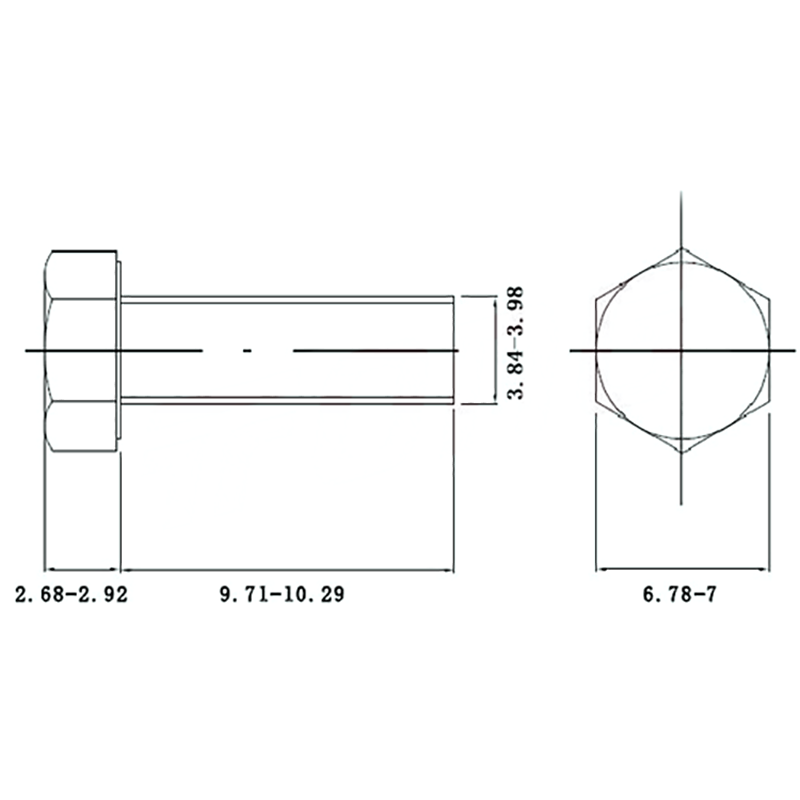
M4 DIN 933 Hex Screw
QS Fastener: M4 DIN 933 Hex Screw
Name: M4 DIN 933 Hex Screw
Standard: DIN933
Material: SS 304
Size: M4
Lenght: 10 mm
Surface: Natural color
Standard: DIN933
Material: SS 304
Size: M4
Lenght: 10 mm
Surface: Natural color
Quantity
M4 DIN 933 Hex Screw, fabricated from SS304 stainless steel, 10 mm in length and supplied with a plain (self-finish) surface, combines corrosion resistance with high strength. It is the ideal fastener for precision electronics, medical and food-processing equipment, providing reliable installation and maintenance-free service.
The corrosion resistance of 304 stainless steel (06Cr19Ni10, Cr≈18 %, Ni≈8 %) is conferred by a surface Cr₂O₃ passive film whose stable existence requires “high oxygen + low Cl⁻ + low sulfur”. When the environment deviates from this window, the passive film is locally destroyed, leading to pitting, crevice corrosion or even stress corrosion cracking (SCC). Below, measured data from two typical scenarios are provided, followed by directly applicable protection recommendations for the M4 DIN 933 Hex Screw.
1. Polluted industrial atmosphere
Typical composition: SO₂ 50–200 µg·m⁻³, NOₓ 40–150 µg·m⁻³, dust containing FeS₂ and C; at relative humidity >70 % the dust absorbs moisture to form H₂SO₄/HNO₃ micro-droplets with pH≈2–4.
Typical composition: SO₂ 50–200 µg·m⁻³, NOₓ 40–150 µg·m⁻³, dust containing FeS₂ and C; at relative humidity >70 % the dust absorbs moisture to form H₂SO₄/HNO₃ micro-droplets with pH≈2–4.
Corrosion rate: under GB/T 19292.1-2018 corrosion category C4, the weight-loss rate for 304 reaches 2–4 g·m⁻²·a⁻¹, approximately 10–20 times that in clean atmosphere; shallow pits 0.1–0.3 mm in diameter appear on the surface within 1–3 months. If the M4 DIN 933 Hex Screw is directly exposed to such an atmosphere, pit depth increases by ~0.1 mm per year, markedly reducing its ability to maintain preload.
Mechanism: HS⁻ generated by SO₂ reduction, together with NO₃⁻, jointly destroy the passive film, forming porous corrosion products such as FeS and FeSO₄·xH₂O; oxygen depletion inside the pits creates an active–passive cell that accelerates local micro-galvanic corrosion of the M4 DIN 933 Hex Screw.
2. Coastal salt-spray environment
Salt-spray deposition 10–50 mg NaCl·m⁻²·d⁻¹; Cl⁻ concentration in the liquid film can reach 0.1–0.5 mol·L⁻¹; temperature 25–35 °C, humidity 75–90 %.
Corrosion rate: per ASTM B117 1000 h continuous salt spray, weight loss for 304 is 0.8–1.2 g·m⁻²; coupons exposed for one year in the Xisha marine atmosphere showed a pitting density of 50–80 pits·cm⁻² and a maximum pit depth of 0.12 mm. If the M4 DIN 933 Hex Screw is used in this environment without surface upgrading, its effective cross-sectional area can decrease by more than 5 % within three years.
Salt-spray deposition 10–50 mg NaCl·m⁻²·d⁻¹; Cl⁻ concentration in the liquid film can reach 0.1–0.5 mol·L⁻¹; temperature 25–35 °C, humidity 75–90 %.
Corrosion rate: per ASTM B117 1000 h continuous salt spray, weight loss for 304 is 0.8–1.2 g·m⁻²; coupons exposed for one year in the Xisha marine atmosphere showed a pitting density of 50–80 pits·cm⁻² and a maximum pit depth of 0.12 mm. If the M4 DIN 933 Hex Screw is used in this environment without surface upgrading, its effective cross-sectional area can decrease by more than 5 % within three years.
Mechanism: the small Cl⁻ radius allows penetration of the Cr₂O₃ film, forming soluble CrCl₃·6H₂O and locally thinning the film; pH inside the pits drops to 1–2, accelerating anodic dissolution. If the temperature exceeds 60 °C, the critical stress-intensity factor for SCC (KISCC) can drop below 15 MPa·m½, causing brittle fracture of the M4 DIN 933 Hex Screw at tensile stresses far below the yield strength.
Integrated protection strategy (implemented on the M4 DIN 933 Hex Screw as the unit):
① Electropolish the surface to Ra≤0.4 µm to reduce Cl⁻ retention;
① Electropolish the surface to Ra≤0.4 µm to reduce Cl⁻ retention;
② After assembly, perform overall passivation (HNO₃ 20 %, 50 °C, 30 min) to restore the Cr₂O₃ film;
③ Where necessary, switch to 316L (Mo≥2 %) or apply a 25 µm epoxy–zinc-aluminium coating.
After the above treatments, the expected weight-loss rate of the M4 DIN 933 Hex Screw in C4 atmosphere and marine salt spray can be reduced to <0.3 g·m⁻²·a⁻¹, with pitting density <5 pits·cm⁻², significantly extending service life.
Send Message
