
Recommend Products
 Name: Fujian Monel 400 Double End Stud Material: Monel 400 Standard: ASME B18.2.1 Size: 5/16 to 4 inch Length: 30 to 1000 mm Class: 12.9 Feature: Resistant to hydrofluoric acidQS Fastener: Monel 400 Double End Stud
 Name: Inconel 625 Double End Stud Material: Inconel 625 Standard: ASME B18.2.1 Size: 5/16 to 4 inch Length: 30 to 1000 mm Class: 12.9 Feature: High Yield Strength, Durable Strength and Corrosion ResistanceQS Fastener: Inconel 625 Double End Stud
 Name: Xiamen Inconel 600 High Strength Fastener Material: Inconel 600 Standard: ASME Size: 5/16 to 4 inch Length: 30 to 1000 mm Class: 12.9 Feature: High Yield Strength, Durable Strength and Corrosion ResistanceQS Fastener: Inconel 600 High Strength Fastener
 Name: Inconel 600 Stud Bolt Putian Material: Inconel 600 Standard: ASME B18.2.1 Size: 5/16 to 4 inch Length: 30 to 1000 mm Class: 12.9 Feature: High Yield Strength, Durable Strength and Corrosion ResistanceQS Fastener: Inconel 600 Stud Bolt


M3 Stainless Steel 304 Screw
QS Fastener: M3 Stainless Steel 304 Screw
Name: M3 Stainless Steel 304 Screw
Standard: DIN933
Material: SS304
Size: M3
Lenght: 35 mm
Surface: Natural color
Standard: DIN933
Material: SS304
Size: M3
Lenght: 35 mm
Surface: Natural color
Quantity
M3 Stainless Steel 304 Screw, manufactured to DIN933 standard, 35 mm in length, offers outstanding corrosion and acid-alkali resistance. Its natural finish is free of coatings or plating, ensuring zero contamination, making it ideal for precision electronics, medical devices, and food-processing equipment. The threads are burr-free and 100 % inspected with go/no-go gauges, allowing smooth installation and a secure, vibration-resistant lock. Despite its compact size, it delivers high load-bearing capability, helping to upgrade the safety of your product.
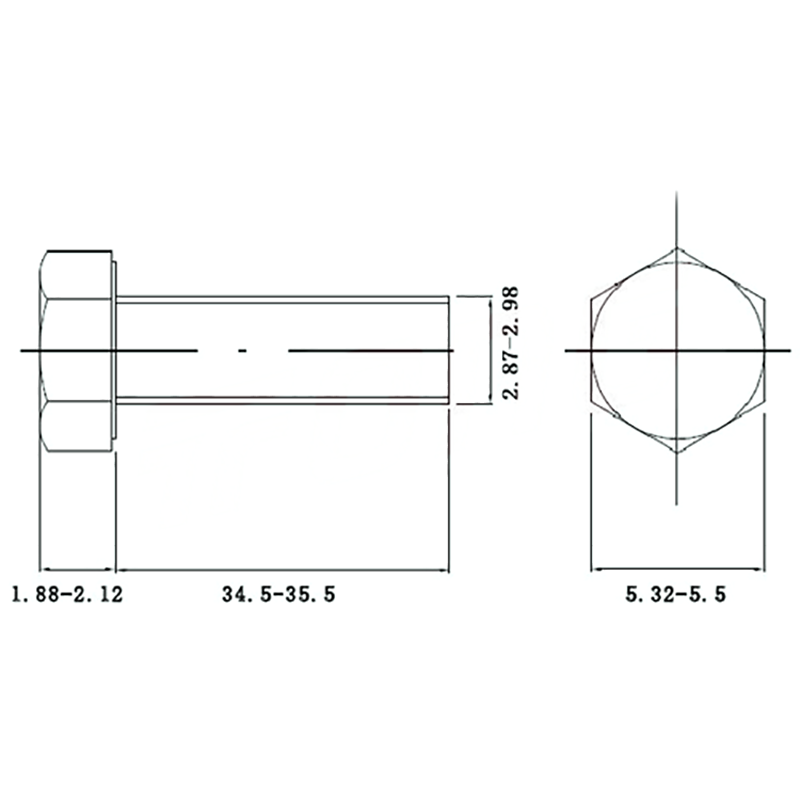
The load-bearing capacity of M3 Stainless Steel 304 Screw can be analyzed from three aspects: material properties, effective thread area, and actual service conditions.
1. Material properties: ISO 3506-1 specifies that the “70” in A2-70 denotes a minimum tensile strength Rm of 700 MPa and a 0.2 % proof strength Rp0.2 ≥ 450 MPa, with elongation ≥ 0.4 d. These properties are measured at 20 °C in air. As temperature rises, strength decreases: approximately 10 % at 150 °C and 30 % at 300 °C. Hardness is HV 200–250, equivalent to HRB 90–100, and these indicators also apply to M3 Stainless Steel 304 Screw.
2. Effective thread area: ISO 898-1 gives the nominal stress area As for M3×0.5 as As = π/4·(d–0.9382 P)² = 5.03 mm². Thus, the theoretical ultimate tensile load Ft of M3 Stainless Steel 304 Screw is Ft = Rm·As = 700 MPa × 5.03 mm² ≈ 3.5 kN, and the yield load Fy = Rp0.2·As = 450 MPa × 5.03 mm² ≈ 2.3 kN.
3. Installation torque: Using the VDI 2230 formula T = k·F·d, where k ≈ 0.17 (mean dry friction coefficient 304/304, range 0.12–0.22), and a target preload F = 0.75 Fy = 1.7 kN, yields T = 0.17 × 1.7 kN × 3 mm ≈ 0.87 N·m; handbooks round this to 0.9 N·m. If M3 Stainless Steel 304 Screw is lightly lubricated, k drops to 0.12 and T reduces to 0.6 N·m, requiring corresponding adjustment.
4. Long-term safe load: Provided that thread engagement length ≥ 1.0 d, the clamped parts are aluminum or steel, and no dynamic loads are present, an allowable load of 0.7 Fy = 1.6 kN can be adopted for M3 Stainless Steel 304 Screw. If engagement is insufficient or thin sheets are used, check thread shear and pull-out:
• Minimum shear strength of 304 internal threads is 0.58 Rm ≈ 400 MPa; the effective shear area of M3 internal threads is 6.77 mm², giving 2.7 kN per engaged turn and 10.8 kN for four turns, far exceeding the strength of M3 Stainless Steel 304 Screw itself, so failure mode remains tensile fracture of the shank.
• Minimum shear strength of 304 internal threads is 0.58 Rm ≈ 400 MPa; the effective shear area of M3 internal threads is 6.77 mm², giving 2.7 kN per engaged turn and 10.8 kN for four turns, far exceeding the strength of M3 Stainless Steel 304 Screw itself, so failure mode remains tensile fracture of the shank.
• If the clamped part is ABS (σt ≈ 50 MPa), verify pull-out of the hole wall: for a 3.2 mm hole diameter and 2 mm plate thickness, pull-out area is 20 mm², allowing a maximum of 1 kN. In this case, system capacity is governed by the plastic plate, not M3 Stainless Steel 304 Screw.
5. Fatigue and vibration: The fatigue limit of A2-70 is about 0.3 Rm ≈ 210 MPa, corresponding to an alternating load amplitude of ±530 N. If M3 Stainless Steel 304 Screw is subjected to vibration, elastic washers or thread-locking adhesive are recommended to reduce preload loss.
Conclusion: At room temperature, in steel-to-steel joints with sufficient thread engagement and static loading, the recommended working tensile load for M3 Stainless Steel 304 Screw is 1.4–1.6 kN with a torque of 0.9 N·m. Design verification must also include clamped parts, temperature, vibration, and corrosion margins to ensure overall joint safety.
Send Message
