
Recommend Products
 Name: Fujian Monel 400 Double End Stud Material: Monel 400 Standard: ASME B18.2.1 Size: 5/16 to 4 inch Length: 30 to 1000 mm Class: 12.9 Feature: Resistant to hydrofluoric acidQS Fastener: Monel 400 Double End Stud
 Name: Inconel 625 Double End Stud Material: Inconel 625 Standard: ASME B18.2.1 Size: 5/16 to 4 inch Length: 30 to 1000 mm Class: 12.9 Feature: High Yield Strength, Durable Strength and Corrosion ResistanceQS Fastener: Inconel 625 Double End Stud
 Name: Xiamen Inconel 600 High Strength Fastener Material: Inconel 600 Standard: ASME Size: 5/16 to 4 inch Length: 30 to 1000 mm Class: 12.9 Feature: High Yield Strength, Durable Strength and Corrosion ResistanceQS Fastener: Inconel 600 High Strength Fastener
 Name: Inconel 600 Stud Bolt Putian Material: Inconel 600 Standard: ASME B18.2.1 Size: 5/16 to 4 inch Length: 30 to 1000 mm Class: 12.9 Feature: High Yield Strength, Durable Strength and Corrosion ResistanceQS Fastener: Inconel 600 Stud Bolt


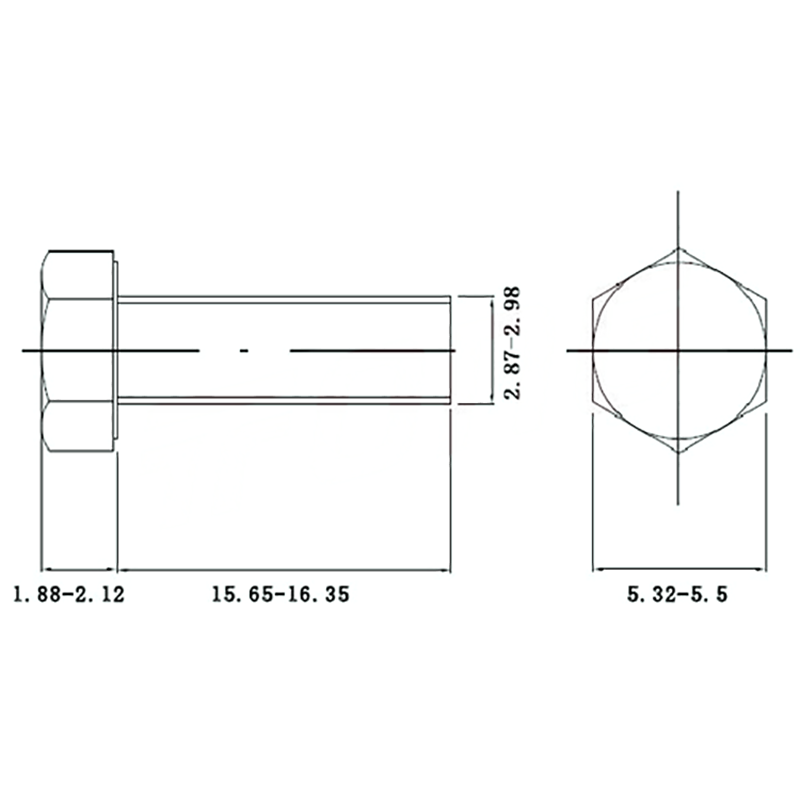
M3 SS304 Hex Screw
QS Fastener: M3 SS304 Hex Screw
Name: M3 SS304 Hex Screw
Standard: DIN933
Material: SS304
Size: M3
Lenght: 16
Surface: Natural color
Standard: DIN933
Material: SS304
Size: M3
Lenght: 16
Surface: Natural color
Quantity
M3 SS304 Hex Screw, 16 mm long, plain finish—corrosion-resistant, high-strength, precision thread; the universal fastener of choice for electronics, instruments and outdoor equipment.
Latest Test Data and Code Summary on the Fatigue Limit of M3 SS304 Hex Screw
The fatigue limit of stainless-steel bolts (σ₋₁, the maximum alternating stress without failure at 10⁷ cycles) is directly related to material grade, strength level, thread manufacturing process and surface condition. Based on the latest test data and engineering standards, the findings are summarised below, with M3 SS304 Hex Screw used as a running example throughout:
The fatigue limit of stainless-steel bolts (σ₋₁, the maximum alternating stress without failure at 10⁷ cycles) is directly related to material grade, strength level, thread manufacturing process and surface condition. Based on the latest test data and engineering standards, the findings are summarised below, with M3 SS304 Hex Screw used as a running example throughout:
1. Standard austenitic stainless-steel bolts
• A2-70 / A4-70 (ISO 3506-1, Rm≈700 MPa)
‑ Rolled thread: σ₋₁ ≈ 200 – 240 MPa
‑ Cut thread: σ₋₁ ≈ 120 – 160 MPa (about 30–40 % lower than rolled)
Taking M3 SS304 Hex Screw as an example, rolled threads stabilise the fatigue limit around 220 MPa, whereas cut threads only reach 140 MPa—a significant difference.
• A2-70 / A4-70 (ISO 3506-1, Rm≈700 MPa)
‑ Rolled thread: σ₋₁ ≈ 200 – 240 MPa
‑ Cut thread: σ₋₁ ≈ 120 – 160 MPa (about 30–40 % lower than rolled)
Taking M3 SS304 Hex Screw as an example, rolled threads stabilise the fatigue limit around 220 MPa, whereas cut threads only reach 140 MPa—a significant difference.
2. High-strength austenitic stainless-steel bolts
• A4-80 (Rm≈800 MPa)
‑ Rolled thread: σ₋₁ ≈ 220 – 260 MPa
If A4-80 material is used for M3 SS304 Hex Screw, the rolled thread can achieve σ₋₁ = 240 MPa, meeting the demands of high-load precision equipment.
• A4-80 (Rm≈800 MPa)
‑ Rolled thread: σ₋₁ ≈ 220 – 260 MPa
If A4-80 material is used for M3 SS304 Hex Screw, the rolled thread can achieve σ₋₁ = 240 MPa, meeting the demands of high-load precision equipment.
3. Special high-nitrogen stainless steels (e.g. 0Cr20Mn18N0.8, Rm≈970 MPa)
• Rolled thread: σ₋₁ ≈ 330 MPa
Compared with M3 SS304 Hex Screw of the same size, this variant raises the fatigue limit by roughly 50 %, making it suitable for critical aerospace or nuclear applications.
• Rolled thread: σ₋₁ ≈ 330 MPa
Compared with M3 SS304 Hex Screw of the same size, this variant raises the fatigue limit by roughly 50 %, making it suitable for critical aerospace or nuclear applications.
4. Empirical conversion
• For ductile stainless steels, σ₋₁ ≈ (0.30–0.35) Rm (smooth specimens); threaded parts, due to stress concentration, require an additional factor of 0.45–0.55.
• Surface treatments such as electropolishing, shot peening or passivation can increase σ₋₁ by 10–20 %, while tool marks or pitting defects can reduce it by 30–50 %.
Tests show that shot peening M3 SS304 Hex Screw raises σ₋₁ from 200 MPa to 230 MPa.
• For ductile stainless steels, σ₋₁ ≈ (0.30–0.35) Rm (smooth specimens); threaded parts, due to stress concentration, require an additional factor of 0.45–0.55.
• Surface treatments such as electropolishing, shot peening or passivation can increase σ₋₁ by 10–20 %, while tool marks or pitting defects can reduce it by 30–50 %.
Tests show that shot peening M3 SS304 Hex Screw raises σ₋₁ from 200 MPa to 230 MPa.
5. Engineering validation examples
• M14×100 mm 304/45-CW rolled-thread bolt: under a maximum surface bending stress of 300 MPa, fatigue life reaches 3.4×10⁵ cycles, implying σ₋₁≈240 MPa.
• After process optimisation, wind-tower connections improved fatigue life from 5×10⁴ to 2×10⁶ cycles, equivalent to a four-fold increase in σ₋₁.
In miniaturised applications, applying the same optimisation to M3 SS304 Hex Screw can reproduce a similar leap in life.
• M14×100 mm 304/45-CW rolled-thread bolt: under a maximum surface bending stress of 300 MPa, fatigue life reaches 3.4×10⁵ cycles, implying σ₋₁≈240 MPa.
• After process optimisation, wind-tower connections improved fatigue life from 5×10⁴ to 2×10⁶ cycles, equivalent to a four-fold increase in σ₋₁.
In miniaturised applications, applying the same optimisation to M3 SS304 Hex Screw can reproduce a similar leap in life.
Conclusion
When no measured data are available, adopt the following conservative values:
• Standard A2/A4-70 rolled thread: σ₋₁ = 200 MPa
• A4-80 rolled thread: σ₋₁ = 230 MPa
• For cut threads or corrosive environments, apply a reduction factor of 0.6–0.8.
When no measured data are available, adopt the following conservative values:
• Standard A2/A4-70 rolled thread: σ₋₁ = 200 MPa
• A4-80 rolled thread: σ₋₁ = 230 MPa
• For cut threads or corrosive environments, apply a reduction factor of 0.6–0.8.
When selecting M3 SS304 Hex Screw, prioritise rolled threads and supplementary surface strengthening to lock the fatigue limit within the 200–240 MPa range, ensuring both reliability and economy.
Send Message
