
Recommend Products
 Name: Fujian Monel 400 Double End Stud Material: Monel 400 Standard: ASME B18.2.1 Size: 5/16 to 4 inch Length: 30 to 1000 mm Class: 12.9 Feature: Resistant to hydrofluoric acidQS Fastener: Monel 400 Double End Stud
 Name: Inconel 625 Double End Stud Material: Inconel 625 Standard: ASME B18.2.1 Size: 5/16 to 4 inch Length: 30 to 1000 mm Class: 12.9 Feature: High Yield Strength, Durable Strength and Corrosion ResistanceQS Fastener: Inconel 625 Double End Stud
 Name: Xiamen Inconel 600 High Strength Fastener Material: Inconel 600 Standard: ASME Size: 5/16 to 4 inch Length: 30 to 1000 mm Class: 12.9 Feature: High Yield Strength, Durable Strength and Corrosion ResistanceQS Fastener: Inconel 600 High Strength Fastener
 Name: Inconel 600 Stud Bolt Putian Material: Inconel 600 Standard: ASME B18.2.1 Size: 5/16 to 4 inch Length: 30 to 1000 mm Class: 12.9 Feature: High Yield Strength, Durable Strength and Corrosion ResistanceQS Fastener: Inconel 600 Stud Bolt


M3 DIN976 Thread Rod
QS Fastener: M3 DIN976 Thread Rod
Name: M3 DIN976 Thread Rod
Standard: DIN976
Material: SS304
Size: M3
Lenght: 1000 mm
Surface: Natural color
Standard: DIN976
Material: SS304
Size: M3
Lenght: 1000 mm
Surface: Natural color
Quantity
M3 DIN976 Thread Rod is manufactured from SS304 stainless steel with a natural polished surface. The 1000 mm full-length rod can be cut to size directly, offering excellent corrosion resistance and high strength. It is suitable for photovoltaic brackets, equipment maintenance, precision fixtures and similar applications, providing easy installation and cost savings.
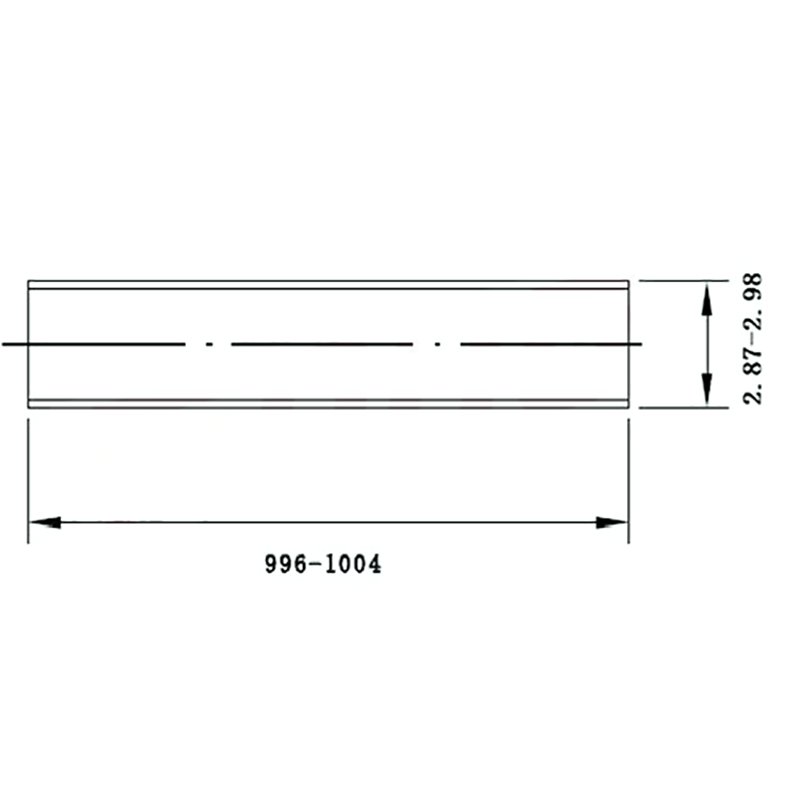
The load-bearing capacity of M3 DIN976 Thread Rod must be evaluated by simultaneously considering material strength, thread geometry, boundary conditions and safety factors. A step-by-step technical analysis is given below.
1. Material and strength basis
M3 DIN976 Thread Rod normally employs 304 stainless steel (EN 1.4301, Chinese standard 06Cr19Ni10). According to EN 10269 and GB/T 3098.6 at room temperature, the proof strength Rp0.2 is ≥ 205 MPa and the tensile strength Rm is ≥ 520 MPa. Engineering calculations usually adopt an allowable stress σ_allow = Rp0.2 / γ_M, where γ_M is the material partial factor. For static loads GB 50017 uses 1.1 and ISO 898-1 uses 1.25. To unify criteria, this paper adopts the commonly used and conservative value σ_allow = 185 MPa (≈ 205 MPa / 1.1).
M3 DIN976 Thread Rod normally employs 304 stainless steel (EN 1.4301, Chinese standard 06Cr19Ni10). According to EN 10269 and GB/T 3098.6 at room temperature, the proof strength Rp0.2 is ≥ 205 MPa and the tensile strength Rm is ≥ 520 MPa. Engineering calculations usually adopt an allowable stress σ_allow = Rp0.2 / γ_M, where γ_M is the material partial factor. For static loads GB 50017 uses 1.1 and ISO 898-1 uses 1.25. To unify criteria, this paper adopts the commonly used and conservative value σ_allow = 185 MPa (≈ 205 MPa / 1.1).
2. Effective thread area
The stress area As of M3 DIN976 Thread Rod is calculated per ISO 898-1:
As = π/4 · (d – 0.9382 P)²
with d = 3 mm and P = 0.5 mm →
As = π/4 · (3 – 0.9382 × 0.5)² = 5.03 mm².
The stress area As of M3 DIN976 Thread Rod is calculated per ISO 898-1:
As = π/4 · (d – 0.9382 P)²
with d = 3 mm and P = 0.5 mm →
As = π/4 · (3 – 0.9382 × 0.5)² = 5.03 mm².
3. Ultimate tensile capacity
F_t,max = σ_allow · As = 185 MPa × 5.03 mm² ≈ 930 N ≈ 95 kgf.
If checked against the ultimate strength (Rm = 520 MPa), the theoretical breaking force is
F_u = 520 MPa × 5.03 mm² ≈ 2.6 kN; however, engineering applications require a yield margin, so 930 N is taken as the design limit.
F_t,max = σ_allow · As = 185 MPa × 5.03 mm² ≈ 930 N ≈ 95 kgf.
If checked against the ultimate strength (Rm = 520 MPa), the theoretical breaking force is
F_u = 520 MPa × 5.03 mm² ≈ 2.6 kN; however, engineering applications require a yield margin, so 930 N is taken as the design limit.
4. Transverse or bending loads
When M3 DIN976 Thread Rod is subjected to transverse point or distributed loads, bending stress and deflection must be checked. Treating the 1 m long M3 rod as a simply supported beam, the modulus of elasticity for 304 is E ≈ 200 GPa and the second moment of area I = πd⁴/64 = 3.98 mm⁴.
When M3 DIN976 Thread Rod is subjected to transverse point or distributed loads, bending stress and deflection must be checked. Treating the 1 m long M3 rod as a simply supported beam, the modulus of elasticity for 304 is E ≈ 200 GPa and the second moment of area I = πd⁴/64 = 3.98 mm⁴.
For a central point load F, the maximum bending stress σ_b = (F L/4) · (d/2) / I; imposing σ_b ≤ σ_allow gives F_lat ≈ 0.5 N. Thus the transverse load capacity is extremely low, and intermediate supports or a larger size are necessary.
5. Fatigue and vibration
If M3 DIN976 Thread Rod experiences alternating loads, the fatigue limit follows EN 1993-1-9, with a fatigue class of 36 MPa for 2 × 10⁶ cycles. Owing to a stress concentration factor Kt ≈ 3.5 for the M3 thread, the allowable stress amplitude drops to about 10 MPa, corresponding to a fatigue load capacity of only about 50 N. Therefore, vibration environments require preload locking or vibration-damping designs.
If M3 DIN976 Thread Rod experiences alternating loads, the fatigue limit follows EN 1993-1-9, with a fatigue class of 36 MPa for 2 × 10⁶ cycles. Owing to a stress concentration factor Kt ≈ 3.5 for the M3 thread, the allowable stress amplitude drops to about 10 MPa, corresponding to a fatigue load capacity of only about 50 N. Therefore, vibration environments require preload locking or vibration-damping designs.
6. Safety factor recommendations
For static lifting use γ = 2.5 → allowable working tension 930 N / 2.5 ≈ 370 N (≈ 38 kgf).
For pedestrian guardrails or equipment enclosures, per GB 50009 use γ = 3.0 → 310 N (≈ 32 kgf).
For static lifting use γ = 2.5 → allowable working tension 930 N / 2.5 ≈ 370 N (≈ 38 kgf).
For pedestrian guardrails or equipment enclosures, per GB 50009 use γ = 3.0 → 310 N (≈ 32 kgf).
Conclusion
Under pure axial static loading at room temperature, non-corrosive environment and effective grip length ≥ 20 mm, the recommended safe working tension for M3 DIN976 Thread Rod is about 370 N (38 kgf). Any transverse, impact or fatigue conditions require re-calculation or a larger specification.
Under pure axial static loading at room temperature, non-corrosive environment and effective grip length ≥ 20 mm, the recommended safe working tension for M3 DIN976 Thread Rod is about 370 N (38 kgf). Any transverse, impact or fatigue conditions require re-calculation or a larger specification.
Send Message
