
Recommend Products
 Name: Fujian Monel 400 Double End Stud Material: Monel 400 Standard: ASME B18.2.1 Size: 5/16 to 4 inch Length: 30 to 1000 mm Class: 12.9 Feature: Resistant to hydrofluoric acidQS Fastener: Monel 400 Double End Stud
 Name: Inconel 625 Double End Stud Material: Inconel 625 Standard: ASME B18.2.1 Size: 5/16 to 4 inch Length: 30 to 1000 mm Class: 12.9 Feature: High Yield Strength, Durable Strength and Corrosion ResistanceQS Fastener: Inconel 625 Double End Stud
 Name: Xiamen Inconel 600 High Strength Fastener Material: Inconel 600 Standard: ASME Size: 5/16 to 4 inch Length: 30 to 1000 mm Class: 12.9 Feature: High Yield Strength, Durable Strength and Corrosion ResistanceQS Fastener: Inconel 600 High Strength Fastener
 Name: Inconel 600 Stud Bolt Putian Material: Inconel 600 Standard: ASME B18.2.1 Size: 5/16 to 4 inch Length: 30 to 1000 mm Class: 12.9 Feature: High Yield Strength, Durable Strength and Corrosion ResistanceQS Fastener: Inconel 600 Stud Bolt


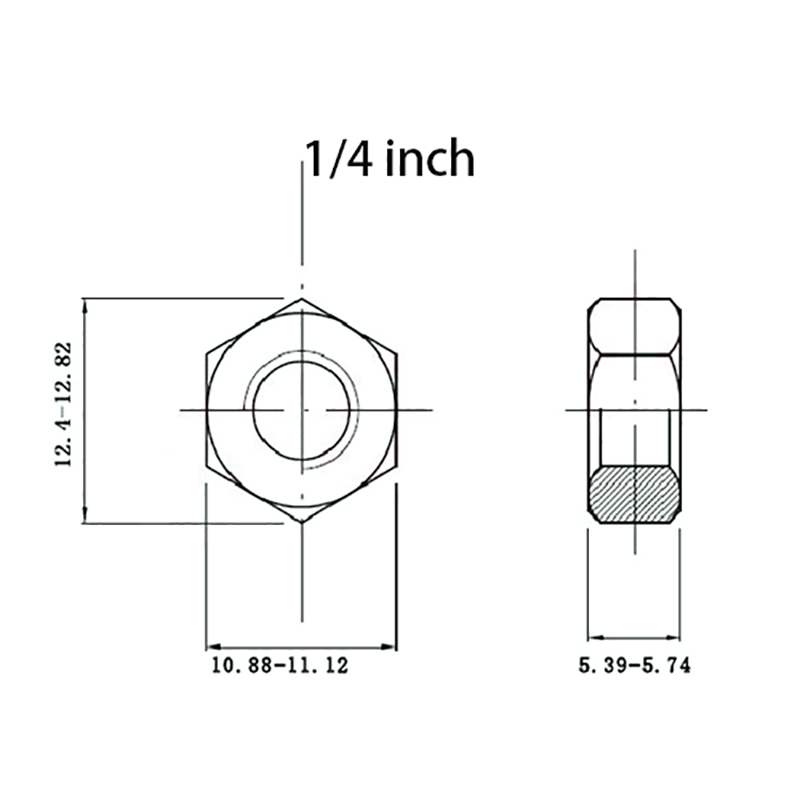
1/4 inch SS316 Hex Nut
Fully compliant with ANSI B18.2.2, this hex nut is precision-machined from corrosion-resistant 316 stainless steel. Thread specification: 1/4-28 UNC. Supplied in the natural, passivated finish, it withstands aggressive marine and chemical environments. Exact dimensions, fully formed threads and consistent prevailing torque allow long-term locking without loosening—ideal for high-end equipment and precision instrumentation. Available from stock; small-lot rapid delivery supported.
Fully compliant with ANSI B18.2.2, this hex nut is precision-machined from corrosion-resistant 316 stainless steel. Thread specification: 1/4-28 UNC. Supplied in the natural, passivated finish, it withstands aggressive marine and chemical environments. Exact dimensions, fully formed threads and consistent prevailing torque allow long-term locking without loosening—ideal for high-end equipment and precision instrumentation. Available from stock; small-lot rapid delivery supported.
Magnetic Behavior of Stainless-Steel Fasteners & Selection Considerations for 1/4 inch SS316 Hex Nut
The magnetism of stainless-steel fasteners is a complex topic that spans metallurgy, processing routes and end-use requirements. The following analysis is structured around microstructural evolution, manufacturing effects, demagnetisation techniques and relevant industry standards, with particular focus on austenitic stainless components such as 1/4 inch SS316 Hex Nut.
The magnetism of stainless-steel fasteners is a complex topic that spans metallurgy, processing routes and end-use requirements. The following analysis is structured around microstructural evolution, manufacturing effects, demagnetisation techniques and relevant industry standards, with particular focus on austenitic stainless components such as 1/4 inch SS316 Hex Nut.
1. Microstructure & Magnetism
In the annealed condition austenitic grades (e.g., 304 or the 316 used in 1/4 inch SS316 Hex Nut) consist solely of γ-austenite (face-centred cubic, FCC) and should exhibit a relative permeability μ ≤ 1.05. Cold work, however, triggers strain-induced martensitic transformation (SIMT), generating body-centred tetragonal (BCT) martensite. Experimental data show:
- 15 % cold work → 5–8 % martensite, μ rises to 1.2–1.5.
- 30 % cold work → 15–20 % martensite, μ can exceed 2.0.
In the annealed condition austenitic grades (e.g., 304 or the 316 used in 1/4 inch SS316 Hex Nut) consist solely of γ-austenite (face-centred cubic, FCC) and should exhibit a relative permeability μ ≤ 1.05. Cold work, however, triggers strain-induced martensitic transformation (SIMT), generating body-centred tetragonal (BCT) martensite. Experimental data show:
- 15 % cold work → 5–8 % martensite, μ rises to 1.2–1.5.
- 30 % cold work → 15–20 % martensite, μ can exceed 2.0.
Thanks to 2–3 % Mo, 1/4 inch SS316 Hex Nut has an Md30 temperature ~50 °C lower than 304, cutting martensite formation by 30–40 % under identical strain—making it the preferred choice for low-magnetic applications.
2. Manufacturing Impact
a) Cold Heading
- Typical heading strain on 1/4 inch SS316 Hex Nut is 40–50 %, raising μ to 1.8–2.2.
- Magnetisation correlates exponentially with strain: B = 0.5 e^(0.03 ε) (ε = true strain).
a) Cold Heading
- Typical heading strain on 1/4 inch SS316 Hex Nut is 40–50 %, raising μ to 1.8–2.2.
- Magnetisation correlates exponentially with strain: B = 0.5 e^(0.03 ε) (ε = true strain).
b) Hot Heading
- Above 850 °C dynamic recrystallisation suppresses martensite.
- Resulting μ of 1/4 inch SS316 Hex Nut ≤ 1.1, but an extra pickling/passivation step is required to remove oxide scale.
- Above 850 °C dynamic recrystallisation suppresses martensite.
- Resulting μ of 1/4 inch SS316 Hex Nut ≤ 1.1, but an extra pickling/passivation step is required to remove oxide scale.
3. Demagnetisation Techniques
a) Solution Anneal
- 1050–1100 °C / water quench drives reverse martensitic transformation in 1/4 inch SS316 Hex Nut, yet tensile strength drops ≈40 % (from 800 MPa to 500 MPa).
a) Solution Anneal
- 1050–1100 °C / water quench drives reverse martensitic transformation in 1/4 inch SS316 Hex Nut, yet tensile strength drops ≈40 % (from 800 MPa to 500 MPa).
b) Low-Temperature Stress-Relief
- 400 °C for 2 h cuts residual magnetism by ~30 % with <10 % loss in strength.
- 400 °C for 2 h cuts residual magnetism by ~30 % with <10 % loss in strength.
c) Magnetic Shielding
- A μ-metal electro-plated layer can hold surface induction of 1/4 inch SS316 Hex Nut below 0.5 mT.
- A μ-metal electro-plated layer can hold surface induction of 1/4 inch SS316 Hex Nut below 0.5 mT.
4. Industry Benchmarks
- Nuclear: magnetic flux < 5 × 10⁻⁵ Wb → 1/4 inch SS316 Hex Nut recommended.
- MRI surroundings: μ < 1.01 → 316 grade preferred.
- Automotive sensor mounts: remanence < 2 G → 1/4 inch SS316 Hex Nut after stress-relief meets the spec.
- Nuclear: magnetic flux < 5 × 10⁻⁵ Wb → 1/4 inch SS316 Hex Nut recommended.
- MRI surroundings: μ < 1.01 → 316 grade preferred.
- Automotive sensor mounts: remanence < 2 G → 1/4 inch SS316 Hex Nut after stress-relief meets the spec.
Recommended Solutions
1. Low-magnetism service: specify 1/4 inch SS316 Hex Nut (typical μ 1.02–1.15).
2. Medium-/high-magnetism environment: 304 grade with cold work limited to <20 %.
3. Near-zero magnetism: use A286 super-alloy (μ ≈ 1.002) or subject 1/4 inch SS316 Hex Nut to vacuum solution treatment.
1. Low-magnetism service: specify 1/4 inch SS316 Hex Nut (typical μ 1.02–1.15).
2. Medium-/high-magnetism environment: 304 grade with cold work limited to <20 %.
3. Near-zero magnetism: use A286 super-alloy (μ ≈ 1.002) or subject 1/4 inch SS316 Hex Nut to vacuum solution treatment.
Caution
Neither ASTM F593 nor ISO 3506 currently limits magnetic properties, but ASTM A967 Appendix X1 offers demagnetisation guidelines. In practice, a trade-off exists—e.g., an 8.8-property bolt may drop to 6.8 after demagnetisation.
Neither ASTM F593 nor ISO 3506 currently limits magnetic properties, but ASTM A967 Appendix X1 offers demagnetisation guidelines. In practice, a trade-off exists—e.g., an 8.8-property bolt may drop to 6.8 after demagnetisation.
Send Message
