
Recommend Products
 Name: Fujian Monel 400 Double End Stud Material: Monel 400 Standard: ASME B18.2.1 Size: 5/16 to 4 inch Length: 30 to 1000 mm Class: 12.9 Feature: Resistant to hydrofluoric acidQS Fastener: Monel 400 Double End Stud
 Name: Inconel 625 Double End Stud Material: Inconel 625 Standard: ASME B18.2.1 Size: 5/16 to 4 inch Length: 30 to 1000 mm Class: 12.9 Feature: High Yield Strength, Durable Strength and Corrosion ResistanceQS Fastener: Inconel 625 Double End Stud
 Name: Xiamen Inconel 600 High Strength Fastener Material: Inconel 600 Standard: ASME Size: 5/16 to 4 inch Length: 30 to 1000 mm Class: 12.9 Feature: High Yield Strength, Durable Strength and Corrosion ResistanceQS Fastener: Inconel 600 High Strength Fastener
 Name: Inconel 600 Stud Bolt Putian Material: Inconel 600 Standard: ASME B18.2.1 Size: 5/16 to 4 inch Length: 30 to 1000 mm Class: 12.9 Feature: High Yield Strength, Durable Strength and Corrosion ResistanceQS Fastener: Inconel 600 Stud Bolt


M8-1.25 X 12 Hex Bolt
QS Fastener: M8-1.25 X 12 Hex Bolt
Name: M8-1.25 X 12 Hex Bolt
Standard: DIN 933
Material: D2-80
Size: M8
Lenght: 12 mm
Surface: Natural color
Standard: DIN 933
Material: D2-80
Size: M8
Lenght: 12 mm
Surface: Natural color
Quantity
M8-1.25 X 12 Hex Bolt is manufactured to DIN 933 from high-strength D2-80 alloy steel, delivering a tensile strength of ≥800 MPa. Its precise dimensions and 12 mm shank length make it ideal for thin-wall or precision assemblies. The natural finish offers both a clean appearance and reliable corrosion resistance, so M8-1.25 X 12 Hex Bolt can be installed directly in critical areas of industrial equipment, automotive systems, and rail transportation, ensuring robust clamping and long service life.
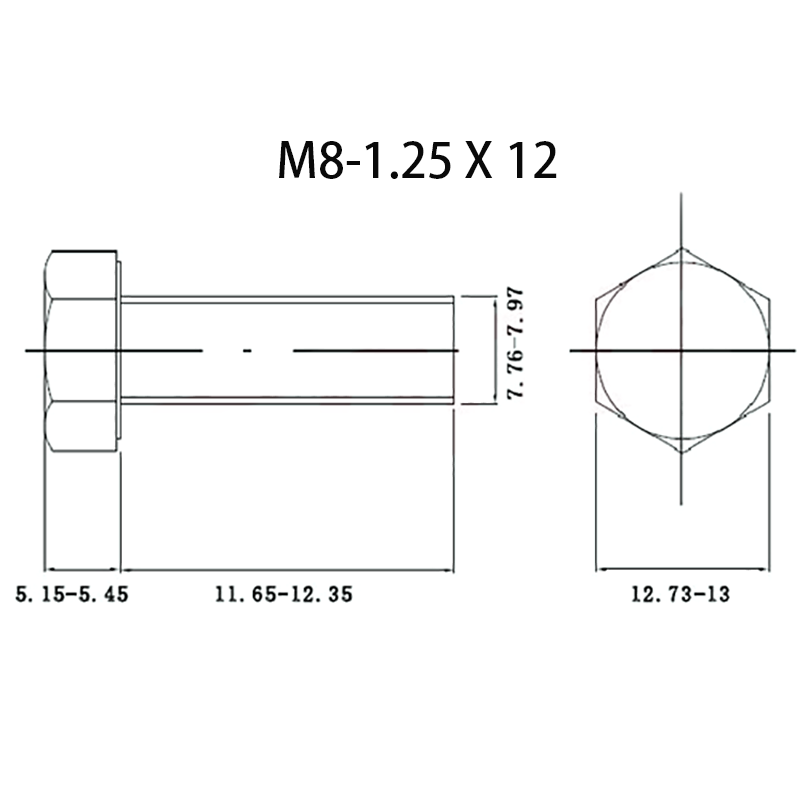
D2-80 is a low-nickel, Cr-Ni-Mo-N duplex stainless steel whose microstructure consists of 45–55 % austenite and ferrite in alternating layers. High-density dislocations at the α/γ interfaces, together with Mo- and Cr-rich passive films, give M8-1.25 X 12 Hex Bolt exceptional strength and corrosion resistance. Compared with conventional 18-8 (304) austenitic stainless steel, M8-1.25 X 12 Hex Bolt offers the following five advantages:
1. Pitting and crevice corrosion
Potentiodynamic polarization curves show that D2-80 has a pitting potential Eb = 346 mV (SCE), slightly lower than 304’s 397 mV. However, the Mo ≈ 2.5 % and N ≈ 0.16 % in M8-1.25 X 12 Hex Bolt synergistically stabilize the passive film, reducing the measured pitting rate to 5.8 g m⁻² h⁻¹ versus 6.48 g m⁻² h⁻¹ for 304. In environments containing >1 000 mg L⁻¹ Cl⁻, the critical crevice corrosion temperature (CCT) of M8-1.25 X 12 Hex Bolt is about 8 °C higher than that of 304.
Potentiodynamic polarization curves show that D2-80 has a pitting potential Eb = 346 mV (SCE), slightly lower than 304’s 397 mV. However, the Mo ≈ 2.5 % and N ≈ 0.16 % in M8-1.25 X 12 Hex Bolt synergistically stabilize the passive film, reducing the measured pitting rate to 5.8 g m⁻² h⁻¹ versus 6.48 g m⁻² h⁻¹ for 304. In environments containing >1 000 mg L⁻¹ Cl⁻, the critical crevice corrosion temperature (CCT) of M8-1.25 X 12 Hex Bolt is about 8 °C higher than that of 304.
2. Uniform corrosion in sulfuric acid
During 48 h immersion in 5 % H₂SO₄ at 80 °C, 304 suffers a corrosion rate of 449.66 g m⁻² h⁻¹ with extensive intergranular attack. Thanks to the dense Cr-Mo oxide film at duplex interfaces, M8-1.25 X 12 Hex Bolt exhibits a rate of only 3.74 g m⁻² h⁻¹—two orders of magnitude lower—demonstrating outstanding resistance to sulfuric acid.
During 48 h immersion in 5 % H₂SO₄ at 80 °C, 304 suffers a corrosion rate of 449.66 g m⁻² h⁻¹ with extensive intergranular attack. Thanks to the dense Cr-Mo oxide film at duplex interfaces, M8-1.25 X 12 Hex Bolt exhibits a rate of only 3.74 g m⁻² h⁻¹—two orders of magnitude lower—demonstrating outstanding resistance to sulfuric acid.
3. Intergranular corrosion
According to ISO 3651-2 Method D (boiling 65 % HNO₃, 48 h × 5 cycles), 304 records a mass loss of 282.74 g m⁻² due to continuous carbide precipitation at grain boundaries. The carbon content of D2-80 in M8-1.25 X 12 Hex Bolt is ≤0.030 %, and the α/γ boundaries inhibit carbide formation, cutting mass loss to 160.91 g m⁻² and markedly lowering intergranular attack susceptibility.
According to ISO 3651-2 Method D (boiling 65 % HNO₃, 48 h × 5 cycles), 304 records a mass loss of 282.74 g m⁻² due to continuous carbide precipitation at grain boundaries. The carbon content of D2-80 in M8-1.25 X 12 Hex Bolt is ≤0.030 %, and the α/γ boundaries inhibit carbide formation, cutting mass loss to 160.91 g m⁻² and markedly lowering intergranular attack susceptibility.
4. Stress-corrosion cracking (SCC)
In boiling 42 % MgCl₂ under σ = 0.8 σ₀.₂, cracks initiate in 304 after Tᵢ = 1 h and propagate through in Tₚ = 3 h, showing typical intergranular brittle fracture. The ferrite phase in M8-1.25 X 12 Hex Bolt impedes slip-band penetration, while nitrogen atoms pin dislocations, extending Tᵢ to 23 h and Tₚ to 92 h—an SCC life improvement of more than 30×.
In boiling 42 % MgCl₂ under σ = 0.8 σ₀.₂, cracks initiate in 304 after Tᵢ = 1 h and propagate through in Tₚ = 3 h, showing typical intergranular brittle fracture. The ferrite phase in M8-1.25 X 12 Hex Bolt impedes slip-band penetration, while nitrogen atoms pin dislocations, extending Tᵢ to 23 h and Tₚ to 92 h—an SCC life improvement of more than 30×.
5. Overall application assessment
Based on ASTM G48, G102, and NACE TM0177 calculations, the pitting resistance equivalent number (PREN = Cr + 3.3Mo + 16N) of M8-1.25 X 12 Hex Bolt is 34.7, far exceeding 304’s 19.0. Yield strength is ≥640 MPa, 2.5 times that of 304. Consequently, whether on offshore platforms, in wet flue-gas desulfurization towers, or on high-pressure hydrocracking reactor flanges, M8-1.25 X 12 Hex Bolt provides a long-life, maintenance-free fastening solution under extreme Cl⁻, H₂S, sulfuric-acid, and high-temperature stress conditions.
Based on ASTM G48, G102, and NACE TM0177 calculations, the pitting resistance equivalent number (PREN = Cr + 3.3Mo + 16N) of M8-1.25 X 12 Hex Bolt is 34.7, far exceeding 304’s 19.0. Yield strength is ≥640 MPa, 2.5 times that of 304. Consequently, whether on offshore platforms, in wet flue-gas desulfurization towers, or on high-pressure hydrocracking reactor flanges, M8-1.25 X 12 Hex Bolt provides a long-life, maintenance-free fastening solution under extreme Cl⁻, H₂S, sulfuric-acid, and high-temperature stress conditions.
Send Message
