
Recommend Products
 Name: Fujian Monel 400 Double End Stud Material: Monel 400 Standard: ASME B18.2.1 Size: 5/16 to 4 inch Length: 30 to 1000 mm Class: 12.9 Feature: Resistant to hydrofluoric acidQS Fastener: Monel 400 Double End Stud
 Name: Inconel 625 Double End Stud Material: Inconel 625 Standard: ASME B18.2.1 Size: 5/16 to 4 inch Length: 30 to 1000 mm Class: 12.9 Feature: High Yield Strength, Durable Strength and Corrosion ResistanceQS Fastener: Inconel 625 Double End Stud
 Name: Xiamen Inconel 600 High Strength Fastener Material: Inconel 600 Standard: ASME Size: 5/16 to 4 inch Length: 30 to 1000 mm Class: 12.9 Feature: High Yield Strength, Durable Strength and Corrosion ResistanceQS Fastener: Inconel 600 High Strength Fastener
 Name: Inconel 600 Stud Bolt Putian Material: Inconel 600 Standard: ASME B18.2.1 Size: 5/16 to 4 inch Length: 30 to 1000 mm Class: 12.9 Feature: High Yield Strength, Durable Strength and Corrosion ResistanceQS Fastener: Inconel 600 Stud Bolt


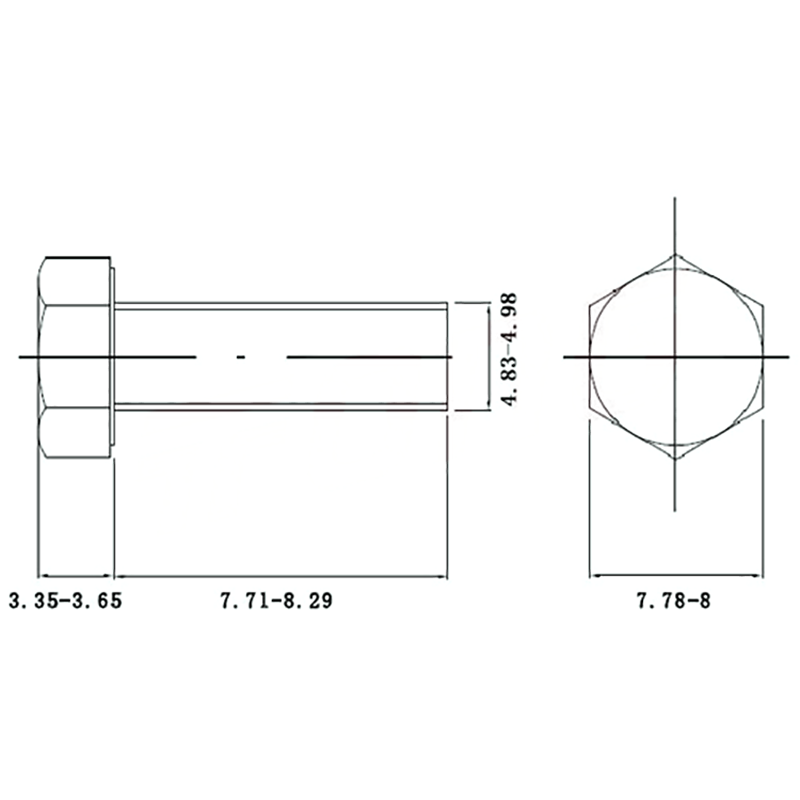
M5 SS316 Hex Bolt
QS Fastener: M5 SS316 Hex Bolt
Name: M5 SS316 Hex Bolt
Standard: DIN933
Material: SS316
Size: M5-0.8
Lenght: 8 mm
Surface: Natural color
Standard: DIN933
Material: SS316
Size: M5-0.8
Lenght: 8 mm
Surface: Natural color
Quantity
M5 SS316 Hex Bolt is manufactured from 316 stainless steel, resistant to chloride-ion corrosion and marine environments; 8 mm long, DIN933 standard, natural surface finish—no coating required to retain its appearance over time. Whether for marine equipment, food machinery or outdoor installations, it delivers zero-maintenance strength to safeguard your critical connections.
High- and low-temperature applications of stainless-steel fasteners
Performance Analysis of M5 SS316 Hex Bolt under Extreme Temperatures
Performance Analysis of M5 SS316 Hex Bolt under Extreme Temperatures
I. High-temperature range
1. Temperature–strength mapping: When test temperature T ≤ 100 ℃, the nominal tensile strength Rm of 304 (A2-70) and that of 316 (A4-70) to which M5 SS316 Hex Bolt belongs remains at the room-temperature value (700 MPa and 800 MPa class, respectively); when T > 100 ℃, every 100 ℃ rise reduces Rm by ~5 %, i.e., at 200 ℃ Rm drops to 95 %, at 300 ℃ to 90 %, and so on.
1. Temperature–strength mapping: When test temperature T ≤ 100 ℃, the nominal tensile strength Rm of 304 (A2-70) and that of 316 (A4-70) to which M5 SS316 Hex Bolt belongs remains at the room-temperature value (700 MPa and 800 MPa class, respectively); when T > 100 ℃, every 100 ℃ rise reduces Rm by ~5 %, i.e., at 200 ℃ Rm drops to 95 %, at 300 ℃ to 90 %, and so on.
2. Creep and intergranular corrosion: Above 350 ℃, carbon diffusion accelerates, the sensitization zone appears, M23C6 precipitates at grain boundaries and increases susceptibility to intergranular corrosion; simultaneously, the creep strain rate rises, and the 1000 h rupture strength of M5 SS316 Hex Bolt is only 30 %–35 % of its room-temperature Rm.
3. Upper usage limit: Standards specify 400 ℃ as the “functional limit” for austenitic stainless-steel bolts; beyond this temperature the yield strength falls below 60 % of the room-temperature value, failing to meet normal preload requirements, and nickel- or iron-based superalloys must be used; under such conditions M5 SS316 Hex Bolt is no longer suitable.
II. Low-temperature range
1. Low-temperature toughness index: Per GB/T 229 Charpy V-notch impact test, 304 exhibits KV2 ≥ 60 J at –196 ℃ with ≥ 50 % fibrous fracture, maintaining the toughness of the face-centered-cubic structure; owing to Mo solid-solution strengthening (2.0 %–3.0 %) and reduced stacking-fault energy, M5 SS316 Hex Bolt achieves KV2 ≥ 70 J at –60 ℃, yet KV2 plunges below 30 J when the temperature drops further to –80 ℃, marking a ductile-to-brittle transition.
1. Low-temperature toughness index: Per GB/T 229 Charpy V-notch impact test, 304 exhibits KV2 ≥ 60 J at –196 ℃ with ≥ 50 % fibrous fracture, maintaining the toughness of the face-centered-cubic structure; owing to Mo solid-solution strengthening (2.0 %–3.0 %) and reduced stacking-fault energy, M5 SS316 Hex Bolt achieves KV2 ≥ 70 J at –60 ℃, yet KV2 plunges below 30 J when the temperature drops further to –80 ℃, marking a ductile-to-brittle transition.
2. Phase-transformation risk: Below –60 ℃, prolonged loading on M5 SS316 Hex Bolt may induce minor ε-martensite, causing local embrittlement; magnetic permeability μr rises from 1.02 to above 1.10, which can serve as an in-situ non-destructive monitoring indicator.
3. Exception for studs: GB/T 3098.6 distinguishes studs from bolts and screws, allowing the use of 304 or solution-strengthened 316L bars; because studs have no thread cold-work-hardened zone, the minimum service temperature can extend to –196 ℃ provided the work-hardening ratio remains ≤ 15 %, preventing threaded components such as M5 SS316 Hex Bolt from cold embrittlement due to excessive deformation.
4. Design margin: In cryogenic service at –196 ℃, the allowable stress of 304 bolts is recommended at 75 % of the room-temperature value, combined with a 0.2 % pre-strain aging treatment to reduce preload loss caused by thermal contraction; when M5 SS316 Hex Bolt is used within –60 ℃, the impact-toughness safety factor should be ≥ 2.5 to prevent brittle crack propagation induced by Mo segregation at low temperatures.
In summary, when selecting fasteners for high- or low-temperature systems, engineers must simultaneously consider the temperature–strength decay curve, the ductile-to-brittle transition temperature (DBTT) and the corrosion–creep coupling effects of M5 SS316 Hex Bolt; finite-element thermo-mechanical coupled analyses and actual cryogenic impact retests should be performed when necessary to ensure the safety and reliability of M5 SS316 Hex Bolt and the entire joint throughout its service life.
Send Message
