
Recommend Products
 Name: Fujian Monel 400 Double End Stud Material: Monel 400 Standard: ASME B18.2.1 Size: 5/16 to 4 inch Length: 30 to 1000 mm Class: 12.9 Feature: Resistant to hydrofluoric acidQS Fastener: Monel 400 Double End Stud
 Name: Inconel 625 Double End Stud Material: Inconel 625 Standard: ASME B18.2.1 Size: 5/16 to 4 inch Length: 30 to 1000 mm Class: 12.9 Feature: High Yield Strength, Durable Strength and Corrosion ResistanceQS Fastener: Inconel 625 Double End Stud
 Name: Xiamen Inconel 600 High Strength Fastener Material: Inconel 600 Standard: ASME Size: 5/16 to 4 inch Length: 30 to 1000 mm Class: 12.9 Feature: High Yield Strength, Durable Strength and Corrosion ResistanceQS Fastener: Inconel 600 High Strength Fastener
 Name: Inconel 600 Stud Bolt Putian Material: Inconel 600 Standard: ASME B18.2.1 Size: 5/16 to 4 inch Length: 30 to 1000 mm Class: 12.9 Feature: High Yield Strength, Durable Strength and Corrosion ResistanceQS Fastener: Inconel 600 Stud Bolt


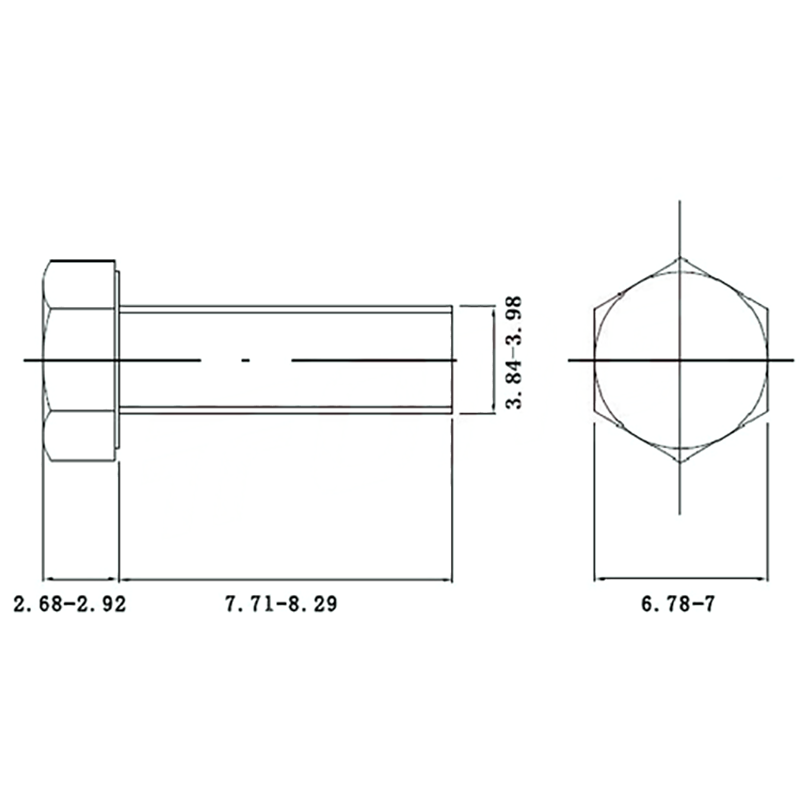
M4 SS304 Hex Bolt
QS Fastener: M4 SS304 Hex Bolt
Name: M4 SS304 Hex Bolt
Standard: DIN933
Material: SS304
Size: M4-0.7
Lenght: 8 mm
Surface: Natural color
Standard: DIN933
Material: SS304
Size: M4-0.7
Lenght: 8 mm
Surface: Natural color
Quantity
M4 SS304 Hex Bolt is manufactured from SS304 (A2-70) stainless steel, conforms to DIN 933, features M4-0.7 threads and an 8 mm length, and is supplied in the natural finish. Combining corrosion resistance, heat resistance and high strength, it is the ideal choice for food machinery, medical equipment and outdoor assemblies. Ample stock is available, and mill test reports can be provided by batch to ensure worry-free purchasing and rapid on-line deployment.
Performance Comparison of 304 vs. 316 Fasteners
304 and 316 both belong to the 18-8 austenitic stainless steel family. For small fasteners such as the M4 SS304 Hex Bolt, tensile strength is about 520 MPa at room temperature, yield strength ≥ 205 MPa, and surface hardness ≤ HB 187; the mechanical differences are negligible. The true dividing line lies in the corrosion-resistance mechanism.
304 and 316 both belong to the 18-8 austenitic stainless steel family. For small fasteners such as the M4 SS304 Hex Bolt, tensile strength is about 520 MPa at room temperature, yield strength ≥ 205 MPa, and surface hardness ≤ HB 187; the mechanical differences are negligible. The true dividing line lies in the corrosion-resistance mechanism.
A standard M4 SS304 Hex Bolt contains 18 % Cr and 8 % Ni; its passive film is mainly Cr₂O₃. A 316 Hex Bolt adds 2.0–3.0 % Mo on this basis, forming a composite passive film that includes MoO₄²⁻. When tested per ASTM G48-11 Method A, the critical pitting temperature (CPT) of the M4 SS304 Hex Bolt in 6 % FeCl₃ solution is only 15 °C, whereas the 316 version reaches 25 °C.
Case Study: A coastal 5 MW wind-turbine tower initially used A2-70 bolts (such as the M4 SS304 Hex Bolt). After three years of operation, 0.3 mm deep pitting was found at the thread roots. After switching to A4-70 (316), no corrosion was detected during the six-year inspection. It should be noted that, for M4-sized Hex Bolts, pitting propagation is faster than in larger fasteners.
In intergranular-corrosion testing, an M4 SS304 Hex Bolt sensitized at 650 °C exhibited a corrosion rate of 0.6 mm/year, while the 316 version showed only 0.08 mm/year. This indicates that, in welded applications, the use of the M4 SS304 Hex Bolt requires a rigorous evaluation of the heat-treatment process.
Material-selection Guidelines
1. In marine environments, the M4 SS304 Hex Bolt is recommended only for short-term exposure where Cl⁻ < 50 mg/L.
2. For non-pressure parts such as chemical-pipe supports, the service life of the M4 SS304 Hex Bolt can be extended by monthly passivation.
3. For food-equipment installation, 316 is preferred because the M4 SS304 Hex Bolt tends to develop rust stains under acidic cleaning agents.
4. In dry conditions such as electronic-device enclosure fastening, the M4 SS304 Hex Bolt offers a clear cost-performance advantage.
1. In marine environments, the M4 SS304 Hex Bolt is recommended only for short-term exposure where Cl⁻ < 50 mg/L.
2. For non-pressure parts such as chemical-pipe supports, the service life of the M4 SS304 Hex Bolt can be extended by monthly passivation.
3. For food-equipment installation, 316 is preferred because the M4 SS304 Hex Bolt tends to develop rust stains under acidic cleaning agents.
4. In dry conditions such as electronic-device enclosure fastening, the M4 SS304 Hex Bolt offers a clear cost-performance advantage.
Conclusion: For M4 Hex Bolts, 316 can last 2–3 times longer than the M4 SS304 Hex Bolt under severe conditions, yet in most standard industrial applications, a properly installed M4 SS304 Hex Bolt still meets more than 85 % of service requirements.
Send Message
