
Recommend Products
 Name: Fujian Monel 400 Double End Stud Material: Monel 400 Standard: ASME B18.2.1 Size: 5/16 to 4 inch Length: 30 to 1000 mm Class: 12.9 Feature: Resistant to hydrofluoric acidQS Fastener: Monel 400 Double End Stud
 Name: Inconel 625 Double End Stud Material: Inconel 625 Standard: ASME B18.2.1 Size: 5/16 to 4 inch Length: 30 to 1000 mm Class: 12.9 Feature: High Yield Strength, Durable Strength and Corrosion ResistanceQS Fastener: Inconel 625 Double End Stud
 Name: Xiamen Inconel 600 High Strength Fastener Material: Inconel 600 Standard: ASME Size: 5/16 to 4 inch Length: 30 to 1000 mm Class: 12.9 Feature: High Yield Strength, Durable Strength and Corrosion ResistanceQS Fastener: Inconel 600 High Strength Fastener
 Name: Inconel 600 Stud Bolt Putian Material: Inconel 600 Standard: ASME B18.2.1 Size: 5/16 to 4 inch Length: 30 to 1000 mm Class: 12.9 Feature: High Yield Strength, Durable Strength and Corrosion ResistanceQS Fastener: Inconel 600 Stud Bolt


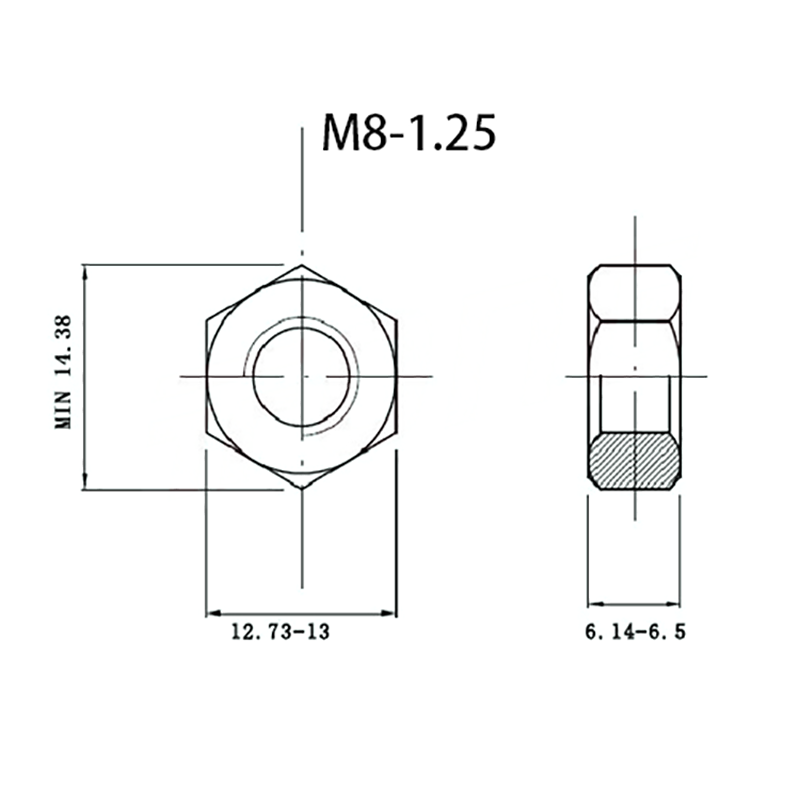
M8-1.25 DIN934 Nut
QS Fastener: M8-1.25 DIN934 Nut
Name: M8-1.25 DIN934 Nut
Standard: DIN934
Material: 304
Size: M8
Surface: Natural color
Standard: DIN934
Material: 304
Size: M8
Surface: Natural color
Quantity
The M8-1.25 DIN934 Nut is forged in one piece from SS304 stainless steel, delivering excellent resistance to acids, alkalis and elevated temperatures. Its mechanical strength and prevailing-torque performance fully comply with the DIN934 standard. The natural, uncoated surface eliminates the need for additional plating and allows direct use in food-processing machinery, medical equipment and highly corrosive outdoor environments. Installation is quick and maintenance-free over the product’s lifetime, making the M8-1.25 DIN934 Nut the ideal choice for premium-grade fastening.
Thread GO / NO-GO gauge failures
Based on our long-term experience in handling GO / NO-GO gauge rejections for the M8-1.25 DIN934 Nut, we have identified five frequent root causes:
Based on our long-term experience in handling GO / NO-GO gauge rejections for the M8-1.25 DIN934 Nut, we have identified five frequent root causes:
1. Gauge-brand variation: When the same batch of M8-1.25 DIN934 Nut is inspected with gauges from different manufacturers, conflicting pass/fail verdicts may arise. ASME B1.3M stipulates that if any qualified gauge accepts the part, the M8-1.25 DIN934 Nut shall be deemed acceptable.
2. Measurement-technique differences: Some customers insist that a GO gauge must run through “effortlessly”; any slight drag is judged a failure. However, the stainless steel of the M8-1.25 DIN934 Nut is relatively soft and threads can sustain minor nicks that create light resistance. GB/T 5779.1 states that damage shall not be cause for rejection unless it impairs function, and the tightening torque shall not exceed 0.001 d³ N·m. Thus, if the GO gauge can be turned through with moderate force, the M8-1.25 DIN934 Nut should still be accepted.
3. Tolerance-class mismatch: If the M8-1.25 DIN934 Nut is manufactured to Class 2A but inspected with a Class 3A gauge, the GO member will inevitably refuse entry.
4. New-versus-used gauge variation: The same M8-1.25 DIN934 Nut can yield different results when inspected with a new versus a used—but still calibrated—ring gauge. ASME B1.3M permits “batch acceptance if either of two qualified gauges passes.”
5. Product defects: Burrs, insufficient thread depth or diameter deviations on the M8-1.25 DIN934 Nut will directly trigger GO / NO-GO failures.
Conclusion: Selecting gauges of consistent brand and correct tolerance class, standardizing inspection procedures, and promptly removing defective M8-1.25 DIN934 Nut parts can dramatically reduce GO / NO-GO rejection rates, improving delivery quality and customer satisfaction.
Send Message
