
Recommend Products
 Name: Fujian Monel 400 Double End Stud Material: Monel 400 Standard: ASME B18.2.1 Size: 5/16 to 4 inch Length: 30 to 1000 mm Class: 12.9 Feature: Resistant to hydrofluoric acidQS Fastener: Monel 400 Double End Stud
 Name: Inconel 625 Double End Stud Material: Inconel 625 Standard: ASME B18.2.1 Size: 5/16 to 4 inch Length: 30 to 1000 mm Class: 12.9 Feature: High Yield Strength, Durable Strength and Corrosion ResistanceQS Fastener: Inconel 625 Double End Stud
 Name: Xiamen Inconel 600 High Strength Fastener Material: Inconel 600 Standard: ASME Size: 5/16 to 4 inch Length: 30 to 1000 mm Class: 12.9 Feature: High Yield Strength, Durable Strength and Corrosion ResistanceQS Fastener: Inconel 600 High Strength Fastener
 Name: Inconel 600 Stud Bolt Putian Material: Inconel 600 Standard: ASME B18.2.1 Size: 5/16 to 4 inch Length: 30 to 1000 mm Class: 12.9 Feature: High Yield Strength, Durable Strength and Corrosion ResistanceQS Fastener: Inconel 600 Stud Bolt


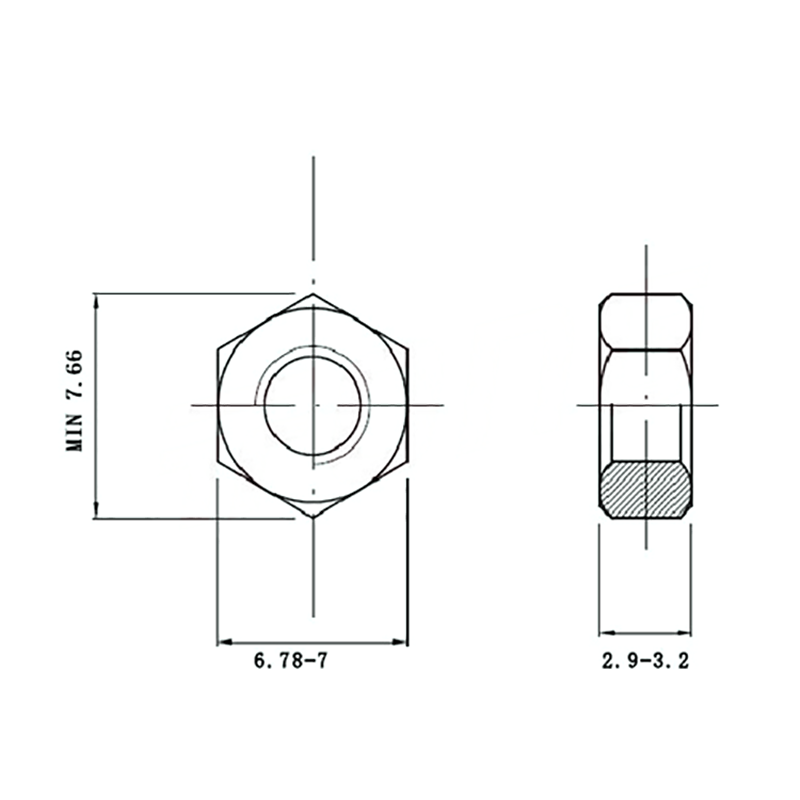
M4 Stainless Steel 316 Nut
QS Fastener: M4 Stainless Steel 316 Nut
Name: M4 Stainless Steel 316 Nut
Standard: DIN934
Material: SS316
Size: M4
Surface: Natural color
Standard: DIN934
Material: SS316
Size: M4
Surface: Natural color
Quantity
M4 Stainless Steel 316 Nut is precision-machined from marine-grade SS316 stainless steel. This hex nut complies with DIN934 and is inherently resistant to chloride ions, seawater and chemical attack; it retains its bright, original finish without any coating and stays attractive for decades. Tight tolerances, fully formed threads and smooth, gall-free assembly allow perfect locking with bolts or studs of the same specification. It is widely used in marine engineering, chemical plant, outdoor high-end electronics and medical equipment, giving your joints a 30-year, rust-free guarantee.
The stainless-steel salt-spray test is an accelerated test that “puts metal in a salt-fog cabinet and sees how long it takes to rust”.
The cabinet works like a large oven: the water bath at the bottom is heated to 35 °C and a 5 % neutral salt solution (pH 6.5-7.2) is atomised so that a fine mist settles evenly on the samples. Temperature, salt concentration, spray volume and salt-sedimentation rate are all locked to GB/T 10125 or ASTM B117, ensuring global comparability.
The cabinet works like a large oven: the water bath at the bottom is heated to 35 °C and a 5 % neutral salt solution (pH 6.5-7.2) is atomised so that a fine mist settles evenly on the samples. Temperature, salt concentration, spray volume and salt-sedimentation rate are all locked to GB/T 10125 or ASTM B117, ensuring global comparability.
Why test stainless steel at all?
“Stainless” does not mean “never rusts”; it only means “rusts slowly”. Chloride ions (plentiful in NaCl) can rupture the 1-3 nm Cr₂O₃ passive film, causing pitting, rust spots or even stress-corrosion cracking. Twenty-four hours in the cabinet simulates several months to a year of natural marine exposure and quickly scores the material, heat treatment and surface process.
“Stainless” does not mean “never rusts”; it only means “rusts slowly”. Chloride ions (plentiful in NaCl) can rupture the 1-3 nm Cr₂O₃ passive film, causing pitting, rust spots or even stress-corrosion cracking. Twenty-four hours in the cabinet simulates several months to a year of natural marine exposure and quickly scores the material, heat treatment and surface process.
Typical results
SS304: rust spots appear after 48 h; passing ≥720 h neutral salt-spray is deemed acceptable.
SS316, thanks to 2-3 % Mo, still shows no rust after 48 h and easily exceeds 1000 h.
Top-grade marine 316L after electropolishing can challenge 2000 h without corrosion.
Note: salt-spray hours ≠ service life; the figures allow only side-by-side comparison, not linear extrapolation to 30 years.
SS304: rust spots appear after 48 h; passing ≥720 h neutral salt-spray is deemed acceptable.
SS316, thanks to 2-3 % Mo, still shows no rust after 48 h and easily exceeds 1000 h.
Top-grade marine 316L after electropolishing can challenge 2000 h without corrosion.
Note: salt-spray hours ≠ service life; the figures allow only side-by-side comparison, not linear extrapolation to 30 years.
How is it done?
1. Degrease samples with alcohol; do not touch with bare hands.
2. Mount at 15° on PVC racks to avoid solution pooling.
3. Run continuous spray or spray/dry cycles.
4. At the prescribed time rinse off salt, dry, examine under magnification, count rust spots and rate to ISO 8993:
Class A (no rust), B (≤0.25 % area), C (≤0.5 %), D (>0.5 %).
1. Degrease samples with alcohol; do not touch with bare hands.
2. Mount at 15° on PVC racks to avoid solution pooling.
3. Run continuous spray or spray/dry cycles.
4. At the prescribed time rinse off salt, dry, examine under magnification, count rust spots and rate to ISO 8993:
Class A (no rust), B (≤0.25 % area), C (≤0.5 %), D (>0.5 %).
How do companies use it?
Incoming inspection—three pieces from every lot of M4 Stainless Steel 316 Nut are exposed for 720 h; no rust, be put in storage.
Process comparison—identical 316 blanks are laser-marked with “black” and “white” parameters; after 72 h the black-marked zone is dotted with rust while the white-marked zone stays bright silver, immediately revealing which setting damages the passive film less.
Incoming inspection—three pieces from every lot of M4 Stainless Steel 316 Nut are exposed for 720 h; no rust, be put in storage.
Process comparison—identical 316 blanks are laser-marked with “black” and “white” parameters; after 72 h the black-marked zone is dotted with rust while the white-marked zone stays bright silver, immediately revealing which setting damages the passive film less.
Export orders—customers specify that M4 Stainless Steel 316 Nut must pass 1000 h neutral salt-spray; the report travels with the goods and prevents claims.
R&D—M4 Stainless Steel 316 Nut samples undergo cyclic salt-spray plus condensing-water tests to compare different passivation chemistries; the optimum process is screened in two weeks, saving half a year of seaside exposure.
R&D—M4 Stainless Steel 316 Nut samples undergo cyclic salt-spray plus condensing-water tests to compare different passivation chemistries; the optimum process is screened in two weeks, saving half a year of seaside exposure.
In short, the salt-spray test is the “medical chart” of stainless steel; only when the numbers pass can the word “stainless” truly be trusted.
Send Message
