
Recommend Products
 Name: Fujian Monel 400 Double End Stud Material: Monel 400 Standard: ASME B18.2.1 Size: 5/16 to 4 inch Length: 30 to 1000 mm Class: 12.9 Feature: Resistant to hydrofluoric acidQS Fastener: Monel 400 Double End Stud
 Name: Inconel 625 Double End Stud Material: Inconel 625 Standard: ASME B18.2.1 Size: 5/16 to 4 inch Length: 30 to 1000 mm Class: 12.9 Feature: High Yield Strength, Durable Strength and Corrosion ResistanceQS Fastener: Inconel 625 Double End Stud
 Name: Xiamen Inconel 600 High Strength Fastener Material: Inconel 600 Standard: ASME Size: 5/16 to 4 inch Length: 30 to 1000 mm Class: 12.9 Feature: High Yield Strength, Durable Strength and Corrosion ResistanceQS Fastener: Inconel 600 High Strength Fastener
 Name: Inconel 600 Stud Bolt Putian Material: Inconel 600 Standard: ASME B18.2.1 Size: 5/16 to 4 inch Length: 30 to 1000 mm Class: 12.9 Feature: High Yield Strength, Durable Strength and Corrosion ResistanceQS Fastener: Inconel 600 Stud Bolt


M4 Stainless Steel 304 Sunk Screw is manufactured in strict accordance with DIN 7991, using food-grade SS304 stainless steel formed in a single cold-heading operation. Tensile strength ≥ 700 MPa, salt-spray endurance ≥ 1 000 h. The 8 mm length and natural finish need no extra coating, retaining a mirror-like corrosion resistance and appearance in harsh settings such as kitchen equipment, medical instruments and marine engineering. The precisely milled 90° countersink sits flush with the work-piece, eliminating drag or snagging hazards; roll-burnished threads raise locking torque by 15 % and resist stripping after repeated assembly cycles. Full batch traceability is provided; MOQ = 1 piece, ex-stock shipment within 48 h, letting you operate with minimum inventory yet maximum delivery speed.
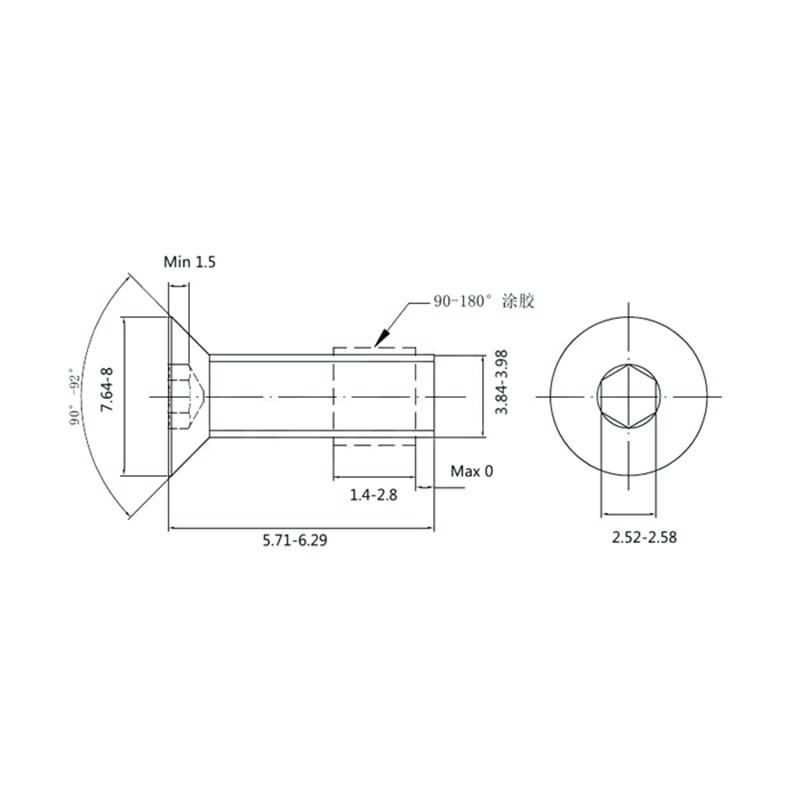
Countersunk and hexagon-head bolts are the two most common externally threaded fasteners, but they differ markedly in head geometry, load path, installation space, locking reliability, cost and maintainability. Only by grasping these differences can engineers strike the best balance among structure, process and cost. The comparison below follows eight dimensions, using M4 Stainless Steel 304 Sunk Screw as the reference for quick selection.
1. Head geometry & space demand
The 90° cone of M4 Stainless Steel 304 Sunk Screw finishes flush with the surface, making it ideal for streamlined skins, rotating parts or areas touched by people, removing any risk of aerodynamic drag, scratching or catching. Hexagon heads are tall and need wrench swing clearance; they often cannot fit inside narrow cavities or sandwich structures.
The 90° cone of M4 Stainless Steel 304 Sunk Screw finishes flush with the surface, making it ideal for streamlined skins, rotating parts or areas touched by people, removing any risk of aerodynamic drag, scratching or catching. Hexagon heads are tall and need wrench swing clearance; they often cannot fit inside narrow cavities or sandwich structures.
2. Pre-load & load capacity
A hex bolt can be tightened with a wrench, socket or pneumatic tool to high torque, giving high clamp force and excellent tension/shear performance. M4 Stainless Steel 304 Sunk Screw relies on an internal hex drive whose strength limits torque; for the same size pre-load is typically 20 %–30 % lower. Under heavy, alternating or vibratory loads de-rate the screw or increase the quantity.
A hex bolt can be tightened with a wrench, socket or pneumatic tool to high torque, giving high clamp force and excellent tension/shear performance. M4 Stainless Steel 304 Sunk Screw relies on an internal hex drive whose strength limits torque; for the same size pre-load is typically 20 %–30 % lower. Under heavy, alternating or vibratory loads de-rate the screw or increase the quantity.
3. Anti-loosening & reliability
Hex heads can be combined with spring washers, flat washers, nylon-insert nuts, double nuts, etc. Because M4 Stainless Steel 304 Sunk Screw is buried, a spring washer cannot be used; only thread-locker, nylon patches or self-locking threads are possible, giving fewer options and higher risk under vibration or thermal cycling.
Hex heads can be combined with spring washers, flat washers, nylon-insert nuts, double nuts, etc. Because M4 Stainless Steel 304 Sunk Screw is buried, a spring washer cannot be used; only thread-locker, nylon patches or self-locking threads are possible, giving fewer options and higher risk under vibration or thermal cycling.
4. Installation & removal efficiency
A hex bolt is zipped on by an air wrench in one shot—perfect for high-volume lines. M4 Stainless Steel 304 Sunk Screw must be aligned by hand, pressed and kept square; otherwise the cone will skid and machine a burr. During disassembly the recess is often clogged with paint or dust and must be cleaned first, cutting maintenance efficiency.
A hex bolt is zipped on by an air wrench in one shot—perfect for high-volume lines. M4 Stainless Steel 304 Sunk Screw must be aligned by hand, pressed and kept square; otherwise the cone will skid and machine a burr. During disassembly the recess is often clogged with paint or dust and must be cleaned first, cutting maintenance efficiency.
5. Work-piece machining requirements
M4 Stainless Steel 304 Sunk Screw demands an accurately pre-cut countersink; any deviation in diameter, angle or depth leaves the head proud or causes interference, raising machining cost. Hex bolts need only a plain clearance or tapped hole with generous positional tolerance and can be match-drilled on site.
M4 Stainless Steel 304 Sunk Screw demands an accurately pre-cut countersink; any deviation in diameter, angle or depth leaves the head proud or causes interference, raising machining cost. Hex bolts need only a plain clearance or tapped hole with generous positional tolerance and can be match-drilled on site.
6. Material & size coverage
Hex bolts range from M1.6 to beyond M100, strengths 4.8–12.9, in stainless steel, copper, titanium, plastic, etc. Because of its enlarged cone, large or high-strength versions of M4 Stainless Steel 304 Sunk Screw must be hot-forged, incurring high die costs; commercial supply is common only to M24, and above M30 they are specials.
Hex bolts range from M1.6 to beyond M100, strengths 4.8–12.9, in stainless steel, copper, titanium, plastic, etc. Because of its enlarged cone, large or high-strength versions of M4 Stainless Steel 304 Sunk Screw must be hot-forged, incurring high die costs; commercial supply is common only to M24, and above M30 they are specials.
7. Cost comparison
For the same size and strength M4 Stainless Steel 304 Sunk Screw has a heavier blank and more machining, so its unit price is 15 %–30 % higher. Add the cost of countersinking and the total joint can be 50 % or more expensive.
For the same size and strength M4 Stainless Steel 304 Sunk Screw has a heavier blank and more machining, so its unit price is 15 %–30 % higher. Add the cost of countersinking and the total joint can be 50 % or more expensive.
8. Failure modes & maintainability
If a hex bolt fails it can still be gripped with pliers or an angle grinder. Once the internal hex of M4 Stainless Steel 304 Sunk Screw rounds out or its cone corrodes, there is almost nothing to grip; removal usually calls for spark erosion or welding on a nut, making repairs costly.
If a hex bolt fails it can still be gripped with pliers or an angle grinder. Once the internal hex of M4 Stainless Steel 304 Sunk Screw rounds out or its cone corrodes, there is almost nothing to grip; removal usually calls for spark erosion or welding on a nut, making repairs costly.
Conclusion
M4 Stainless Steel 304 Sunk Screw wins where a flush, smooth, compact surface is required—automotive body panels, aircraft skins, rail-vehicle interiors, food machinery and similar applications. Hexagon bolts remain irreplaceable when high pre-load, high vibration resistance or high maintainability are paramount. Engineers should first decide whether the head must be flush, then integrate load, space, process and life requirements to select rationally instead of chasing appearance or strength alone.
M4 Stainless Steel 304 Sunk Screw wins where a flush, smooth, compact surface is required—automotive body panels, aircraft skins, rail-vehicle interiors, food machinery and similar applications. Hexagon bolts remain irreplaceable when high pre-load, high vibration resistance or high maintainability are paramount. Engineers should first decide whether the head must be flush, then integrate load, space, process and life requirements to select rationally instead of chasing appearance or strength alone.
Send Message
