
Recommend Products
 Name: Fujian Monel 400 Double End Stud Material: Monel 400 Standard: ASME B18.2.1 Size: 5/16 to 4 inch Length: 30 to 1000 mm Class: 12.9 Feature: Resistant to hydrofluoric acidQS Fastener: Monel 400 Double End Stud
 Name: Inconel 625 Double End Stud Material: Inconel 625 Standard: ASME B18.2.1 Size: 5/16 to 4 inch Length: 30 to 1000 mm Class: 12.9 Feature: High Yield Strength, Durable Strength and Corrosion ResistanceQS Fastener: Inconel 625 Double End Stud
 Name: Xiamen Inconel 600 High Strength Fastener Material: Inconel 600 Standard: ASME Size: 5/16 to 4 inch Length: 30 to 1000 mm Class: 12.9 Feature: High Yield Strength, Durable Strength and Corrosion ResistanceQS Fastener: Inconel 600 High Strength Fastener
 Name: Inconel 600 Stud Bolt Putian Material: Inconel 600 Standard: ASME B18.2.1 Size: 5/16 to 4 inch Length: 30 to 1000 mm Class: 12.9 Feature: High Yield Strength, Durable Strength and Corrosion ResistanceQS Fastener: Inconel 600 Stud Bolt


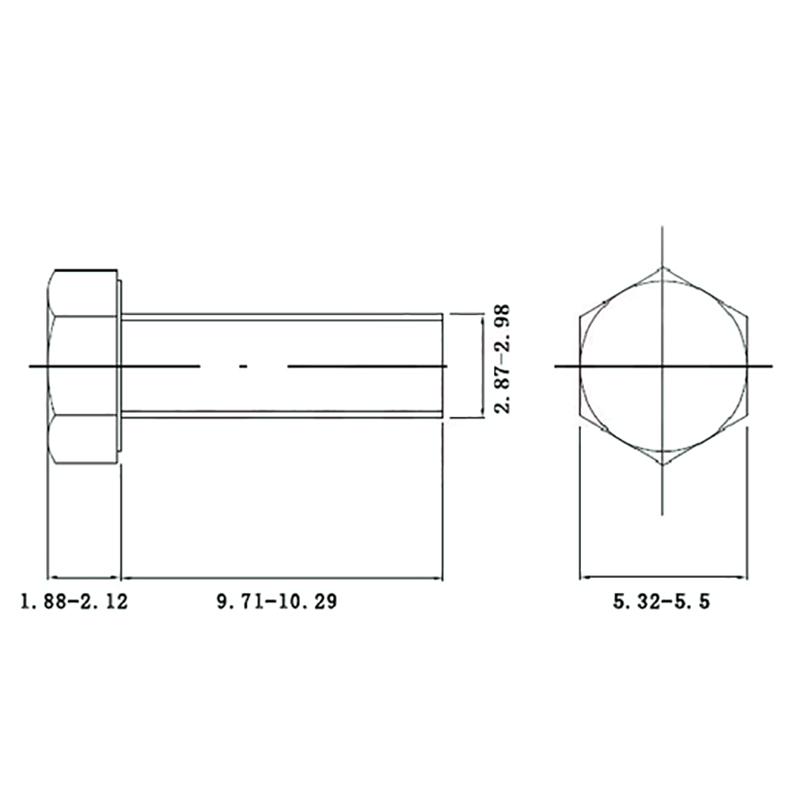
M4 Stainless Steel 304 Bolt
QS Fastener: M4 Stainless Steel 304 Bolt
Name: M4 Stainless Steel 304 Bolt
Standard: DIN933
Material: SS304
Size: M4
Lenght: 10 mm
Surface: Natural color
Standard: DIN933
Material: SS304
Size: M4
Lenght: 10 mm
Surface: Natural color
Quantity
M4 Stainless Steel 304 Bolt, DIN933 standard, 10 mm length, plain (self-colour) finish.
Manufactured from premium SS304 austenitic stainless steel, it resists acids, alkalis and chloride-ion corrosion; strength class A2-70, thread tolerance 6 g, go/no-go acceptance ≥ 98 %. Ideal for food machinery, medical equipment, coastal installations and other demanding applications; salt-spray test ≥ 1 000 h without red rust, service life more than five times that of ordinary carbon-steel bolts.
Manufactured from premium SS304 austenitic stainless steel, it resists acids, alkalis and chloride-ion corrosion; strength class A2-70, thread tolerance 6 g, go/no-go acceptance ≥ 98 %. Ideal for food machinery, medical equipment, coastal installations and other demanding applications; salt-spray test ≥ 1 000 h without red rust, service life more than five times that of ordinary carbon-steel bolts.
Influence of the 18–20 % chromium content in M4 Stainless Steel 304 Bolt
Chromium is the element that gives M4 Stainless Steel 304 Bolt its “stainless” character. When its content lies between 18 % and 20 %, a continuous, dense, self-healing Cr₂O₃-rich passive film forms spontaneously on the surface, raising the substrate potential from –0.56 V to about +0.2 V. This provides excellent resistance to uniform and pitting corrosion in atmospheres, fresh water and weak acids, while also improving high-temperature oxidation resistance and yield strength of M4 Stainless Steel 304 Bolt.
Chromium is the element that gives M4 Stainless Steel 304 Bolt its “stainless” character. When its content lies between 18 % and 20 %, a continuous, dense, self-healing Cr₂O₃-rich passive film forms spontaneously on the surface, raising the substrate potential from –0.56 V to about +0.2 V. This provides excellent resistance to uniform and pitting corrosion in atmospheres, fresh water and weak acids, while also improving high-temperature oxidation resistance and yield strength of M4 Stainless Steel 304 Bolt.
Effects of >20 % Cr
1. Corrosion resistance increases further, especially in oxidising acids and high-temperature oxidising environments.
2. Ferrite formation is promoted, austenite stability drops, σ-phase embrittlement becomes likely and hot-work cracking tendency rises.
3. The nickel equivalent falls; extra Ni or N is needed to retain single-phase austenite, raising cost.
4. Elongation and impact toughness decrease slightly, impairing cold-heading formability of M4 Stainless Steel 304 Bolt.
1. Corrosion resistance increases further, especially in oxidising acids and high-temperature oxidising environments.
2. Ferrite formation is promoted, austenite stability drops, σ-phase embrittlement becomes likely and hot-work cracking tendency rises.
3. The nickel equivalent falls; extra Ni or N is needed to retain single-phase austenite, raising cost.
4. Elongation and impact toughness decrease slightly, impairing cold-heading formability of M4 Stainless Steel 304 Bolt.
Effects of <18 % Cr
1. Continuity of the Cr₂O₃ passive film deteriorates, the electrode potential rise is insufficient, and resistance to pitting, crevice and intergranular corrosion falls markedly; rust appears readily in chlorides or acidic media, endangering the in-service safety of M4 Stainless Steel 304 Bolt.
1. Continuity of the Cr₂O₃ passive film deteriorates, the electrode potential rise is insufficient, and resistance to pitting, crevice and intergranular corrosion falls markedly; rust appears readily in chlorides or acidic media, endangering the in-service safety of M4 Stainless Steel 304 Bolt.
2. High-temperature oxidation resistance weakens.
3. Strength and hardness drop slightly and the work-hardening rate decreases.
4. If carbon is simultaneously high, carbides precipitate more easily along grain boundaries, further reducing corrosion resistance and causing premature failure of M4 Stainless Steel 304 Bolt.
Therefore, keeping chromium within 18–20 % is the optimum balance among corrosion resistance, formability and cost. Any deviation from this range must be compensated by adjusting Ni, N, C or by subsequent heat treatment to ensure that every M4 Stainless Steel 304 Bolt performs reliably for the end user.
Send Message
