
Recommend Products
 Name: Fujian Monel 400 Double End Stud Material: Monel 400 Standard: ASME B18.2.1 Size: 5/16 to 4 inch Length: 30 to 1000 mm Class: 12.9 Feature: Resistant to hydrofluoric acidQS Fastener: Monel 400 Double End Stud
 Name: Inconel 625 Double End Stud Material: Inconel 625 Standard: ASME B18.2.1 Size: 5/16 to 4 inch Length: 30 to 1000 mm Class: 12.9 Feature: High Yield Strength, Durable Strength and Corrosion ResistanceQS Fastener: Inconel 625 Double End Stud
 Name: Xiamen Inconel 600 High Strength Fastener Material: Inconel 600 Standard: ASME Size: 5/16 to 4 inch Length: 30 to 1000 mm Class: 12.9 Feature: High Yield Strength, Durable Strength and Corrosion ResistanceQS Fastener: Inconel 600 High Strength Fastener
 Name: Inconel 600 Stud Bolt Putian Material: Inconel 600 Standard: ASME B18.2.1 Size: 5/16 to 4 inch Length: 30 to 1000 mm Class: 12.9 Feature: High Yield Strength, Durable Strength and Corrosion ResistanceQS Fastener: Inconel 600 Stud Bolt


M4 SS316 Sunk Screw
QS Fastener: M4 SS316 Sunk Screw
Name: M4 SS316 Sunk Screw
Standard: DIN7991
Material: SS316
Size: M4
Lenght: 12 mm
Surface: Natural color
Standard: DIN7991
Material: SS316
Size: M4
Lenght: 12 mm
Surface: Natural color
Quantity
M4 SS316 Sunk Screw conforms to the DIN 7991 countersunk standard, is precision-forged from marine-grade SS316 stainless steel, measures 12 mm in length, carries a natural dull finish, and is cold-headed in one stroke. After 1 000 h of neutral-salt-spray testing no red rust appears. The 90° countersunk head seats flush, eliminating protrusions and letting high-end equipment, yacht railings and hygienic piping upgrade both aesthetics and strength at once. Ex-stock lots are available; small-batch customisation is supported.
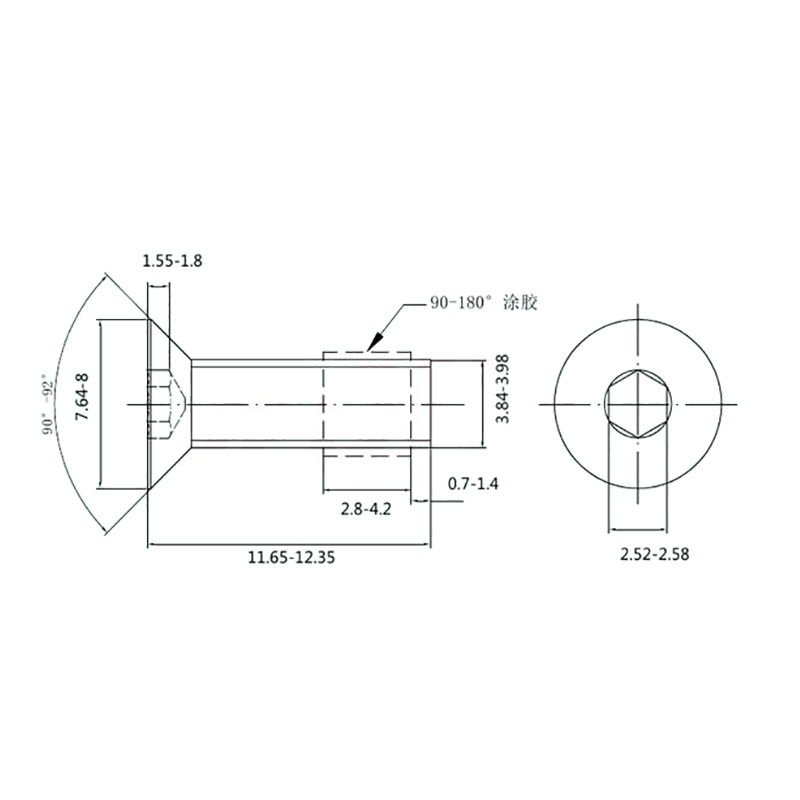
316 countersunk screws—i.e. fasteners made of 316 stainless steel whose 90° conical heads finish level with the work-surface—have become the “invisible joining specialists” in demanding assemblies thanks to three virtues: “resistance to chloride-ion corrosion, high strength at elevated temperature, and a clean, non-magnetic surface”. Taking the M4 SS316 Sunk Screw as an example, this size appears most frequently in precision apparatus: it survives marine-level attack while keeping a flush appearance, giving engineers a “small-yet-perfect” default answer.
1. Coastal & marine: deck rails, hatch covers, desalination modules and mast bases are washed by spray day after day. Plain 304 soon shows rust spots, whereas 316—containing over 2 % Mo—multiplies pitting resistance by several dozen times. If M4 SS316 Sunk Screw is chosen, the countersunk form prevents crew from tripping on protruding heads and reduces eddy drag, improving navigation safety.
2. Food & pharmaceutical machinery demands “easy to clean, no dead corners”. Filling machines, homogenisers and sterilisers use large numbers of M4–M10 × 12–50 mm 316 countersunk bolts; the flush surface lets rinse water run off quickly and denies bacteria a foothold. M4 SS316 Sunk Screw is often used to fasten small sensor brackets; the material meets food-contact standard GB 4806.9-2016 and can touch yoghurt, soy sauce, saline, etc. without extra coating.
3. In chemical and energy plant—desulphurisation towers, electrolytic cells, seawater circulation-pump covers—the flange faces pH 2–11 and 120 °C swings. 316 countersunk bolts resist Cl⁻ and SO₄²⁻ corrosion and stay tough at –196 °C liquid-nitrogen duty, avoiding brittle fracture. The flush head lets insulation aluminium skin lie smooth, cutting thermal bridges and energy loss. For leak-test ports that must pierce thin walls yet remain sealed, M4 SS316 Sunk Screw fills the bill, giving strength while leaving no bump.
4. High-end electronics and medical devices also depend on it. Surgical-lamp arms, MRI supports and coastal 5G-AAU housings all adopt M3–M5 316 countersunk bolts to defeat salt fog and electromagnetic interference; M4 SS316 Sunk Screw is widely used to fix antenna reflectors, keeping the housing surface free of protrusions and satisfying both IP67 sealing and appearance requirements.
In short, from luxury yachts to dairy lines, from offshore wind towers to surgical robots, wherever the three demands “corrosion resistance, hygiene, flush finish” coexist, 316 countersunk bolts are the first “invisible guardians” that engineers think of, and M4 SS316 Sunk Screw, with its just-right size and performance, is the keyword that appears most often on that guardian list.
Send Message
