
Recommend Products
 Name: Fujian Monel 400 Double End Stud Material: Monel 400 Standard: ASME B18.2.1 Size: 5/16 to 4 inch Length: 30 to 1000 mm Class: 12.9 Feature: Resistant to hydrofluoric acidQS Fastener: Monel 400 Double End Stud
 Name: Inconel 625 Double End Stud Material: Inconel 625 Standard: ASME B18.2.1 Size: 5/16 to 4 inch Length: 30 to 1000 mm Class: 12.9 Feature: High Yield Strength, Durable Strength and Corrosion ResistanceQS Fastener: Inconel 625 Double End Stud
 Name: Xiamen Inconel 600 High Strength Fastener Material: Inconel 600 Standard: ASME Size: 5/16 to 4 inch Length: 30 to 1000 mm Class: 12.9 Feature: High Yield Strength, Durable Strength and Corrosion ResistanceQS Fastener: Inconel 600 High Strength Fastener
 Name: Inconel 600 Stud Bolt Putian Material: Inconel 600 Standard: ASME B18.2.1 Size: 5/16 to 4 inch Length: 30 to 1000 mm Class: 12.9 Feature: High Yield Strength, Durable Strength and Corrosion ResistanceQS Fastener: Inconel 600 Stud Bolt


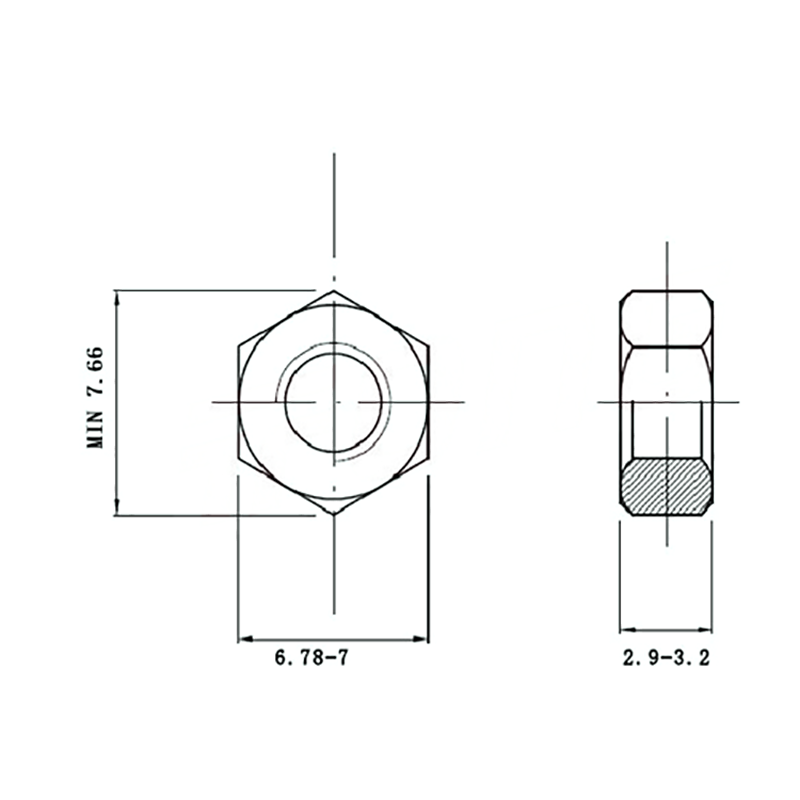
M4 SS316 Hex Nut is made of 316-grade austenitic stainless steel and conforms to the DIN934 standard. It is inherently resistant to chloride ions and seawater corrosion, retaining a mirror-like finish without any coating. The M4-0.7 fine-pitch thread ensures even clamping force, making M4 SS316 Hex Nut ideal for harsh environments such as marine, chemical and medical applications. Ready stock for immediate global dispatch.
To convert the strength of austenitic stainless-steel fasteners to carbon-steel property classes, both “tensile strength Rm” and “proof stress Rp0.2” must be considered simultaneously to obtain an engineering-reliable equivalence.
GB/T 3098.1 “Mechanical properties of bolts, screws and studs” defines carbon-steel classes as:
- Class 8.8: Rm ≥ 800 MPa, Rp0.2 ≥ 640 MPa;
- Class 6.8: Rm ≥ 600 MPa, Rp0.2 ≥ 480 MPa.
- Class 8.8: Rm ≥ 800 MPa, Rp0.2 ≥ 640 MPa;
- Class 6.8: Rm ≥ 600 MPa, Rp0.2 ≥ 480 MPa.
GB/T 3098.6 “Mechanical properties of stainless-steel bolts, screws and studs” stipulates:
- Class 70 (A2-70, A4-70): Rm ≥ 700 MPa, Rp0.2 ≥ 450 MPa;
- Class 80 (A2-80, A4-80): Rm ≥ 800 MPa, Rp0.2 ≥ 600 MPa.
- Class 70 (A2-70, A4-70): Rm ≥ 700 MPa, Rp0.2 ≥ 450 MPa;
- Class 80 (A2-80, A4-80): Rm ≥ 800 MPa, Rp0.2 ≥ 600 MPa.
Comparative analysis shows:
1. Class 70 stainless steel has Rm = 700 MPa, lying between carbon-steel classes 6.8 (600 MPa) and 8.8 (800 MPa), but its Rp0.2 of only 450 MPa is below the 480 MPa of class 6.8. Thus its “strength band” is roughly equivalent to class 6.8 and should be used only for non-critical joints or where preload is low on M4 SS316 Hex Nut.
1. Class 70 stainless steel has Rm = 700 MPa, lying between carbon-steel classes 6.8 (600 MPa) and 8.8 (800 MPa), but its Rp0.2 of only 450 MPa is below the 480 MPa of class 6.8. Thus its “strength band” is roughly equivalent to class 6.8 and should be used only for non-critical joints or where preload is low on M4 SS316 Hex Nut.
2. Class 80 stainless steel has Rm = 800 MPa, identical to class 8.8 carbon steel, and Rp0.2 = 600 MPa, which is about 6 % lower than the 640 MPa of class 8.8—an acceptable margin. In practice, after friction-coefficient correction or slight preload increase, M4 SS316 Hex Nut can be treated as “functionally equivalent” to class 8.8.
Additional factors to note:
- Temperature: austenitic grades retain strength up to 300 °C, whereas carbon-steel class 8.8 softens markedly above 250 °C; M4 SS316 Hex Nut therefore offers superior thermal stability.
- Temperature: austenitic grades retain strength up to 300 °C, whereas carbon-steel class 8.8 softens markedly above 250 °C; M4 SS316 Hex Nut therefore offers superior thermal stability.
- Corrosion allowance: the absence of coatings allows wall thickness to be reduced by 5–10 % versus carbon steel, indirectly increasing the effective load capacity of M4 SS316 Hex Nut.
- Ductility: stainless steel elongation after fracture is ≥30 %, far above the 12 % of carbon steel, so M4 SS316 Hex Nut is safer under impact or alternating loads.
Overall conclusion:
A2/A4-70 stainless ≈ class 6.8 carbon steel—downgrade substitution is acceptable when necessary;
A2/A4-80 stainless ≈ class 8.8 carbon steel—after preload correction, M4 SS316 Hex Nut can be directly interchanged.
A2/A4-70 stainless ≈ class 6.8 carbon steel—downgrade substitution is acceptable when necessary;
A2/A4-80 stainless ≈ class 8.8 carbon steel—after preload correction, M4 SS316 Hex Nut can be directly interchanged.
Send Message
