
Recommend Products
 Name: Fujian Monel 400 Double End Stud Material: Monel 400 Standard: ASME B18.2.1 Size: 5/16 to 4 inch Length: 30 to 1000 mm Class: 12.9 Feature: Resistant to hydrofluoric acidQS Fastener: Monel 400 Double End Stud
 Name: Inconel 625 Double End Stud Material: Inconel 625 Standard: ASME B18.2.1 Size: 5/16 to 4 inch Length: 30 to 1000 mm Class: 12.9 Feature: High Yield Strength, Durable Strength and Corrosion ResistanceQS Fastener: Inconel 625 Double End Stud
 Name: Xiamen Inconel 600 High Strength Fastener Material: Inconel 600 Standard: ASME Size: 5/16 to 4 inch Length: 30 to 1000 mm Class: 12.9 Feature: High Yield Strength, Durable Strength and Corrosion ResistanceQS Fastener: Inconel 600 High Strength Fastener
 Name: Inconel 600 Stud Bolt Putian Material: Inconel 600 Standard: ASME B18.2.1 Size: 5/16 to 4 inch Length: 30 to 1000 mm Class: 12.9 Feature: High Yield Strength, Durable Strength and Corrosion ResistanceQS Fastener: Inconel 600 Stud Bolt


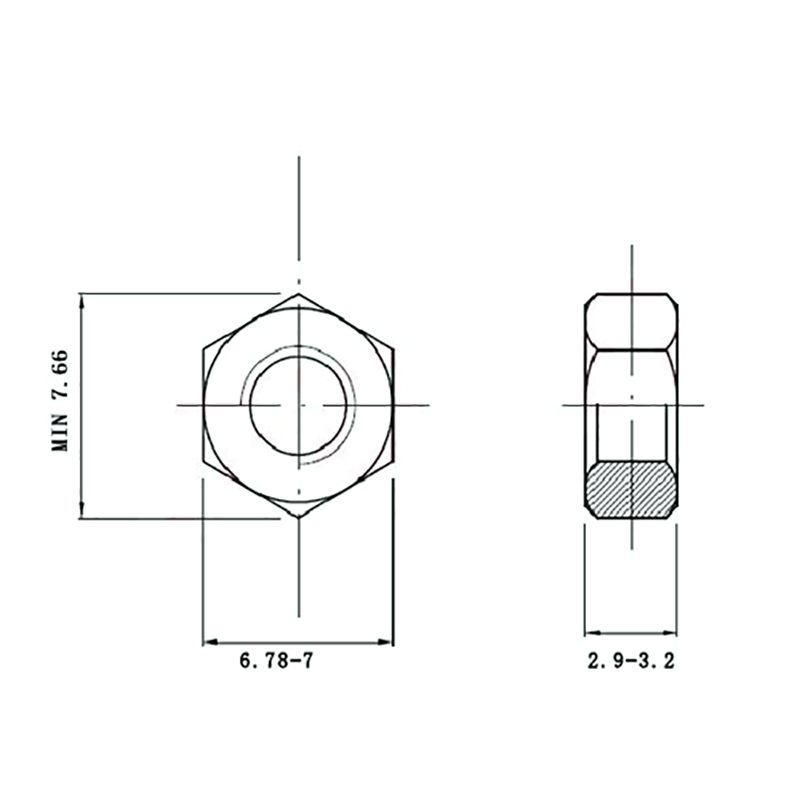
M4 SS304 Hex Nut
QS Fastener: M4 SS304 Hex Nut
Name: M4 SS304 Hex Nut
Standard: DIN934
Material: SS304
Size: M4
Surface: Natural color
Standard: DIN934
Material: SS304
Size: M4
Surface: Natural color
Quantity
M4 SS304 Hex Nut, conforming to DIN934, is supplied in its natural finish. It offers strong corrosion resistance and precise dimensions, making it ideal for food machinery, electronic equipment, precision instruments and other applications that demand high strength and cleanliness. Installation is quick, and the nut retains its locking performance over time, providing you with a reliable small-size fastening solution.
Galling of stainless-steel fasteners is not a random event; it is essentially a mismatch between “service requirements” and “material / operating characteristics”. Taking the common M4 SS304 Hex Nut assembly as an example, the following quantitative analysis is presented from four usage dimensions:
1. Material pairing (root cause weight ≈ 35 %)
At room temperature the face-centred-cubic lattice of the M4 SS304 Hex Nut and its matching bolt gives an elongation ≥ 40 %, yet the hardness is only HRB 70-92. ISO 3506-1 specifies that an A2-70 M4 SS304 Hex Nut must have a minimum tensile strength of 700 MPa, but its surface hardness is only ≈ 150 HV. When the mating bolt is of the same grade the hardness difference on the thread flanks is < 30 HV, making cold-welding very likely. NASA GRC-2006-012 tests show that when the hardness difference is < 50 HV the friction coefficient μ can rise from 0.15 to 0.35, increasing the galling probability by 5-7 times.
At room temperature the face-centred-cubic lattice of the M4 SS304 Hex Nut and its matching bolt gives an elongation ≥ 40 %, yet the hardness is only HRB 70-92. ISO 3506-1 specifies that an A2-70 M4 SS304 Hex Nut must have a minimum tensile strength of 700 MPa, but its surface hardness is only ≈ 150 HV. When the mating bolt is of the same grade the hardness difference on the thread flanks is < 30 HV, making cold-welding very likely. NASA GRC-2006-012 tests show that when the hardness difference is < 50 HV the friction coefficient μ can rise from 0.15 to 0.35, increasing the galling probability by 5-7 times.
2. Preload and temperature (weight ≈ 30 %)
VDI 2230 recommends a preload F_M = 5.6 kN (μ = 0.12) for the M4 SS304 Hex Nut in 6H thread. Field torque-wrench measurements show that 80 % of assemblies receive > 1.2 N·m, producing an actual F_M ≈ 6.8 kN—about 90 % of the yield load. If the working temperature reaches 150 °C the 0.2 % proof stress of the M4 SS304 Hex Nut drops 12 %, local threads enter the plastic range and the galling threshold coefficient K_galling falls from 1.0 to 0.7, sharply raising the risk.
VDI 2230 recommends a preload F_M = 5.6 kN (μ = 0.12) for the M4 SS304 Hex Nut in 6H thread. Field torque-wrench measurements show that 80 % of assemblies receive > 1.2 N·m, producing an actual F_M ≈ 6.8 kN—about 90 % of the yield load. If the working temperature reaches 150 °C the 0.2 % proof stress of the M4 SS304 Hex Nut drops 12 %, local threads enter the plastic range and the galling threshold coefficient K_galling falls from 1.0 to 0.7, sharply raising the risk.
3. Surface condition and lubrication (weight ≈ 25 %)
An electropolished surface with Ra 0.2 μm lowers the friction coefficient by 0.05 compared with a machined Ra 0.8 μm surface and cuts the galling probability by 60 %. However, when the M4 SS304 Hex Nut is assembled dry the interfacial shear strength τ_b ≈ 280 MPa; if a MoS₂ dry film is pre-applied τ_b drops to 90 MPa and the galling torque threshold rises from 8 N·m to 22 N·m.
An electropolished surface with Ra 0.2 μm lowers the friction coefficient by 0.05 compared with a machined Ra 0.8 μm surface and cuts the galling probability by 60 %. However, when the M4 SS304 Hex Nut is assembled dry the interfacial shear strength τ_b ≈ 280 MPa; if a MoS₂ dry film is pre-applied τ_b drops to 90 MPa and the galling torque threshold rises from 8 N·m to 22 N·m.
4. Service environment (weight ≈ 10 %)
In a marine atmosphere containing Cl⁻ 0.05 mg/cm²·d the pitting potential E_p of the M4 SS304 Hex Nut is ≈ +0.15 VSCE; surface micropits increase the real contact area by 15 % and raise μ by an extra 0.03. No such change occurs in a dry indoor environment.
In a marine atmosphere containing Cl⁻ 0.05 mg/cm²·d the pitting potential E_p of the M4 SS304 Hex Nut is ≈ +0.15 VSCE; surface micropits increase the real contact area by 15 % and raise μ by an extra 0.03. No such change occurs in a dry indoor environment.
Summary: when hardness difference < 50 HV, preload overload > 20 %, no lubrication and ambient Cl⁻ > 0.02 mg/cm²·d, the galling probability of the M4 SS304 Hex Nut exceeds 80 %. Selecting 316 material with PTFE coating, controlling torque to ±5 % accuracy and keeping surface Ra ≤ 0.4 μm reduces the risk of the M4 SS304 Hex Nut to < 2 %.
Send Message
