
Recommend Products
 Name: Fujian Monel 400 Double End Stud Material: Monel 400 Standard: ASME B18.2.1 Size: 5/16 to 4 inch Length: 30 to 1000 mm Class: 12.9 Feature: Resistant to hydrofluoric acidQS Fastener: Monel 400 Double End Stud
 Name: Inconel 625 Double End Stud Material: Inconel 625 Standard: ASME B18.2.1 Size: 5/16 to 4 inch Length: 30 to 1000 mm Class: 12.9 Feature: High Yield Strength, Durable Strength and Corrosion ResistanceQS Fastener: Inconel 625 Double End Stud
 Name: Xiamen Inconel 600 High Strength Fastener Material: Inconel 600 Standard: ASME Size: 5/16 to 4 inch Length: 30 to 1000 mm Class: 12.9 Feature: High Yield Strength, Durable Strength and Corrosion ResistanceQS Fastener: Inconel 600 High Strength Fastener
 Name: Inconel 600 Stud Bolt Putian Material: Inconel 600 Standard: ASME B18.2.1 Size: 5/16 to 4 inch Length: 30 to 1000 mm Class: 12.9 Feature: High Yield Strength, Durable Strength and Corrosion ResistanceQS Fastener: Inconel 600 Stud Bolt


M4 DIN7991 Sunk Screw
QS Fastener: M4 DIN7991 Sunk Screw
Name: M4 DIN7991 Sunk Screw
Standard: DIN7991
Material: SS304
Size: M4
Lenght: 8 mm
Surface: Natural color
Standard: DIN7991
Material: SS304
Size: M4
Lenght: 8 mm
Surface: Natural color
Quantity
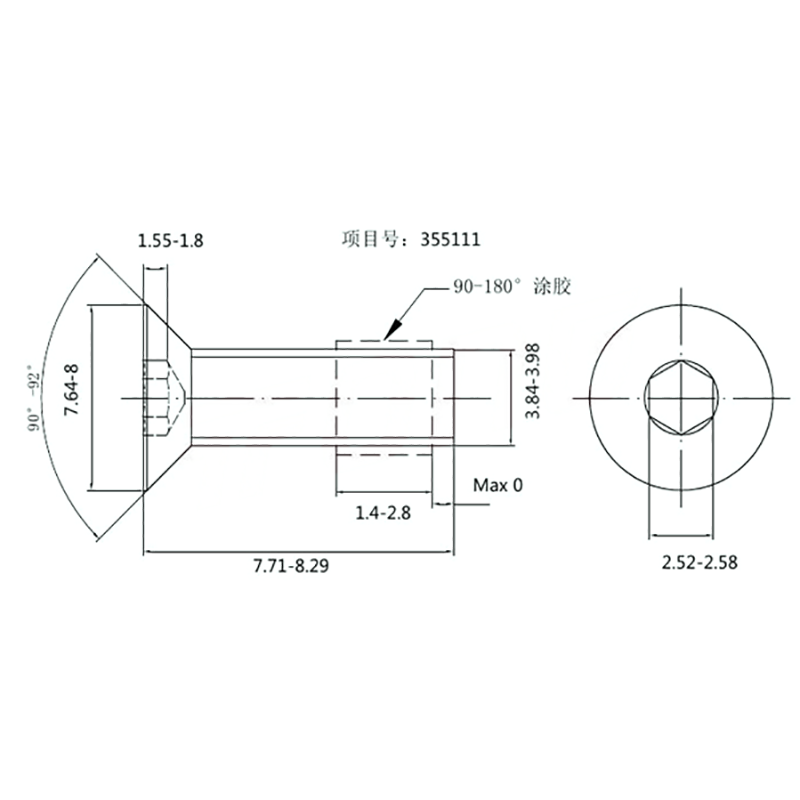
This M4 DIN7991 Sunk Screw is made of SS304 stainless steel, 8 mm long with a natural surface finish, offering excellent corrosion resistance and a clean appearance. It complies with the German DIN7991 standard; the 90° countersunk head mates flush with the work-piece, leaving no protrusion or sharp edges and giving a smooth, attractive surface after assembly. Widely used in food machinery, medical devices, yachts and premium household appliances where both appearance and rust prevention are critical. Kept in bulk stock and available for fast delivery in small batches, it helps cut assembly costs and raise the overall grade of your product.
M4 DIN7991 Sunk Screw – Six Do’s & Six Don’ts
Field-ready pocket guide
Field-ready pocket guide
Do “look”: inspect on arrival. The countersunk cone, the threads and the driver recess must be free of dents and burrs; SS304 on the M4 DIN7991 Sunk Score bruises easily, and loose steel particles can later turn into surface rust spots.
Do “match”: align hole diameter, countersink angle and sheet thickness in one go. DIN7991 is 90°; use a cutter of the same angle for the countersink. Sheet thickness ≥ 0.7 D (D = nominal diameter of the M4 DIN7991 Sunk Screw), or the head will stand proud.
Do “clean”: stainless fears chloride ions. Before assembly remove cutting fluid and glove salts with alcohol or a neutral detergent; never use tapping oil containing chlorinated paraffins, or the M4 DIN7991 Sunk Screw may pit.
Do “lubricate”: dry threads gall. Smear the M4 DIN7991 Sunk Screw with a trace of stainless anti-seize (containing PTFE or MoS₂); ordinary grease carbonises at high temperature and becomes an abrasive.
Do “stay straight”: the power driver must be square to the work-piece. If the M4 DIN7991 Sunk Screw is tilted, the cone will show linear indentations that act as stress raisers and may crack later. Start two or three threads by hand, check alignment, then finish at low speed.
Do “sequence”: on multi-row patterns tighten M4 DIN7991 Sunk Screws “inside-out, diagonally” in two steps—30 % torque to expel air, 100 % torque to final tightness—preventing distortion that could open gaps where water hides.
Don’t “force”: SS304 is about class 70; the proof load of the M4 DIN7991 Sunk Screw is only 2.3 kN. If A2-70 or higher is required, switch to A4-80 or a larger size.
Don’t “rush”: high driver speed can raise the surface of the M4 DIN7991 Sunk Screw to 300 °C, precipitating chromium carbides at the austenite grain boundaries and causing inter-granular rust later. Keep below 300 rpm.
Don’t “mix”: locking M4 DIN7991 Sunk Screws together with carbon-steel or copper parts sets up a galvanic cell; in rain, rust from the carbon steel will streak the countersunk face. If mixing is unavoidable, add insulating washers and coat the whole joint.
Don’t “re-turn”: once the M4 DIN7991 Sunk Screw is fully tightened, never loosen and retighten; the cone is already work-hardened, and backing off destroys preload, giving a false torque and later loosening.
Don’t “hammer”: the countersunk face and the sheet must mate with zero gap. Never drive the M4 DIN7991 Sunk Screw flush with a punch; impact can locally transform austenite to martensite, producing magnetic rust spots within 48 h.
Don’t “seal wrong”: in hot, humid outdoor service, if you must seal the countersink of the M4 DIN7991 Sunk Screw with adhesive, use a neutral-cure silicone; acid-cure types release acetic acid that seeps along the threads and causes filamentary rust within six months.
Remember the six do’s and six don’ts, and your M4 DIN7991 Sunk Screw will be right the first time—still bright when you remove it ten years on.
Send Message
