
Recommend Products
 Name: Fujian Monel 400 Double End Stud Material: Monel 400 Standard: ASME B18.2.1 Size: 5/16 to 4 inch Length: 30 to 1000 mm Class: 12.9 Feature: Resistant to hydrofluoric acidQS Fastener: Monel 400 Double End Stud
 Name: Inconel 625 Double End Stud Material: Inconel 625 Standard: ASME B18.2.1 Size: 5/16 to 4 inch Length: 30 to 1000 mm Class: 12.9 Feature: High Yield Strength, Durable Strength and Corrosion ResistanceQS Fastener: Inconel 625 Double End Stud
 Name: Xiamen Inconel 600 High Strength Fastener Material: Inconel 600 Standard: ASME Size: 5/16 to 4 inch Length: 30 to 1000 mm Class: 12.9 Feature: High Yield Strength, Durable Strength and Corrosion ResistanceQS Fastener: Inconel 600 High Strength Fastener
 Name: Inconel 600 Stud Bolt Putian Material: Inconel 600 Standard: ASME B18.2.1 Size: 5/16 to 4 inch Length: 30 to 1000 mm Class: 12.9 Feature: High Yield Strength, Durable Strength and Corrosion ResistanceQS Fastener: Inconel 600 Stud Bolt


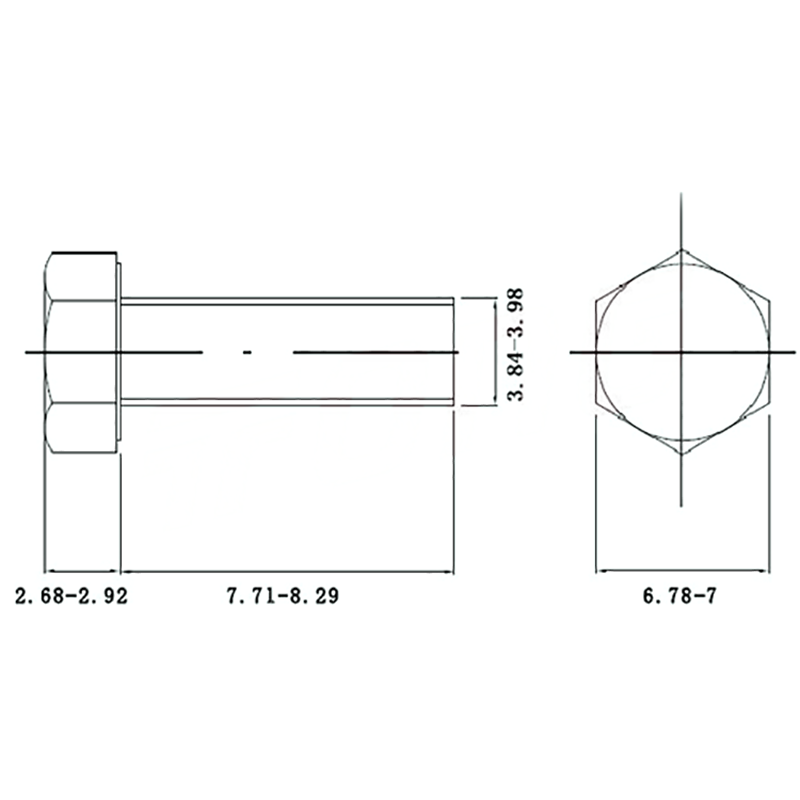
M4 DIN 933 Hex Bolt in SS304 stainless steel, 8 mm long, left in the natural metallic finish, offers high corrosion resistance and high tensile strength. It is suitable for food machinery, precision instruments, and humid environments; the installation torque remains stable, and the threads do not strip even after repeated disassembly, making it a reliable choice for long-term fastening.
Rust issue of the M4 DIN 933 Hex Bolt
When the stainless-steel surface of the M4 DIN 933 Hex Bolt is contaminated with foreign metal dust or particles containing iron, copper, or aluminium, galvanic corrosion is easily triggered in humid conditions. Taking the commonly used 304 stainless steel for the M4 DIN 933 Hex Bolt (typical composition 18Cr-8Ni, passive film Cr₂O₃ thickness 1.5–3 nm, open-circuit potential ≈ −0.15 V vs. SCE) as an example: if ordinary carbon-steel chips (Fe, potential −0.68 V) adhere to the surface, the two metals are separated only by an extremely thin adsorbed water film (0.1–1 mm thick, resistivity ≈ 10 Ω·cm), which can create a micro-cell with an area ratio up to 1:1000. The anodic reaction Fe → Fe²⁺ + 2e⁻ starts rapidly, while the cathodic reaction O₂ + 2H₂O + 4e⁻ → 4OH⁻ proceeds on the surface of the M4 DIN 933 Hex Bolt, raising the local pH. The resulting Fe²⁺ further hydrolyses to Fe(OH)₃ deposits, forming occluded zones; when Cl⁻ concentrates in the crevice to >0.1 mol/L, the passive film is breached and pitting is initiated. Experiments show that, in 3.5 wt % NaCl at 25 °C, the critical crevice corrosion temperature (CCT) of 304 stainless steel is only 15–20 °C, whereas 316L (containing 2–3 % Mo) raises the CCT to 25–30 °C; the added Mo forms MoO₄²⁻ within the passive film, inhibiting Cl⁻ ingress. In field surveys, M4 DIN 933 Hex Bolts on coastal projects developed rust spots within two weeks due to carbon-steel dust contamination, with a corrosion current density of 5–10 μA cm⁻², equivalent to an annual weight loss of 0.1 mm a⁻¹. Preventive measures include: thorough degreasing and dust removal with acetone or alcohol before installing the M4 DIN 933 Hex Bolt; using 316L or 2205 duplex steel to improve galvanic-corrosion resistance; applying an epoxy zinc-yellow primer ≥20 μm thick or a chromium-free passivation treatment to seal the surface of the M4 DIN 933 Hex Bolt; inserting insulating gaskets (thickness ≥0.5 mm, volume resistivity >10¹⁴ Ω·cm) between the M4 DIN 933 Hex Bolt and dissimilar metals; and periodically rinsing surface salts with de-ionised water while maintaining RH <60 %. These steps markedly reduce the risk of failure for the M4 DIN 933 Hex Bolt.
When the stainless-steel surface of the M4 DIN 933 Hex Bolt is contaminated with foreign metal dust or particles containing iron, copper, or aluminium, galvanic corrosion is easily triggered in humid conditions. Taking the commonly used 304 stainless steel for the M4 DIN 933 Hex Bolt (typical composition 18Cr-8Ni, passive film Cr₂O₃ thickness 1.5–3 nm, open-circuit potential ≈ −0.15 V vs. SCE) as an example: if ordinary carbon-steel chips (Fe, potential −0.68 V) adhere to the surface, the two metals are separated only by an extremely thin adsorbed water film (0.1–1 mm thick, resistivity ≈ 10 Ω·cm), which can create a micro-cell with an area ratio up to 1:1000. The anodic reaction Fe → Fe²⁺ + 2e⁻ starts rapidly, while the cathodic reaction O₂ + 2H₂O + 4e⁻ → 4OH⁻ proceeds on the surface of the M4 DIN 933 Hex Bolt, raising the local pH. The resulting Fe²⁺ further hydrolyses to Fe(OH)₃ deposits, forming occluded zones; when Cl⁻ concentrates in the crevice to >0.1 mol/L, the passive film is breached and pitting is initiated. Experiments show that, in 3.5 wt % NaCl at 25 °C, the critical crevice corrosion temperature (CCT) of 304 stainless steel is only 15–20 °C, whereas 316L (containing 2–3 % Mo) raises the CCT to 25–30 °C; the added Mo forms MoO₄²⁻ within the passive film, inhibiting Cl⁻ ingress. In field surveys, M4 DIN 933 Hex Bolts on coastal projects developed rust spots within two weeks due to carbon-steel dust contamination, with a corrosion current density of 5–10 μA cm⁻², equivalent to an annual weight loss of 0.1 mm a⁻¹. Preventive measures include: thorough degreasing and dust removal with acetone or alcohol before installing the M4 DIN 933 Hex Bolt; using 316L or 2205 duplex steel to improve galvanic-corrosion resistance; applying an epoxy zinc-yellow primer ≥20 μm thick or a chromium-free passivation treatment to seal the surface of the M4 DIN 933 Hex Bolt; inserting insulating gaskets (thickness ≥0.5 mm, volume resistivity >10¹⁴ Ω·cm) between the M4 DIN 933 Hex Bolt and dissimilar metals; and periodically rinsing surface salts with de-ionised water while maintaining RH <60 %. These steps markedly reduce the risk of failure for the M4 DIN 933 Hex Bolt.
Send Message
