
Recommend Products
 Name: Fujian Monel 400 Double End Stud Material: Monel 400 Standard: ASME B18.2.1 Size: 5/16 to 4 inch Length: 30 to 1000 mm Class: 12.9 Feature: Resistant to hydrofluoric acidQS Fastener: Monel 400 Double End Stud
 Name: Inconel 625 Double End Stud Material: Inconel 625 Standard: ASME B18.2.1 Size: 5/16 to 4 inch Length: 30 to 1000 mm Class: 12.9 Feature: High Yield Strength, Durable Strength and Corrosion ResistanceQS Fastener: Inconel 625 Double End Stud
 Name: Xiamen Inconel 600 High Strength Fastener Material: Inconel 600 Standard: ASME Size: 5/16 to 4 inch Length: 30 to 1000 mm Class: 12.9 Feature: High Yield Strength, Durable Strength and Corrosion ResistanceQS Fastener: Inconel 600 High Strength Fastener
 Name: Inconel 600 Stud Bolt Putian Material: Inconel 600 Standard: ASME B18.2.1 Size: 5/16 to 4 inch Length: 30 to 1000 mm Class: 12.9 Feature: High Yield Strength, Durable Strength and Corrosion ResistanceQS Fastener: Inconel 600 Stud Bolt


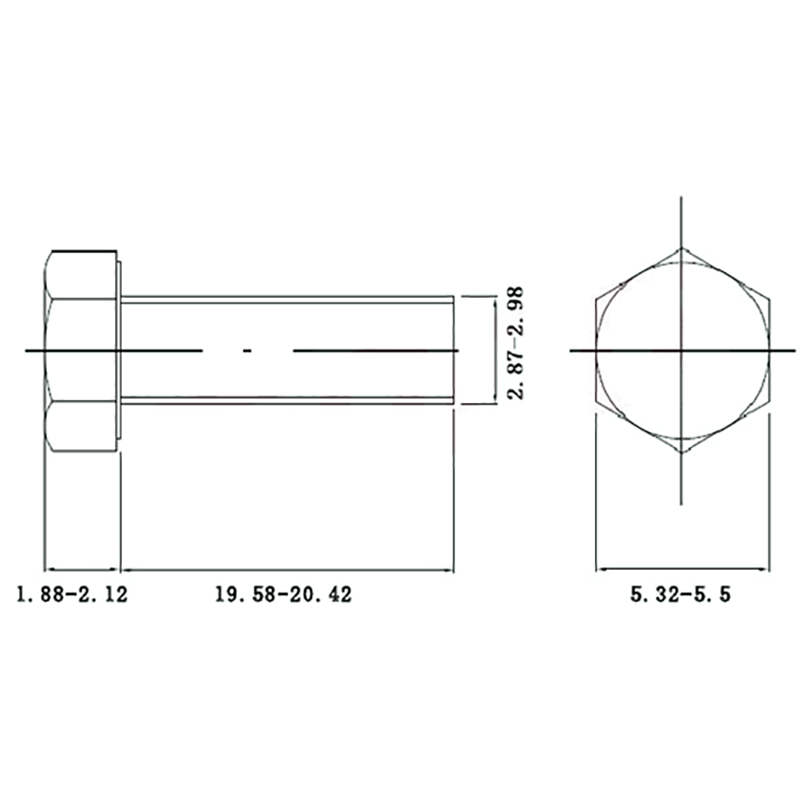
M3 SS316 Hex Bolt
QS Fastener: M3 SS316 Hex Bolt
Name: M3 SS316 Hex Bolt
Standard: DIN933
Material: SS316
Size: M3
Lenght: 20
Surface: Natural color
Standard: DIN933
Material: SS316
Size: M3
Lenght: 20
Surface: Natural color
Quantity
M3 SS316 Hex Bolt is manufactured strictly to DIN933, using SS316 austenitic stainless steel with molybdenum for superior resistance to acids, chloride ions, and marine atmospheric corrosion. Nominal size M3, 20 mm long, plain finish. Threads are precision-rolled and 100 % GO/NO-GO gauge qualified; head width and height conform to DIN dimensions, providing uniform tightening torque and excellent anti-loosening performance. Ideal for demanding applications such as medical devices, food equipment, offshore communications, and high-end electronics. Available from stock with material reports, salt-spray test data, and third-party certifications to shorten your supply chain and improve overall system reliability.
Key differences between M3 SS316 Hex Bolt and 304 stainless-steel fasteners
The differences between 316 and 304 stainless-steel fasteners can be summarized as “one small change in composition, a world of difference in performance.” Below is a professional comparison in six dimensions to help engineers select quickly—especially when looking for small, high-strength fasteners like M3 SS316 Hex Bolt.
The differences between 316 and 304 stainless-steel fasteners can be summarized as “one small change in composition, a world of difference in performance.” Below is a professional comparison in six dimensions to help engineers select quickly—especially when looking for small, high-strength fasteners like M3 SS316 Hex Bolt.
1. Chemical composition—the only but decisive difference
• 304: 06Cr19Ni10, typically 18 %Cr-8 %Ni, no Mo.
• 316: 06Cr17Ni12Mo2, with 2.0–3.0 % Mo added.
→ Mo raises the pitting-resistance equivalent PREN = %Cr + 3.3×%Mo + 16×%N to 24–28 for 316, whereas 304 remains at 18–19; this is the fundamental reason M3 SS316 Hex Bolt survives over 1 000 h in salt-spray tests.
• 304: 06Cr19Ni10, typically 18 %Cr-8 %Ni, no Mo.
• 316: 06Cr17Ni12Mo2, with 2.0–3.0 % Mo added.
→ Mo raises the pitting-resistance equivalent PREN = %Cr + 3.3×%Mo + 16×%N to 24–28 for 316, whereas 304 remains at 18–19; this is the fundamental reason M3 SS316 Hex Bolt survives over 1 000 h in salt-spray tests.
2. Corrosion resistance—the watershed between “marine grade” and “humid grade”
• Salt-spray test: under neutral 5 % NaCl at 35 °C, 304 shows rust spots in 48–72 h, while M3 SS316 Hex Bolt remains stable beyond 1 000 h.
• Critical crevice-corrosion temperature (CCT): 316 ≥20 °C, 304 ≈5 °C; therefore, coastal or chemical-plant railings and pipe flanges are specified to 316/A4, often using M3 SS316 Hex Bolt as the standard fastener.
• Salt-spray test: under neutral 5 % NaCl at 35 °C, 304 shows rust spots in 48–72 h, while M3 SS316 Hex Bolt remains stable beyond 1 000 h.
• Critical crevice-corrosion temperature (CCT): 316 ≥20 °C, 304 ≈5 °C; therefore, coastal or chemical-plant railings and pipe flanges are specified to 316/A4, often using M3 SS316 Hex Bolt as the standard fastener.
3. Mechanical properties—almost identical in the same class, but different cold-working routes
Typical room-temperature values (solution-annealed)
Typical room-temperature values (solution-annealed)
| Rm (MPa) | Rp0.2 (MPa) | A50 (%) | |
| 304 (A2-70) | 700 | 350 | 60 |
| 316 (A4-70) including M3 SS316 Hex Bolt | 700 | 350 | 60 |
4. High- and low-temperature performance
• Continuous service limit: ~870 °C for both; between 600–850 °C, Mo solid-solution strengthening gives 316 a 15–20 % higher creep strength than 304, making M3 SS316 Hex Bolt preferred for engine bays or heat-exchanger flanges.
• Charpy impact at –196 °C: both retain ≥150 J, meeting LNG cryogenic fastening requirements; M3 SS316 Hex Bolt can be used with confidence in low-temperature service.
• Continuous service limit: ~870 °C for both; between 600–850 °C, Mo solid-solution strengthening gives 316 a 15–20 % higher creep strength than 304, making M3 SS316 Hex Bolt preferred for engine bays or heat-exchanger flanges.
• Charpy impact at –196 °C: both retain ≥150 J, meeting LNG cryogenic fastening requirements; M3 SS316 Hex Bolt can be used with confidence in low-temperature service.
5. Magnetism, weldability, and hydrogen embrittlement
• Both are non-magnetic in the solution-annealed state (μr ≤1.005); cold work increases magnetism more in 304, while 316 remains stable—ideal for MRI environments, e.g., M3 SS316 Hex Bolt in medical imaging equipment.
• Welding: 304L/316L low-carbon versions avoid intergranular corrosion without post-weld annealing; standard 304/316 require it.
• Uncoated design eliminates hydrogen-embrittlement risk from zinc plating; both share this benefit, but M3 SS316 Hex Bolt is ready for direct use in NACE MR0175 environments.
• Both are non-magnetic in the solution-annealed state (μr ≤1.005); cold work increases magnetism more in 304, while 316 remains stable—ideal for MRI environments, e.g., M3 SS316 Hex Bolt in medical imaging equipment.
• Welding: 304L/316L low-carbon versions avoid intergranular corrosion without post-weld annealing; standard 304/316 require it.
• Uncoated design eliminates hydrogen-embrittlement risk from zinc plating; both share this benefit, but M3 SS316 Hex Bolt is ready for direct use in NACE MR0175 environments.
6. Cost and application scenarios
• Material price gap: 316 wire rod currently costs ~35–45 % more than 304; in indoor conditions with <50 ppm chloride ions, 304 is more economical.
• Quick guide
– Kitchen appliances, home appliances, dry indoor machinery: 304
– Offshore wind, salt-spray, chemical fog, swimming-pool equipment, food/pharma pressure vessels: 316 (or 316L), with common sizes including M3 SS316 Hex Bolt, M4, M5, etc.
• Material price gap: 316 wire rod currently costs ~35–45 % more than 304; in indoor conditions with <50 ppm chloride ions, 304 is more economical.
• Quick guide
– Kitchen appliances, home appliances, dry indoor machinery: 304
– Offshore wind, salt-spray, chemical fog, swimming-pool equipment, food/pharma pressure vessels: 316 (or 316L), with common sizes including M3 SS316 Hex Bolt, M4, M5, etc.
One-sentence summary
304 is the “all-rounder”; 316 is the “marine expert.” When salt, de-icing salts, chlorinated chemicals, or temperatures above 60 °C are present, the 2–3 % difference provided by Mo determines whether M3 SS316 Hex Bolt will perform safely for 30 years.
304 is the “all-rounder”; 316 is the “marine expert.” When salt, de-icing salts, chlorinated chemicals, or temperatures above 60 °C are present, the 2–3 % difference provided by Mo determines whether M3 SS316 Hex Bolt will perform safely for 30 years.
Send Message
