
Recommend Products
 Name: Fujian Monel 400 Double End Stud Material: Monel 400 Standard: ASME B18.2.1 Size: 5/16 to 4 inch Length: 30 to 1000 mm Class: 12.9 Feature: Resistant to hydrofluoric acidQS Fastener: Monel 400 Double End Stud
 Name: Inconel 625 Double End Stud Material: Inconel 625 Standard: ASME B18.2.1 Size: 5/16 to 4 inch Length: 30 to 1000 mm Class: 12.9 Feature: High Yield Strength, Durable Strength and Corrosion ResistanceQS Fastener: Inconel 625 Double End Stud
 Name: Xiamen Inconel 600 High Strength Fastener Material: Inconel 600 Standard: ASME Size: 5/16 to 4 inch Length: 30 to 1000 mm Class: 12.9 Feature: High Yield Strength, Durable Strength and Corrosion ResistanceQS Fastener: Inconel 600 High Strength Fastener
 Name: Inconel 600 Stud Bolt Putian Material: Inconel 600 Standard: ASME B18.2.1 Size: 5/16 to 4 inch Length: 30 to 1000 mm Class: 12.9 Feature: High Yield Strength, Durable Strength and Corrosion ResistanceQS Fastener: Inconel 600 Stud Bolt


M3 SS304 Thread Rod
QS Fastener: M3 SS304 Thread Rod
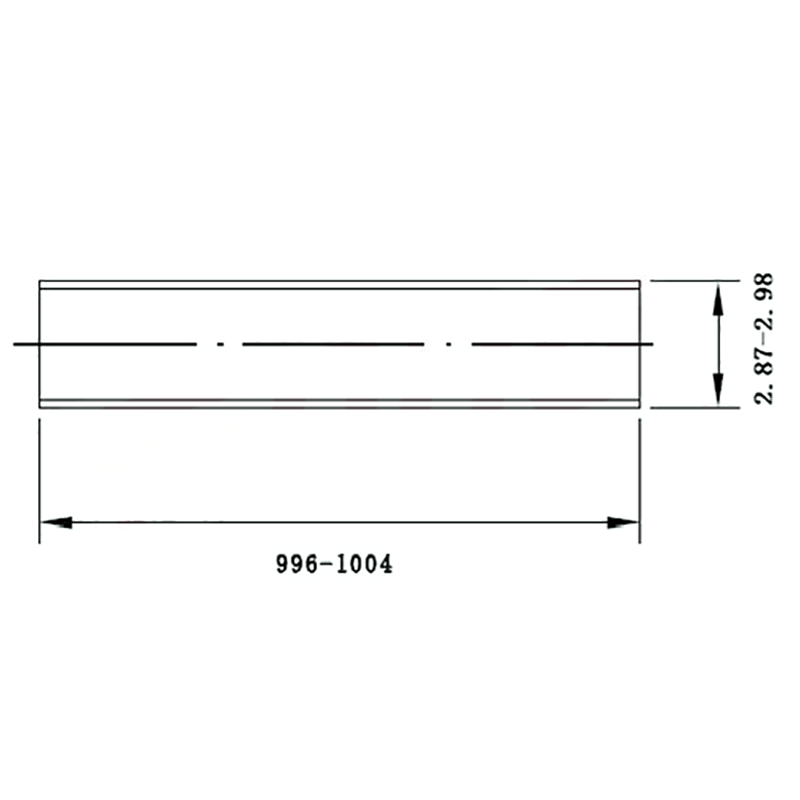
Name: M3 SS304 Thread Rod
Standard: DIN976
Material: SS304
Size: M3
Lenght: 1000 mm
Surface: Natural color
Standard: DIN976
Material: SS304
Size: M3
Lenght: 1000 mm
Surface: Natural color
Quantity
M3 SS304 Thread Rod is manufactured to DIN976, using genuine 304 stainless steel. Each full-length bar measures 1000 mm, is free of welds, and retains its natural finish. It offers excellent corrosion and heat resistance, making it ideal for long-term exposed or hygienic fastening applications such as food machinery, photovoltaic brackets, and electronic enclosures. Installation is simple, the rod can be cut to any required length, ample stock is on hand, and same-day dispatch is available.
Does stainless steel need a coating? In one sentence: it depends on the environment, the function, and the cost. Below, we analyze each point using M3 SS304 Thread Rod as the reference.
1. The “no-coating” camp — “passivation and material selection are enough”
Advantages:
- Austenitic stainless steels (the 304/316 grades used in M3 SS304 Thread Rod) contain ≥12 % Cr and spontaneously form a Cr₂O₃ passive film that self-heals in ordinary or mildly corrosive atmospheres.
Advantages:
- Austenitic stainless steels (the 304/316 grades used in M3 SS304 Thread Rod) contain ≥12 % Cr and spontaneously form a Cr₂O₃ passive film that self-heals in ordinary or mildly corrosive atmospheres.
- Maintenance-free and 100 % recyclable, yielding the lowest life-cycle cost; for example, a 1000 mm length of bare M3 SS304 Thread Rod can be used straight away.
- The natural metallic appearance is widely accepted in industrial, food-grade, and medical clean environments.
Disadvantages:
- If the passive film is continuously exposed to Cl⁻ > 50 ppm, acid mist, or coastal salt spray, pitting or stress-corrosion cracking may occur; in such cases M3 SS304 Thread Rod still requires periodic flushing.
- If the passive film is continuously exposed to Cl⁻ > 50 ppm, acid mist, or coastal salt spray, pitting or stress-corrosion cracking may occur; in such cases M3 SS304 Thread Rod still requires periodic flushing.
- Tool scratches and fingerprints are easily left on the surface, affecting appearance; this is commonly seen on M3 SS304 Thread Rod during transit.
- Cannot provide special functions such as insulation, friction reduction, anti-stick, or antimicrobial properties.
2. The “coating” camp — “give M3 SS304 Thread Rod a jacket”
Advantages:
- Enhanced corrosion resistance: fluorocarbon, organic-silicone-aluminium, or epoxy-phenolic systems can extend salt-spray life from a few hundred to several thousand hours, suitable for chemical tanks or seaside railings; tests show that coated M3 SS304 Thread Rod achieves a five-fold increase in salt-spray life.
Advantages:
- Enhanced corrosion resistance: fluorocarbon, organic-silicone-aluminium, or epoxy-phenolic systems can extend salt-spray life from a few hundred to several thousand hours, suitable for chemical tanks or seaside railings; tests show that coated M3 SS304 Thread Rod achieves a five-fold increase in salt-spray life.
- Functional expansion: PVD copper-like, black titanium, or antimicrobial nano layers add aesthetics and hygiene, popular for elevator panels and kitchenware; M3 SS304 Thread Rod can also receive black-titanium PVD for decorative structures.
- Reduces galvanic corrosion: the coating isolates M3 SS304 Thread Rod from carbon-steel supports, preventing potential-difference-induced corrosion.
Disadvantages:
- High process threshold: surfaces must be degreased, roughened, primed, and cured; any pinhole can initiate pitting, especially at the thread root of M3 SS304 Thread Rod.
- Limited service life: UV radiation and thermal cycling lead to chalking and flaking, requiring periodic recoating and raising maintenance costs.
- High process threshold: surfaces must be degreased, roughened, primed, and cured; any pinhole can initiate pitting, especially at the thread root of M3 SS304 Thread Rod.
- Limited service life: UV radiation and thermal cycling lead to chalking and flaking, requiring periodic recoating and raising maintenance costs.
- Environmental and recycling concerns: fluorinated or heavy-metal coatings increase VOC emissions and must be stripped before recycling.
3. Professional recommendations from engineers
- Material first: in dry indoor environments → choose bare M3 SS304 Thread Rod; in coastal high-salt-spray or chemical acid/alkali conditions → move directly to 316L or duplex 2205, more reliable than painting.
- Material first: in dry indoor environments → choose bare M3 SS304 Thread Rod; in coastal high-salt-spray or chemical acid/alkali conditions → move directly to 316L or duplex 2205, more reliable than painting.
- Extreme environment but cost-constrained: adopt the “material + coating” dual safeguard, e.g., M3 SS304 Thread Rod + fluorocarbon system, giving >3000 h salt-spray life.
- Clearly defined functional needs: anti-fingerprint → apply a transparent nano coating on M3 SS304 Thread Rod; thermal insulation → choose ceramic coating; decorative → use a 1–3 µm PVD colour film that does not affect the thread fit of M3 SS304 Thread Rod.
- Clearly defined functional needs: anti-fingerprint → apply a transparent nano coating on M3 SS304 Thread Rod; thermal insulation → choose ceramic coating; decorative → use a 1–3 µm PVD colour film that does not affect the thread fit of M3 SS304 Thread Rod.
- Maintenance strategy: for bare M3 SS304 Thread Rod, wipe every six months with water or a neutral detergent to remove chloride deposits; for coated items, inspect coating adhesion every 1–2 years and touch up locally.
Conclusion: M3 SS304 Thread Rod is not “stainless forever” but “less prone to rust”. In ordinary environments, leaving it uncoated is most economical; in harsh conditions or when special functions are required, coating is a necessary complement. Proper material selection, matching coating, and scheduled maintenance are the keys to maximizing the value of M3 SS304 Thread Rod.
Send Message
