
Recommend Products
 Name: Fujian Monel 400 Double End Stud Material: Monel 400 Standard: ASME B18.2.1 Size: 5/16 to 4 inch Length: 30 to 1000 mm Class: 12.9 Feature: Resistant to hydrofluoric acidQS Fastener: Monel 400 Double End Stud
 Name: Inconel 625 Double End Stud Material: Inconel 625 Standard: ASME B18.2.1 Size: 5/16 to 4 inch Length: 30 to 1000 mm Class: 12.9 Feature: High Yield Strength, Durable Strength and Corrosion ResistanceQS Fastener: Inconel 625 Double End Stud
 Name: Xiamen Inconel 600 High Strength Fastener Material: Inconel 600 Standard: ASME Size: 5/16 to 4 inch Length: 30 to 1000 mm Class: 12.9 Feature: High Yield Strength, Durable Strength and Corrosion ResistanceQS Fastener: Inconel 600 High Strength Fastener
 Name: Inconel 600 Stud Bolt Putian Material: Inconel 600 Standard: ASME B18.2.1 Size: 5/16 to 4 inch Length: 30 to 1000 mm Class: 12.9 Feature: High Yield Strength, Durable Strength and Corrosion ResistanceQS Fastener: Inconel 600 Stud Bolt


M3 SS 316 Hex Nut is manufactured to DIN934, using premium SS316 stainless steel that resists acids, alkalis, and chloride-induced corrosion, making it ideal for marine and chemical equipment. Size M3, height 2.15–2.4 mm, natural finish—no extra coating is needed to retain long-lasting luster. It is the first choice for reliable fastening in demanding environments.
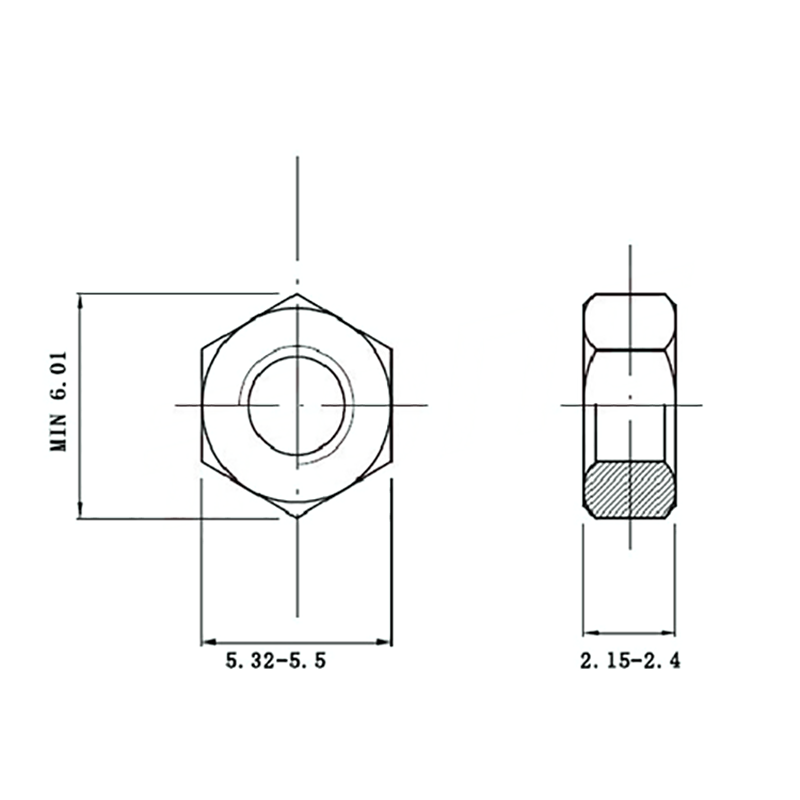
SS316 (SUS316, 1.4401) is an austenitic stainless steel created by adding 2.0–3.0 % Mo to the 304 base; its essential properties are summarized as “three highs, one excellence, one non-.” When these properties are concentrated into one tiny M3 SS 316 Hex Nut, their value becomes especially pronounced:
1. High corrosion resistance
The addition of Mo markedly improves resistance to pitting and crevice corrosion in reducing media (sulfuric, phosphoric, and acetic acids) and chloride environments; in seawater, salt spray, or chemical atmospheres, a single M3 SS 316 Hex Nut can remain rust-free for years.
The addition of Mo markedly improves resistance to pitting and crevice corrosion in reducing media (sulfuric, phosphoric, and acetic acids) and chloride environments; in seawater, salt spray, or chemical atmospheres, a single M3 SS 316 Hex Nut can remain rust-free for years.
With 16–18 % Cr and 10–14 % Ni, a stable passive film forms, ensuring that M3 SS 316 Hex Nut stays reliable under severe conditions.
2. High-temperature strength
Continuous service up to 870 °C, short-term up to 925 °C; superior high-temperature creep strength compared with 304 means that M3 SS 316 Hex Nut maintains preload in boilers and exhaust systems.
Continuous service up to 870 °C, short-term up to 925 °C; superior high-temperature creep strength compared with 304 means that M3 SS 316 Hex Nut maintains preload in boilers and exhaust systems.
3. High ductility and toughness
Elongation ≥ 40 % allows deep drawing, spinning, and cold heading without cracking; excellent impact toughness down to –196 °C ensures that M3 SS 316 Hex Nut will not become brittle in LNG or liquid nitrogen applications.
Elongation ≥ 40 % allows deep drawing, spinning, and cold heading without cracking; excellent impact toughness down to –196 °C ensures that M3 SS 316 Hex Nut will not become brittle in LNG or liquid nitrogen applications.
4. Excellent weldability
Low-carbon (C ≤ 0.08 %) or ultra-low-carbon 316L (C ≤ 0.03 %) prevents intergranular corrosion; no post-weld annealing is required, so M3 SS 316 Hex Nut can be used immediately, reducing on-site processing.
Low-carbon (C ≤ 0.08 %) or ultra-low-carbon 316L (C ≤ 0.03 %) prevents intergranular corrosion; no post-weld annealing is required, so M3 SS 316 Hex Nut can be used immediately, reducing on-site processing.
5. Non-magnetic (weakly magnetic after cold work)
The austenitic matrix is essentially non-magnetic in the solution-annealed state, making M3 SS 316 Hex Nut suitable for electronics, medical devices, and other magnetically sensitive fields.
The austenitic matrix is essentially non-magnetic in the solution-annealed state, making M3 SS 316 Hex Nut suitable for electronics, medical devices, and other magnetically sensitive fields.
Additional notes:
Surface can be mirror-polished to Ra ≤ 0.1 µm, allowing M3 SS 316 Hex Nut to meet food and pharmaceutical GMP requirements;
Work-hardening through cold deformation increases strength, enabling M3 SS 316 Hex Nut to remain lightweight while retaining locking force;
Price is about 15–20 % higher than 304, but total life-cycle maintenance costs for M3 SS 316 Hex Nut are lower in harsh environments.
Surface can be mirror-polished to Ra ≤ 0.1 µm, allowing M3 SS 316 Hex Nut to meet food and pharmaceutical GMP requirements;
Work-hardening through cold deformation increases strength, enabling M3 SS 316 Hex Nut to remain lightweight while retaining locking force;
Price is about 15–20 % higher than 304, but total life-cycle maintenance costs for M3 SS 316 Hex Nut are lower in harsh environments.
Send Message
