
Recommend Products
 Name: Fujian Monel 400 Double End Stud Material: Monel 400 Standard: ASME B18.2.1 Size: 5/16 to 4 inch Length: 30 to 1000 mm Class: 12.9 Feature: Resistant to hydrofluoric acidQS Fastener: Monel 400 Double End Stud
 Name: Inconel 625 Double End Stud Material: Inconel 625 Standard: ASME B18.2.1 Size: 5/16 to 4 inch Length: 30 to 1000 mm Class: 12.9 Feature: High Yield Strength, Durable Strength and Corrosion ResistanceQS Fastener: Inconel 625 Double End Stud
 Name: Xiamen Inconel 600 High Strength Fastener Material: Inconel 600 Standard: ASME Size: 5/16 to 4 inch Length: 30 to 1000 mm Class: 12.9 Feature: High Yield Strength, Durable Strength and Corrosion ResistanceQS Fastener: Inconel 600 High Strength Fastener
 Name: Inconel 600 Stud Bolt Putian Material: Inconel 600 Standard: ASME B18.2.1 Size: 5/16 to 4 inch Length: 30 to 1000 mm Class: 12.9 Feature: High Yield Strength, Durable Strength and Corrosion ResistanceQS Fastener: Inconel 600 Stud Bolt


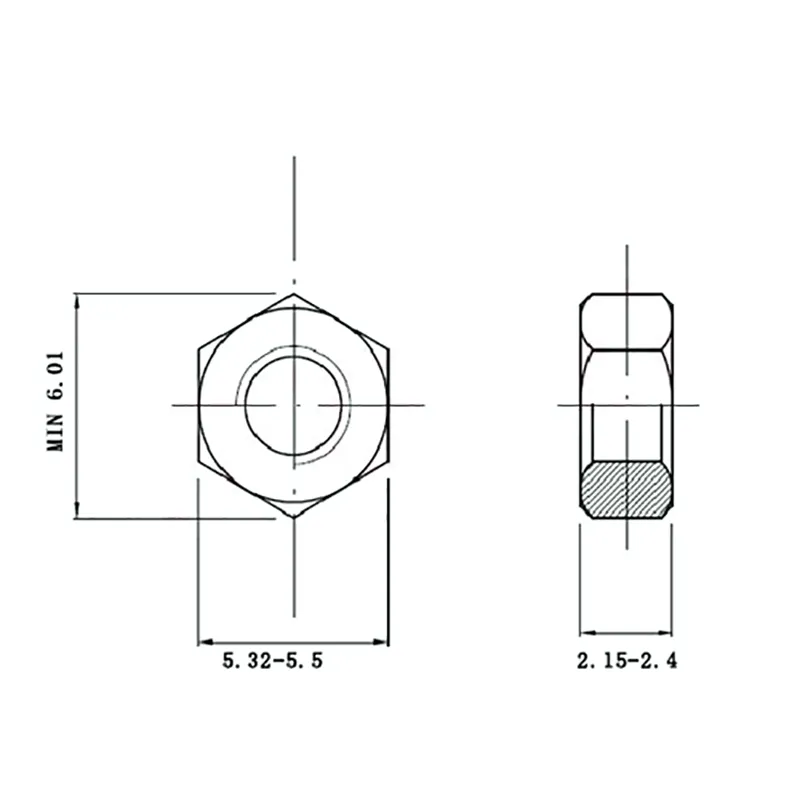
M3 DIN934 Hex Nut
QS Fastener: M3 DIN934 Hex Nut
Name: M3 DIN934 Hex Nut
Standard: DIN934
Material: SS304
Size: M3
Height: 2.15 to 2.4 mm
Surface: Natural color
Standard: DIN934
Material: SS304
Size: M3
Height: 2.15 to 2.4 mm
Surface: Natural color
Quantity
M3 DIN934 Hex Nut is precision-machined from SS304 stainless steel, fully compliant with DIN934 and supplied in its natural finish. It maintains outstanding corrosion resistance in humid, acidic, and alkaline environments. With a height of 2.15–2.4 mm, it balances lightweight design and high-strength clamping, making M3 DIN934 Hex Nut the ideal choice for 3C devices, medical instruments, and precision machinery.
SS304 (06Cr19Ni10) is a typical 18-8 austenitic stainless steel. When M3 DIN934 Hex Nut is made from this material, its corrosion resistance can be summarized as “excellent under normal conditions, but caution is needed in chloride-ion or strongly reducing acid media.”
1. Resistance to Oxidizing Acids
In oxidizing acids such as nitric acid at concentrations ≤65 % and temperatures ≤ boiling point, SS304 rapidly forms a dense Cr₂O₃ passive film, resulting in extremely low corrosion rates and long-term safe operation; therefore, M3 DIN934 Hex Nut remains reliable in equipment handling dilute nitric acid.
In oxidizing acids such as nitric acid at concentrations ≤65 % and temperatures ≤ boiling point, SS304 rapidly forms a dense Cr₂O₃ passive film, resulting in extremely low corrosion rates and long-term safe operation; therefore, M3 DIN934 Hex Nut remains reliable in equipment handling dilute nitric acid.
2. Alkali and Weak Acid Tolerance
It offers good stability against sodium hydroxide, potassium hydroxide, ammonia solution, and most organic acids (acetic, citric, etc.), making it suitable for mildly corrosive environments in the food, pharmaceutical, and water-treatment industries; M3 DIN934 Hex Nut excels in small structural connections within these sectors.
It offers good stability against sodium hydroxide, potassium hydroxide, ammonia solution, and most organic acids (acetic, citric, etc.), making it suitable for mildly corrosive environments in the food, pharmaceutical, and water-treatment industries; M3 DIN934 Hex Nut excels in small structural connections within these sectors.
3. Chloride-Ion Environments
When the medium contains high levels of Cl⁻ (seawater, salt spray, de-icing salts), the passive film is easily breached, leading to pitting or crevice corrosion; under these conditions, M3 DIN934 Hex Nut should preferably be upgraded to 316/316L (with Mo ≥ 2 %).
When the medium contains high levels of Cl⁻ (seawater, salt spray, de-icing salts), the passive film is easily breached, leading to pitting or crevice corrosion; under these conditions, M3 DIN934 Hex Nut should preferably be upgraded to 316/316L (with Mo ≥ 2 %).
4. Temperature Effects
Prolonged exposure between 425–860 °C can cause chromium depletion at grain boundaries, reducing corrosion resistance; at room temperature or below 350 °C, M3 DIN934 Hex Nut continues to offer excellent corrosion performance.
Prolonged exposure between 425–860 °C can cause chromium depletion at grain boundaries, reducing corrosion resistance; at room temperature or below 350 °C, M3 DIN934 Hex Nut continues to offer excellent corrosion performance.
Conclusion: SS304 delivers outstanding corrosion resistance in ordinary atmospheres, fresh water, low-concentration acids and alkalis, and food-grade environments, representing the “golden balance” between cost and corrosion resistance. If M3 DIN934 Hex Nut is to be used in high-chloride or strongly reducing acid environments, upgrading to 316L or higher-alloy materials is recommended.
Send Message
