
Recommend Products
 Name: Fujian Monel 400 Double End Stud Material: Monel 400 Standard: ASME B18.2.1 Size: 5/16 to 4 inch Length: 30 to 1000 mm Class: 12.9 Feature: Resistant to hydrofluoric acidQS Fastener: Monel 400 Double End Stud
 Name: Inconel 625 Double End Stud Material: Inconel 625 Standard: ASME B18.2.1 Size: 5/16 to 4 inch Length: 30 to 1000 mm Class: 12.9 Feature: High Yield Strength, Durable Strength and Corrosion ResistanceQS Fastener: Inconel 625 Double End Stud
 Name: Xiamen Inconel 600 High Strength Fastener Material: Inconel 600 Standard: ASME Size: 5/16 to 4 inch Length: 30 to 1000 mm Class: 12.9 Feature: High Yield Strength, Durable Strength and Corrosion ResistanceQS Fastener: Inconel 600 High Strength Fastener
 Name: Inconel 600 Stud Bolt Putian Material: Inconel 600 Standard: ASME B18.2.1 Size: 5/16 to 4 inch Length: 30 to 1000 mm Class: 12.9 Feature: High Yield Strength, Durable Strength and Corrosion ResistanceQS Fastener: Inconel 600 Stud Bolt


China Manufacturer Hex Nut
QS Fastener: China Manufacturer Hex Nut
Name: China Manufacturer Hex Nut
Standard: ANSI B18.2.2
Material: SS304
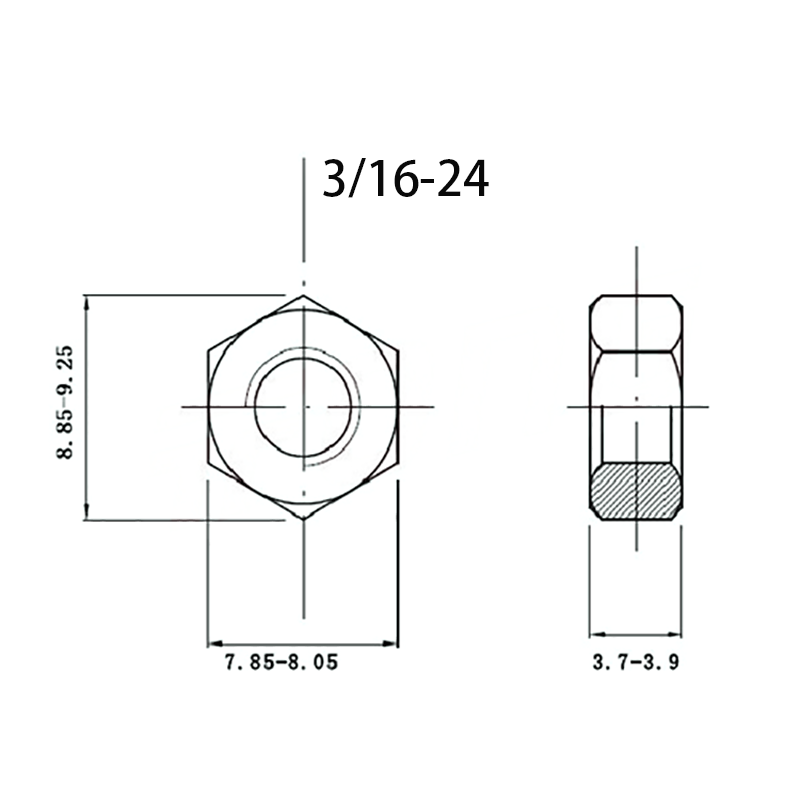
Size: 3/16 inch
Surface: Natural color
Standard: ANSI B18.2.2
Material: SS304
Size: 3/16 inch
Surface: Natural color
Quantity
This China Manufacturer Hex Nut is produced to ANSI B18.2.2 specifications, using SS304 austenitic stainless steel. The 3/16-24 thread size offers a compact footprint while maintaining sufficient load capacity, making it a preferred choice for instrumentation, electronic enclosures, and precision mechanical assemblies. The natural (uncoated) finish retains the material’s inherent corrosion resistance and avoids the variability introduced by aftermarket platings. Stock is readily available for direct global shipment, supporting both prototype runs and high-volume production schedules.
Material and Performance
SS304 (equivalent to A2) provides good oxidation resistance up to moderate temperatures and withstands most industrial atmospheres, dilute acids, and alkalis. The natural surface does not compromise the passive layer; in fact, it preserves the uniform chromium-oxide film that gives stainless its durability. For outdoor or highly saline environments, we recommend upgrading to SS316, but for general indoor machinery, medical devices, and communication equipment, this China Manufacturer Hex Nut delivers reliable, cost-effective service.
SS304 (equivalent to A2) provides good oxidation resistance up to moderate temperatures and withstands most industrial atmospheres, dilute acids, and alkalis. The natural surface does not compromise the passive layer; in fact, it preserves the uniform chromium-oxide film that gives stainless its durability. For outdoor or highly saline environments, we recommend upgrading to SS316, but for general indoor machinery, medical devices, and communication equipment, this China Manufacturer Hex Nut delivers reliable, cost-effective service.
Critical Assembly Practices – Preventing Galling
Austenitic stainless fasteners are prone to galling – a cold-welding phenomenon that seizes threads during tightening. While no single measure eliminates galling entirely, controlling four variables reduces its occurrence from the typical field average of ~3% to below 0.1% in controlled operations.
Austenitic stainless fasteners are prone to galling – a cold-welding phenomenon that seizes threads during tightening. While no single measure eliminates galling entirely, controlling four variables reduces its occurrence from the typical field average of ~3% to below 0.1% in controlled operations.
1. Engagement length – Use a bolt with thread engagement at least 1.0 × nominal diameter (d = 4.76 mm for 3/16 inch). After final torque, 1 to 2 threads (P = 1.058 mm) should project beyond the nut, providing a visual check and avoiding bending overloads.
2. Strength pairing – Per ISO 3506-1, pair an A2-70 bolt (minimum tensile 700 MPa) with an A2-035 grade nut. This ensures the nut’s stripping strength is at least 1.2 times the bolt’s proof load. For reference, an M5×0.8 A2-70 bolt has a proof load of ~9.4 kN; the matching 3/16-24 nut must withstand ≥11.3 kN to prevent thread stripping under full preload.
3. Thread condition – Specify surface roughness Ra ≤ 3.2 µm on nut threads. Degrease with chlorine-free solvents; if burrs are present, light glass-bead blasting (20–40 µm media) is permissible. After any handling impact, a GO thread gauge must pass freely, and a NO-GO gauge must not advance more than 2P – otherwise discard the nut.
4. Alignment and torque – Keep the driving socket within 2° of the bolt axis. Eccentric loading introduces bending stress that accelerates galling. Apply a dry-film lubricant (molybdenum disulfide or PTFE wax) to reduce the friction coefficient from ~0.20 (dry) to ~0.12. For a target preload of 6.8 kN (75% of A2-70 yield), use a two-stage torque sequence: 50% then 100% of final torque T = K·F·d, with K ≈ 0.18, giving T ≈ 5.8 N·m. Finalize at ≤20 rpm; avoid impact wrenches.
Application Scenarios
- Instrumentation – mounting sensors, transmitters, and control valves where space is constrained.
- Electronics – securing heatsinks, chassis grounding studs, and rack-mount hardware.
- Precision machinery – optical stages, robotics arms, and inspection fixtures requiring consistent clamp load without thread damage.
- Instrumentation – mounting sensors, transmitters, and control valves where space is constrained.
- Electronics – securing heatsinks, chassis grounding studs, and rack-mount hardware.
- Precision machinery – optical stages, robotics arms, and inspection fixtures requiring consistent clamp load without thread damage.
Quality and Supply
Every batch is inspected with GO/NO-GO gauges and dimensional verification per ANSI B18.2.2. As a dedicated China Manufacturer Hex Nut supplier, we maintain full traceability from raw material to finished part. For urgent requirements, our warehouse stocks standard China Manufacturer Hex Nuts in natural SS304, ready for same-day dispatch.
Every batch is inspected with GO/NO-GO gauges and dimensional verification per ANSI B18.2.2. As a dedicated China Manufacturer Hex Nut supplier, we maintain full traceability from raw material to finished part. For urgent requirements, our warehouse stocks standard China Manufacturer Hex Nuts in natural SS304, ready for same-day dispatch.
Summary
This China Manufacturer Hex Nut combines standardised geometry, proven stainless steel, and practical anti-galling guidelines. By following the recommended engagement, lubrication, and torque procedures, engineers can achieve consistent, repeatable joints with minimal risk of seizure – a dependable solution for critical assemblies worldwide.
This China Manufacturer Hex Nut combines standardised geometry, proven stainless steel, and practical anti-galling guidelines. By following the recommended engagement, lubrication, and torque procedures, engineers can achieve consistent, repeatable joints with minimal risk of seizure – a dependable solution for critical assemblies worldwide.
Send Message
