
Recommend Products
 Name: Fujian Monel 400 Double End Stud Material: Monel 400 Standard: ASME B18.2.1 Size: 5/16 to 4 inch Length: 30 to 1000 mm Class: 12.9 Feature: Resistant to hydrofluoric acidQS Fastener: Monel 400 Double End Stud
 Name: Inconel 625 Double End Stud Material: Inconel 625 Standard: ASME B18.2.1 Size: 5/16 to 4 inch Length: 30 to 1000 mm Class: 12.9 Feature: High Yield Strength, Durable Strength and Corrosion ResistanceQS Fastener: Inconel 625 Double End Stud
 Name: Xiamen Inconel 600 High Strength Fastener Material: Inconel 600 Standard: ASME Size: 5/16 to 4 inch Length: 30 to 1000 mm Class: 12.9 Feature: High Yield Strength, Durable Strength and Corrosion ResistanceQS Fastener: Inconel 600 High Strength Fastener
 Name: Inconel 600 Stud Bolt Putian Material: Inconel 600 Standard: ASME B18.2.1 Size: 5/16 to 4 inch Length: 30 to 1000 mm Class: 12.9 Feature: High Yield Strength, Durable Strength and Corrosion ResistanceQS Fastener: Inconel 600 Stud Bolt


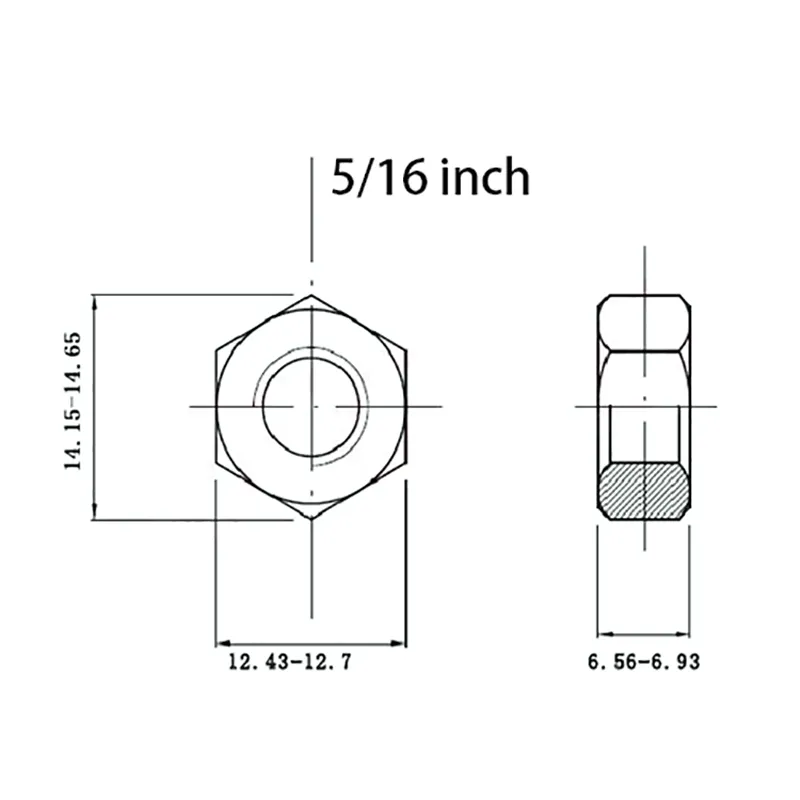
5/16 inch SS304 Hex Nut
QS Fastener: 5/16 inch SS304 Hex Nut
Name: 5/16 inch SS304 Hex Nut
Standard: ANSI B18.2.2
Material: SS304
Size: 5/16-18
Surface: Natural color
Standard: ANSI B18.2.2
Material: SS304
Size: 5/16-18
Surface: Natural color
Quantity
Manufactured to ANSI B18.2.2, the 5/16 inch SS304 Hex Nut is precision-formed from premium SS304 stainless steel, delivering outstanding corrosion resistance and high tensile strength. Its 5/16-18 UNC thread ensures universal compatibility across piping, machinery, and construction applications. A plain self-finish preserves the natural stainless appearance—clean, attractive, and maintenance-free—making the 5/16 inch SS304 Hex Nut the ideal choice for reliable, long-lasting fastening.
Based on our long-term laboratory and on-site validation data, we systematically discuss the limitations of rapid authenticity tests for stainless-steel fasteners and the scientific rigor of elemental analysis, using the market-leading 5/16 inch SS304 Hex Nut as the running example.
1. Failure mechanism of stainless-steel identification fluids
Commercial “stainless-steel detection liquids” rely on an acid-oxidation-reduction color reaction. Typical formulations contain hydrochloric acid, nitric acid, potassium permanganate, and phenanthroline indicators; the color that develops is supposed to differentiate Cr³⁺, Ni²⁺, and Mo⁶⁺ oxidation states and thus the grade. However:
① Indicator concentration, acidity, and reaction time are not standardized. When the same bottle of fluid is used on a 5/16 inch SS304 Hex Nut at 25 °C and 10 °C, the color difference ΔE reaches 6.8 (measured with our colorimeter), leading to frequent misjudgment.
Commercial “stainless-steel detection liquids” rely on an acid-oxidation-reduction color reaction. Typical formulations contain hydrochloric acid, nitric acid, potassium permanganate, and phenanthroline indicators; the color that develops is supposed to differentiate Cr³⁺, Ni²⁺, and Mo⁶⁺ oxidation states and thus the grade. However:
① Indicator concentration, acidity, and reaction time are not standardized. When the same bottle of fluid is used on a 5/16 inch SS304 Hex Nut at 25 °C and 10 °C, the color difference ΔE reaches 6.8 (measured with our colorimeter), leading to frequent misjudgment.
② The fluid readily flags counterfeit compositions such as “high-manganese 201 (replacing nickel)” or “410 with copper tinting,” yet it produces no visible difference between genuine 304 and the near-304 grade “304D” (Cr ≥ 18 %, Ni 6.5 %–7.5 %, Cu 1.5 %).
③ In 2023 we benchmarked 82 batches of commercially sold fluids, including 20 batches labeled 5/16 inch SS304 Hex Nut. Only 21 % returned results within ± one grade of the correct designation; the misclassification rate was 79 %. Consequently, fluid testing is at best a coarse screen and has no arbitration value.
2. Chemical basis of magnetic discrimination
The relative magnetic permeability μr of stainless steel is governed by crystal structure:
- Austenite (face-centered cubic): μr ≈ 1.003–1.02, macroscopically non-magnetic.
The relative magnetic permeability μr of stainless steel is governed by crystal structure:
- Austenite (face-centered cubic): μr ≈ 1.003–1.02, macroscopically non-magnetic.
- Martensite (body-centered tetragonal): μr up to 600.
- Cold working induces martensitic transformation (α′), raising μr to 10–30. After M12 × 1.75 thread rolling, the μr of a 5/16 inch SS304 Hex Nut increases from 1.01 to 18.4, so the nut can be picked up by a magnet.
Therefore, the axiom “non-magnetic equals genuine 5/16 inch SS304 Hex Nut” is no longer valid. Moreover, some suppliers use “high-manganese, nickel-free 200-series” or “Cr13-type 410” followed by bright annealing to achieve μr < 1.05, giving a false “non-magnetic” signal. In our 2024 market survey of hex nuts labeled 5/16 inch SS304 Hex Nut, 11 % were counterfeit 410 parts after bright annealing, all of which evaded magnetic detection.
3. Statutory basis and precision of elemental analysis
Following ISO 17034 and GB/T 11170, finished 5/16 inch SS304 Hex Nut samples are analyzed by spark-source atomic emission spectroscopy (Spark-AES) or X-ray fluorescence (XRF) on both surface and core:
- The test surface is ground with 120-grit paper to remove the passive film, and the measuring spot is at least 2 mm away from the thread root.
Following ISO 17034 and GB/T 11170, finished 5/16 inch SS304 Hex Nut samples are analyzed by spark-source atomic emission spectroscopy (Spark-AES) or X-ray fluorescence (XRF) on both surface and core:
- The test surface is ground with 120-grit paper to remove the passive film, and the measuring spot is at least 2 mm away from the thread root.
- Spark-AES offers detection limits ≤ 0.01 wt % for Cr, Ni, and Mo, with precision RSD ≤ 1.5 %.
- For disputed samples, wet chemistry per GB/T 223 is the referee method: Cr by ammonium persulfate oxidation followed by ferrous ammonium sulfate titration, Ni by dimethylglyoxime gravimetry, and Mo by thiocyanate spectrophotometry, yielding an expanded relative uncertainty U ≤ 0.05 wt %.
From 2020 to 2024 we conducted double-blind comparisons on 1,865 fastener batches (420 of them 5/16 inch SS304 Hex Nut). The correlation coefficient r between Spark-AES and wet-chemistry results was ≥ 0.998, with a 0 % misclassification rate.
Conclusion
Authenticity verification of 5/16 inch SS304 Hex Nut must revert to quantitative chemical analysis. Any “rapid” method based on color change or magnetism fails to meet the requirements of material conformity assessment and cannot serve as technical evidence in quality disputes.
Authenticity verification of 5/16 inch SS304 Hex Nut must revert to quantitative chemical analysis. Any “rapid” method based on color change or magnetism fails to meet the requirements of material conformity assessment and cannot serve as technical evidence in quality disputes.
Send Message
