
Why is it that sometimes the inner diameter of an insulating gasket is smaller than the nominal diameter of a pipe flange
author: www.qishine.com
2026-03-05

As a supplier with many years of experience in the field of sealing and insulation, we would like to emphasize your expertise in technical knowledge and engineering practices. The design of insulating gaskets (or insulating flange gaskets) sometimes does require that their inner diameters be slightly smaller than the nominal inner diameter of the pipe flange, in order to ensure their insulating effect. This is not a manufacturing error but is based on systematic engineering considerations. Below, I will provide a more in-depth analysis and supplementary explanation of this issue, integrating standards and specifications, material mechanics, and field application experience.

Force diagram of the insulating gasket. www.qishine.com
I. In-depth Analysis of Core Reasons
1. Sealing Priority: Ensuring Complete Coverage of the Primary Sealing Surface
Fundamental Principle: The sealing of a flange connection relies on the compression of the Isolation Gasket between the sealing faces of the two flanges (e.g., Raised Face, RTJ Groove) to create plastic deformation, filling microscopic irregularities. The inner boundary of the gasket must completely cover the "seam" formed by the inner bores of the two flanges.
1. Sealing Priority: Ensuring Complete Coverage of the Primary Sealing Surface
Fundamental Principle: The sealing of a flange connection relies on the compression of the Isolation Gasket between the sealing faces of the two flanges (e.g., Raised Face, RTJ Groove) to create plastic deformation, filling microscopic irregularities. The inner boundary of the gasket must completely cover the "seam" formed by the inner bores of the two flanges.
Risk Avoidance: If the gasket's inner diameter is flush with or larger than the pipe's inner diameter, the medium (especially gases, light oils, or corrosive chemicals) could directly penetrate into the flange bolt hole area or to the exterior, causing interface leakage. A slightly smaller inner diameter ensures that the gasket material can expand slightly inward under compression, completely blocking this most vulnerable path.
2. Mechanical Stability and Impact Resistance
Preventing "Blow-out" and "Extrusion": Under system pressure fluctuations, water hammer, or high-velocity flow scour, the gasket experiences shear forces directed toward the inside of the pipe. A slightly smaller inner diameter acts as a subtle "mechanical lock," increasing the gasket's reliability of being retained within the sealing cavity, preventing it from being blown into the pipeline or suffering localized extrusion.
Preventing "Blow-out" and "Extrusion": Under system pressure fluctuations, water hammer, or high-velocity flow scour, the gasket experiences shear forces directed toward the inside of the pipe. A slightly smaller inner diameter acts as a subtle "mechanical lock," increasing the gasket's reliability of being retained within the sealing cavity, preventing it from being blown into the pipeline or suffering localized extrusion.
Protecting the Flange Sealing Face: By covering the edge of the flange bore, the gasket avoids direct scour and erosion of the finely machined metal sealing face by high-speed, particle-laden, or corrosive media.
3. Critical for Electrical Insulation Integrity
Complete Isolation of Electrical Paths: A core function of an insulating gasket is to block stray currents, cathodic protection currents, or prevent electrolytic corrosion between pipeline systems. If the gasket's inner diameter is too large, it could allow the metal edges of the inner bores of the two flanges to form a "point contact" through the conductive medium or direct contact, causing an insulation short circuit and rendering the entire insulating joint ineffective. A smaller inner diameter ensures all-metal components are fully isolated by the insulating material.
Complete Isolation of Electrical Paths: A core function of an insulating gasket is to block stray currents, cathodic protection currents, or prevent electrolytic corrosion between pipeline systems. If the gasket's inner diameter is too large, it could allow the metal edges of the inner bores of the two flanges to form a "point contact" through the conductive medium or direct contact, causing an insulation short circuit and rendering the entire insulating joint ineffective. A smaller inner diameter ensures all-metal components are fully isolated by the insulating material.
4. Installation Practicality and Error Tolerance
Self-Centering Aid: During installation, especially for large-diameter flanges, the gasket can easily shift due to gravity or misalignment. A slightly smaller inner diameter allows the gasket to naturally "grip" the flange bore before the bolts are initially tightened, facilitating positioning for installers.
Self-Centering Aid: During installation, especially for large-diameter flanges, the gasket can easily shift due to gravity or misalignment. A slightly smaller inner diameter allows the gasket to naturally "grip" the flange bore before the bolts are initially tightened, facilitating positioning for installers.
Compensation for Installation Deviation: Field pipeline alignment may have minor angular deviations. A slightly smaller gasket inner diameter provides extra coverage margin, ensuring sealing is maintained even under non-ideal alignment conditions.
5. Compliance with International Standards and Best Practices
Explicit Standard Guidance: For example, ASME B16.21 clearly states that for Non-metallic Isolation Gasket, the inner diameter is typically about 1/16 inch (~1.6 mm) to 1/8 inch (~3.2 mm) smaller than the inner diameter corresponding to the Nominal Pipe Size (NPS). The specific value depends on the flange pressure class and size.
Explicit Standard Guidance: For example, ASME B16.21 clearly states that for Non-metallic Isolation Gasket, the inner diameter is typically about 1/16 inch (~1.6 mm) to 1/8 inch (~3.2 mm) smaller than the inner diameter corresponding to the Nominal Pipe Size (NPS). The specific value depends on the flange pressure class and size.
Other Standards: NACE SP 0286 - 2007
7.2.3 Design
7.2.3.1 Gaskets may either be full face or may fit inside the bolt circle. They should be a minimum of 3.0 mm (120 mil) thick and may protrude into the bore of the pipe by 1.5 mm (60 mil) to prevent electrically conductive bridging over the isolation material. Thinner gaskets may be appropriate to reduce blowout potential.
7.2.3 Design
7.2.3.1 Gaskets may either be full face or may fit inside the bolt circle. They should be a minimum of 3.0 mm (120 mil) thick and may protrude into the bore of the pipe by 1.5 mm (60 mil) to prevent electrically conductive bridging over the isolation material. Thinner gaskets may be appropriate to reduce blowout potential.

Industry Consensus: This design has become standard practice in industries such as oil and gas, petrochemical, offshore platforms, and long-distance pipelines, and is a mandatory requirement, especially for insulating joints involving cathodic protection.
II. Key Supplements and Engineering Details
1. Practical Consideration of Dimensional Tolerances
Not Smaller Is Better: An excessively small inner diameter significantly reduces the effective flow area of the pipe, increases unnecessary pressure drop, and under high pressure may cause the gasket to protrude excessively into the flow path, leading to flow disturbance or tearing of the gasket itself. Typically, the reduction is between 1-3 mm, determined comprehensively based on diameter, pressure, and medium.
Below is Klinger's production dimensions for Type F insulation gaskets.
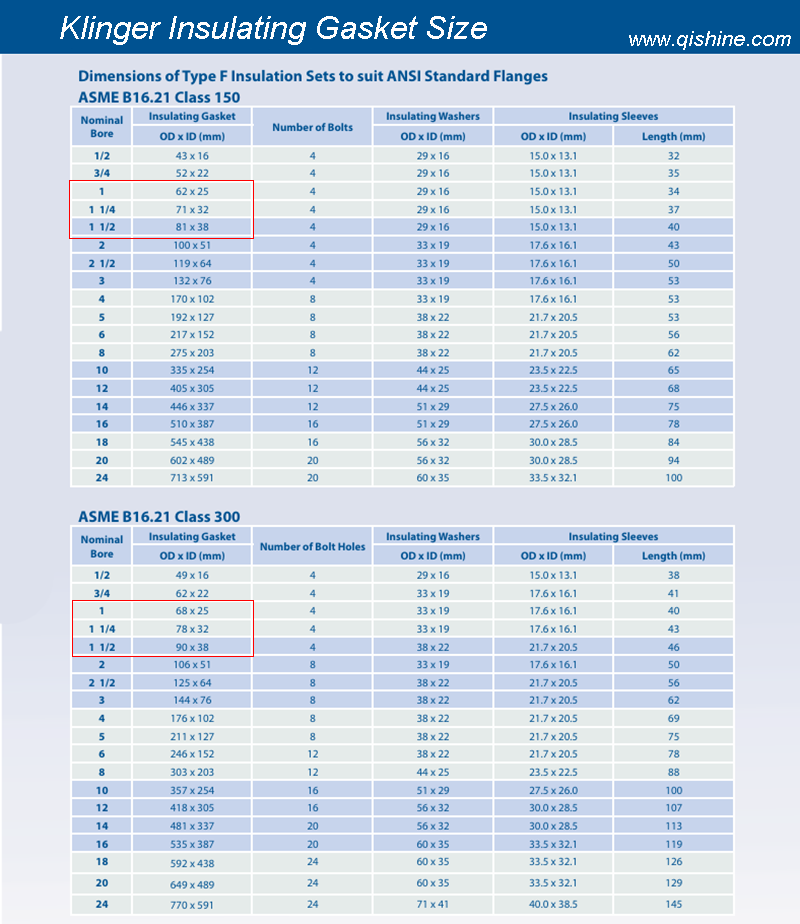
If you wish to obtain more information, you can simply contact us. We will offer you more professional services. (qishine.qishine.com)
Relation to Gasket Material:
Non-elastic materials (e.g., traditional asbestos rubber, non-asbestos sheet): The reduction in inner diameter needs strict control due to their limited ductility.
Non-elastic materials (e.g., traditional asbestos rubber, non-asbestos sheet): The reduction in inner diameter needs strict control due to their limited ductility.
Semi-metallic/composite materials (e.g., flexible graphite spiral wound gaskets, metal serrated gaskets): Due to their soft outer layer, the inner diameter can be designed slightly smaller to utilize their better filling capability.
Fully insulating material gaskets (e.g., phenolic resin, PTFE): Special attention must be paid to their cold flow properties. Appropriate inner diameter margin helps control long-term compression deformation.
2. Special Considerations for Specific Operating Conditions
Solid Particle Media: For slurry or powder pipelines, the gasket inner diameter may even be flush with the pipe inner diameter or adopt a "flush inner ring" design to avoid creating a ledge that impedes flow or causes material accumulation and wear.
Solid Particle Media: For slurry or powder pipelines, the gasket inner diameter may even be flush with the pipe inner diameter or adopt a "flush inner ring" design to avoid creating a ledge that impedes flow or causes material accumulation and wear.
Ultra-high Vacuum Systems: Require the gasket inner diameter to be strictly equal to or slightly larger than the flange inner diameter to prevent the gasket from protruding into the flow path and creating an outgassing source, compromising vacuum integrity.
Thermal Cycling Conditions: Differences in thermal expansion coefficients between flanges, bolts, and the gasket must be calculated. The inner diameter design must consider maintaining effective coverage even after the flange bore expands at high temperatures.
3. Synergy with Matching Insulating Sleeves/Bolts
A complete flange insulation kit typically includes the insulating gasket, insulating sleeves, and insulating washers. The design of the gasket's inner diameter must match the thickness and position of the insulating sleeves to ensure that after sleeve installation, a continuous insulation barrier is maintained between all metal components without any electrical bypass.
A complete flange insulation kit typically includes the insulating gasket, insulating sleeves, and insulating washers. The design of the gasket's inner diameter must match the thickness and position of the insulating sleeves to ensure that after sleeve installation, a continuous insulation barrier is maintained between all metal components without any electrical bypass.
Qishine is ideal choice for EPC companies and project contractors.
Website: www.qishine.com
Email: qishine@qishine.com
Tel: 0592-5225595
Email: qishine@qishine.com
Tel: 0592-5225595
WhatsApp: +86 15960259563
III. Summary and Recommendations
The practice of designing an insulating gasket's inner diameter slightly smaller than the pipe's inner diameter is a classic design that integrates fluid sealing science, material mechanics, and electrical engineering. It represents the optimal balance point between reliability, safety, and cost-effectiveness.
The practice of designing an insulating gasket's inner diameter slightly smaller than the pipe's inner diameter is a classic design that integrates fluid sealing science, material mechanics, and electrical engineering. It represents the optimal balance point between reliability, safety, and cost-effectiveness.
Recommendations for Engineers, Procurement Personnel, and Field Technicians:
1. Strictly Adhere to Drawings: Before installation, verify the inner diameter of the gasket against the drawings and material certificates. Never arbitrarily replace it with a standard gasket of the same nominal diameter.
1. Strictly Adhere to Drawings: Before installation, verify the inner diameter of the gasket against the drawings and material certificates. Never arbitrarily replace it with a standard gasket of the same nominal diameter.
2. Perform On-site Verification: For critical pipelines, use a borescope during installation to check, ensuring the gasket's inner edge protrudes uniformly and slightly into the pipe wall without significant obstruction.
3. Focus on Overall Insulation Performance: After installation, it is essential to measure the insulation resistance of the complete insulating joint (typically required to be >1 MΩ) using a megohmmeter to verify the combined performance of the gasket and other insulating components, not relying solely on dimensions.
4. Record and Provide Feedback: Document the gasket brand, batch, and actual performance (presence of leaks, insulation failure), to accumulate data for future selection and optimization.
In summary, this seemingly minor dimensional difference is actually a crystallization of wisdom designed to ensure the long-term safe, sealed, and insulated operation of pipeline systems. Understanding the principles behind it helps us make more precise decisions in design, procurement, installation, and maintenance.
Insulating Gasket Kit Components Breakdown What Every Procurement Engineer Must Check Before Ordering
How to Select Insulation Gasket Materials Based on Application Temperature
Related Article

Insights from a Case Study on Exporting B8M Fasteners.Recently, during our final outgoing inspection of a batch of B8M stainless steel fasteners destined for Portugal, we discovered varying degrees of burrs on the edges of the bolt hex heads.
How to Efficiently Remove Burrs from Bolt Edges

Insulating Gasket Procurement Pitfalls: From "Price Traps" to "Supplier Selection"
What pitfalls should you watch out for when purchasing insulating gaskets

As a classic modified PTFE gasket material from Garlock, Gylon 3500 is widely used in petrochemical, chemical, and other industries for its excellent resistance to strong acids, solvents, and anti-creep properties.
How to Buy Genuine Gylon 3500 Insulating Gaskets at Competitive Prices in China

