
How to Efficiently Remove Burrs from Bolt Edges
author: www.qishine.com
2026-07-23

Recently, during our final outgoing inspection of a batch of B8M stainless steel fasteners destined for Portugal, we discovered varying degrees of burrs on the edges of the bolt hex heads. Our initial attempt to use an angle grinder for manual removal proved unsatisfactory due to poor handheld stability and inconsistent material removal, which led to irregular indentations on some workpiece edges, unsatisfactory visual consistency, and notably low efficiency. We subsequently switched to sandblasting for whole-batch treatment, which yielded significantly better results – the surfaces became uniformly fine, critical dimensions (such as across-flats distance and head height) remained unaffected, and the method proved suitable for larger batch operations. This practical experience also prompted us to systematically review the causes of burr formation and feasible process solutions.
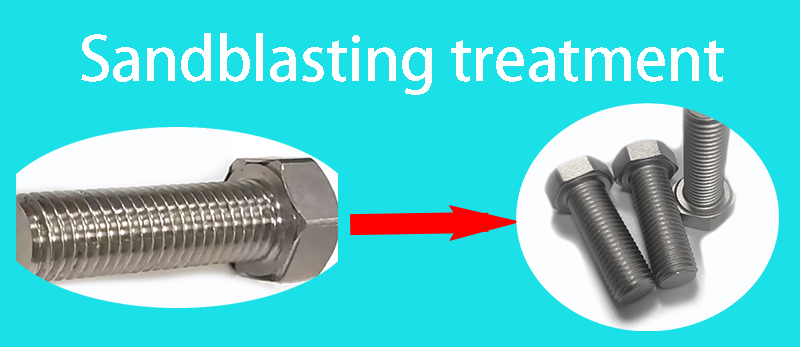
Sandblasting Treatment
I. Mechanism of Burr Formation
In fastener manufacturing, burrs are a typical defect associated with plastic forming processes. Taking cold heading as an example, when metal blanks are extruded and flow within die cavities, some material may squeeze into die parting lines or clearances between punches and dies, forming thin sheet-like or spike-like protrusions – namely burrs or flash. Their size, shape, and distribution are influenced by factors such as die clearance, material flowability, lubrication conditions, and forming speed. Although burrs cannot be entirely eliminated, they can be effectively controlled through post-processing treatments.
In fastener manufacturing, burrs are a typical defect associated with plastic forming processes. Taking cold heading as an example, when metal blanks are extruded and flow within die cavities, some material may squeeze into die parting lines or clearances between punches and dies, forming thin sheet-like or spike-like protrusions – namely burrs or flash. Their size, shape, and distribution are influenced by factors such as die clearance, material flowability, lubrication conditions, and forming speed. Although burrs cannot be entirely eliminated, they can be effectively controlled through post-processing treatments.
II. Comparison of Burr Removal Processes
Beyond sandblasting, the following mature approaches are commonly used in the industry for batch removal of burrs on fasteners:
Beyond sandblasting, the following mature approaches are commonly used in the industry for batch removal of burrs on fasteners:
1. Vibratory Finishing
In this method, workpieces are placed together with abrasive media and compound in a vibrating bowl. High-frequency three-dimensional vibrations cause the media to continuously rub against the edges and surfaces of the workpieces, achieving both deburring and surface smoothing. For geometrically regular parts such as hex heads, the media conform well to the edge contours, providing relatively uniform coverage.
In this method, workpieces are placed together with abrasive media and compound in a vibrating bowl. High-frequency three-dimensional vibrations cause the media to continuously rub against the edges and surfaces of the workpieces, achieving both deburring and surface smoothing. For geometrically regular parts such as hex heads, the media conform well to the edge contours, providing relatively uniform coverage.
- Advantages: Large load capacity per batch, minimal manual intervention, low operating costs, and additional surface polishing effect.
- Limitations: May have insufficient cutting force for thick-rooted or strongly adhered burrs, with a risk of residual burrs requiring rework on some pieces.
- Applicability: Suitable for ordinary fasteners in large batches, with moderate surface finish requirements and controllable burr severity.
- Limitations: May have insufficient cutting force for thick-rooted or strongly adhered burrs, with a risk of residual burrs requiring rework on some pieces.
- Applicability: Suitable for ordinary fasteners in large batches, with moderate surface finish requirements and controllable burr severity.
2. Electrochemical Deburring
Based on the principle of anodic dissolution in electrochemistry, the workpiece is connected as the anode while a specially shaped cathode tool is positioned near the burr areas. Under the action of electrolyte, current density concentrates at the tips, causing burrs to dissolve preferentially and rapidly. This method is particularly effective for complex or concealed areas such as cross-holes and internal cavities.
Based on the principle of anodic dissolution in electrochemistry, the workpiece is connected as the anode while a specially shaped cathode tool is positioned near the burr areas. Under the action of electrolyte, current density concentrates at the tips, causing burrs to dissolve preferentially and rapidly. This method is particularly effective for complex or concealed areas such as cross-holes and internal cavities.
- Advantages: Very short cycle time per piece (from a few seconds to several tens of seconds), no mechanical contact force, no risk of workpiece deformation, and capability for multi-station simultaneous processing.
- Disadvantages: Electrolytes are corrosive, requiring thorough cleaning and neutralization processes plus enhanced anti-rust treatment; surface luster in areas adjacent to burrs may be reduced, so careful evaluation is needed for high-cosmetic requirements; if parameters are not well controlled, there is a slight risk of dimensional changes.
- Applicability: Suitable for structurally complex parts where deburring efficiency is prioritized and where post-treatment facilities are well established.
- Disadvantages: Electrolytes are corrosive, requiring thorough cleaning and neutralization processes plus enhanced anti-rust treatment; surface luster in areas adjacent to burrs may be reduced, so careful evaluation is needed for high-cosmetic requirements; if parameters are not well controlled, there is a slight risk of dimensional changes.
- Applicability: Suitable for structurally complex parts where deburring efficiency is prioritized and where post-treatment facilities are well established.
3. Magnetic Abrasive Finishing
This process uses a magnetic field to drive magnetic abrasive media (typically stainless steel pin-shaped media) to rotate and tumble at high speed within a container, producing continuous friction and shearing action on all exposed surfaces as well as blind spots such as internal holes, grooves, and crevices. Burrs on hex head edges are effectively removed while achieving good overall surface uniformity.
This process uses a magnetic field to drive magnetic abrasive media (typically stainless steel pin-shaped media) to rotate and tumble at high speed within a container, producing continuous friction and shearing action on all exposed surfaces as well as blind spots such as internal holes, grooves, and crevices. Burrs on hex head edges are effectively removed while achieving good overall surface uniformity.
- Advantages: Does not damage the base material or alter critical dimensions; can simultaneously handle shaped parts and mixed batches of large volumes; easy to operate, with relatively long media life.
- Limitations: Moderate-to-high initial equipment investment; single-batch processing time typically ranges from 5 to 20 minutes, requiring process parameter adjustments based on burr severity.
- Applicability: Suitable for batch production of stainless steel and alloy steel fasteners with high requirements for dimensional accuracy and surface consistency.
- Limitations: Moderate-to-high initial equipment investment; single-batch processing time typically ranges from 5 to 20 minutes, requiring process parameter adjustments based on burr severity.
- Applicability: Suitable for batch production of stainless steel and alloy steel fasteners with high requirements for dimensional accuracy and surface consistency.
III. Process Selection Recommendations
Based on a comprehensive comparison, for B8M stainless steel and the specific characteristics of hex-head burrs, magnetic abrasive finishing offers the best balance in dimensional controllability and surface consistency, making it particularly suitable for export batches with stringent quality stability requirements. If production cycle time is extremely tight and a well-established post-treatment cleaning line is available, electrochemical deburring can serve as a high-efficiency alternative. Vibratory finishing, on the other hand, is more appropriate for cost-driven, high-tolerance, large-volume standard fasteners.
Based on a comprehensive comparison, for B8M stainless steel and the specific characteristics of hex-head burrs, magnetic abrasive finishing offers the best balance in dimensional controllability and surface consistency, making it particularly suitable for export batches with stringent quality stability requirements. If production cycle time is extremely tight and a well-established post-treatment cleaning line is available, electrochemical deburring can serve as a high-efficiency alternative. Vibratory finishing, on the other hand, is more appropriate for cost-driven, high-tolerance, large-volume standard fasteners.
In actual selection, we recommend conducting small-batch validation based on burr severity, shift production capacity, dimensional tolerance bands, and environmental support conditions before full-scale implementation – so as to strike an optimal balance among quality, efficiency, and overall manufacturing cost.
Qishine is ideal choice for EPC companies and project contractors.
Website: www.qishine.com
Email: qishine@qishine.com
Tel: 0592-5225595
WhatsApp: +86 15960259563
+86 15985833169
Website: www.qishine.com
Email: qishine@qishine.com
Tel: 0592-5225595
WhatsApp: +86 15960259563
+86 15985833169
What pitfalls should you watch out for when purchasing insulating gaskets
Related Article

Insulating Gasket Procurement Pitfalls: From "Price Traps" to "Supplier Selection"
What pitfalls should you watch out for when purchasing insulating gaskets

As a classic modified PTFE gasket material from Garlock, Gylon 3500 is widely used in petrochemical, chemical, and other industries for its excellent resistance to strong acids, solvents, and anti-creep properties.
How to Buy Genuine Gylon 3500 Insulating Gaskets at Competitive Prices in China


