
What is the difference between Type C and Type D metal spiral wound gaskets
author: www.qishine.com
2026-03-02

Continuing from our previous discussion on Type A and Type B metal spiral wound gaskets, I will now walk you through Type C and Type D metal spiral wound gaskets.
Type C and Type D metal spiral wound gaskets are two very common standard configurations. Their core difference lies in the position and function of the metal reinforcing ring.


Type C metal spiral wound gaskets include Basicing Ring and Outer Ring
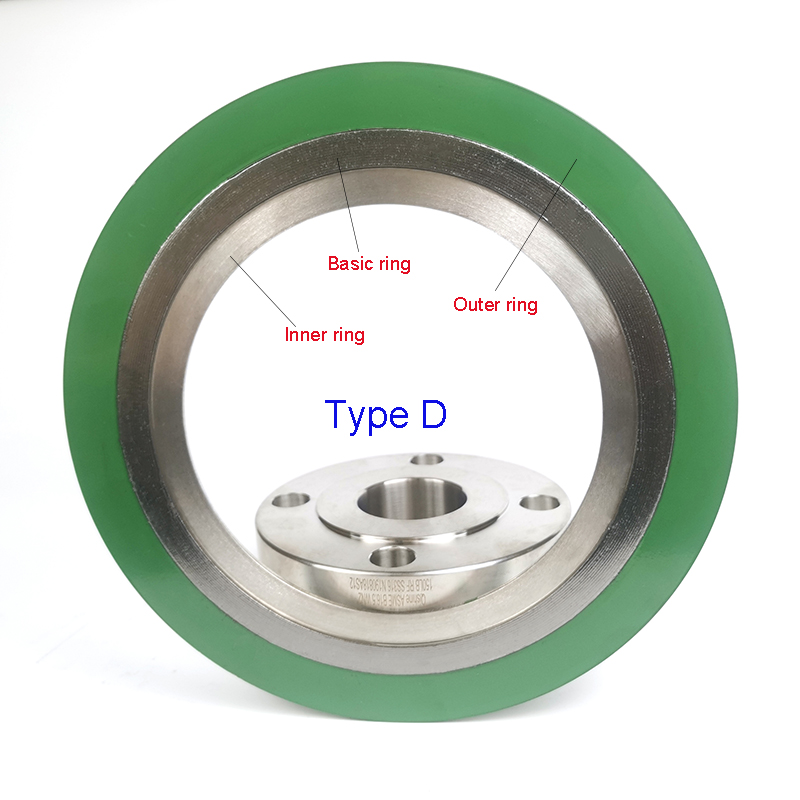


Type D metal spiral wound gaskets include Basic Ring, Outer Ring and Inner Ring
Simply put:
Type C: Features a "centering ring" – a metal ring on the outer circumference, primarily used for installation positioning.
Type C: Features a "centering ring" – a metal ring on the outer circumference, primarily used for installation positioning.
Type D: Features a "reinforcing ring" – a metal ring on the inner circumference, primarily used to enhance pressure-bearing capacity.

The Force acting on the gasket

Type C VS Type D: Applicable to convex Flanges
Below is a detailed comparison from various perspectives:
| Feature | Type C Metal Spiral Wound Gasket | Type D Metal Spiral Wound Gasket |
| Metal Ring Position | Outer reinforcing ring, located on the gasket's outer periphery. | Inner reinforcing ring, located on the gasket's inner periphery (i.e., close to the bolt holes). |
| Core Function of Metal Ring |
1. Centering & Installation: Facilitates alignment during installation, preventing gasket misplacement.
2. Mild Reinforcement: Provides some compression resistance and blow-out protection.
|
1. Mechanical Reinforcement: Significantly increases the gasket's overall strength and compressive resistance, preventing the sealing body from being crushed under high pressure.
2. Compression Limitation: Controls maximum compression to avoid over-compression leading to seal failure.
|
| Primary Application Scenarios |
Medium to low-pressure conditions (common standards like Class 150, 300).
Situations requiring higher installation convenience.
|
Medium to high-pressure and high-temperature/high-pressure conditions (common standards like Class 600, 900, 1500 and above).
Demanding situations requiring high gasket strength and pressure resistance.
|
| Flange Type | Typically used with RF (Raised Face) flanges. The outer ring can fit into the flange edge groove, providing excellent centering. | Primarily used with RJ (Ring Joint/Tongue & Groove) flanges. The inner ring's thickness and shape are designed to match the RJ flange groove, making it the standard configuration for RJ flanges. Also used for high-pressure RF flanges. |
| Pressure Rating | Suitable for relatively lower pressure ratings. | Suitable for higher pressure ratings. |
| Simplified Illustration | Resembles a "plate" – the wound sealing part is the "plate base," and the outer ring is the "plate rim." | Resembles a "picture frame" – the wound sealing part is the "picture," and the inner ring is the "frame border" cling the inner side of the picture. |
Qishine is ideal choice for EPC companies and project contractors.
Website: www.qishine.com
Email: qishine@qishine.com
Tel: 0592-5225595
Email: qishine@qishine.com
Tel: 0592-5225595
WhatsApp: +86 15960259563
+86 15985833169
How to Select the Correct Type?
1. Select Based on Flange and Pressure:
If your flange is an RF Raised Face flange and the pressure rating is not high (e.g., PN16/Class150, PN40/Class300), prioritize Type C for its cost-effectiveness and ease of installation.
If your flange is an RJ Ring Joint flange, you must use Type D; this is the standard pairing.
For high-pressure RF flanges (e.g., PN100/Class600 and above), to ensure sealing stability and pressure resistance, Type D should be selected.
1. Select Based on Flange and Pressure:
If your flange is an RF Raised Face flange and the pressure rating is not high (e.g., PN16/Class150, PN40/Class300), prioritize Type C for its cost-effectiveness and ease of installation.
If your flange is an RJ Ring Joint flange, you must use Type D; this is the standard pairing.
For high-pressure RF flanges (e.g., PN100/Class600 and above), to ensure sealing stability and pressure resistance, Type D should be selected.
|
Basic type/form |
Code |
Applicable flange sealing surface |
Thickness(mm) |
|
|
V-shaped basic ring |
W-shaped basic ring |
|||
|
Basic type |
A or R |
T&G Face/Rearward face/RF/FF/Grooved Face |
3.2,4.5 |
4.8,5.5,7.5 |
|
WIth Inner type |
B or RIR |
T&G Face/Rearward face/RF/FF/Grooved Face |
3.2/2 4.5/3 |
4.8/3.0 5.5/4.0 7.5/5.0 |
|
With Positioning ring type |
C or CG |
RF/FF |
||
|
With Inner ring and Positioning ring type |
D or CGI |
RF/FF |
||
2. Role of Inner/Outer Rings During Installation?
The "outer ring" of Type C acts like an "installation guide," focusing on helping workers install the gasket correctly and quickly.
The "inner ring" of Type D acts like "reinforcing steel," focusing on providing strong support for the soft sealing filler material (graphite, PTFE, etc.), preventing it from being extruded into the pipeline or crushed under high temperature and pressure.
The "outer ring" of Type C acts like an "installation guide," focusing on helping workers install the gasket correctly and quickly.
The "inner ring" of Type D acts like "reinforcing steel," focusing on providing strong support for the soft sealing filler material (graphite, PTFE, etc.), preventing it from being extruded into the pipeline or crushed under high temperature and pressure.
3. A Quick Way to Remember:
Simple mnemonic: Outer ring (Type C) for easy installation, Inner ring (Type D) to withstand high pressure. RJ flanges must use Type D.
Simple mnemonic: Outer ring (Type C) for easy installation, Inner ring (Type D) to withstand high pressure. RJ flanges must use Type D.


Next time, we'll talk about the different colors of the wrapped gaskets.
Gasket Color Code Secrets: What Yellow and Green Really Mean for Your Piping
What is the difference between Type A and Type B spiral wound gaskets
Related Article

Insights from a Case Study on Exporting B8M Fasteners.Recently, during our final outgoing inspection of a batch of B8M stainless steel fasteners destined for Portugal, we discovered varying degrees of burrs on the edges of the bolt hex heads.
How to Efficiently Remove Burrs from Bolt Edges

Insulating Gasket Procurement Pitfalls: From "Price Traps" to "Supplier Selection"
What pitfalls should you watch out for when purchasing insulating gaskets

As a classic modified PTFE gasket material from Garlock, Gylon 3500 is widely used in petrochemical, chemical, and other industries for its excellent resistance to strong acids, solvents, and anti-creep properties.
How to Buy Genuine Gylon 3500 Insulating Gaskets at Competitive Prices in China

