
What is the difference between Type A and Type B spiral wound gaskets

Type A and Type B are the two ring builds buyers meet most often when specifying spiral wound gaskets, and the difference is not cosmetic: the ring configuration decides which flange facing the gasket can seal. Type A is the ringless basic build for tongue-and-groove flanges, while Type B adds a spot-welded inner ring for male-and-female flanges, so the flange facing, not the pressure class alone, settles the choice.
What the Two Types Are Made Of
Both types use the same sealing element: a V-shaped metal strip, stainless steel in most builds, wound together with a non-metallic filler strip such as flexible graphite. The difference sits around that winding. Type A carries no rings at all, and Type B adds one metal inner ring.
| Feature | Type A | Type B |
|---|---|---|
| Winding | Metal strip with non-metallic filler | Metal strip with non-metallic filler |
| Inner ring | None | Metal ring, spot welded to the winding |
| Outer ring | None | None |
| Flange facing | Tongue-and-groove (TG) | Male-and-female (MFM) |
| Cost and tolerance | Lower cost, depends on groove accuracy | Slightly higher, tolerates vibration and uneven bolt load |
Table 1. Type A and Type B spiral wound gasket builds compared.
The inner ring of Type B is normally the same metal as the winding strip, so the assembly stays metallurgically consistent across the joint.

Type A spiral wound gasket: winding only, no inner or outer ring.
Which Flange Facing Takes Which Type
Type A seats in the groove of a tongue-and-groove joint: the groove centres the gasket and takes the blowout load, so the gasket needs no rings of its own. Type B is built for male-and-female joints, where its inner ring drops into the recess and holds the winding centred. Both facings are machined into pipe flanges, and a gasket built for one facing will not seat on the other.
- Tongue-and-groove (TG) facing — fit Type A. The groove positions the gasket and stops it shifting under pressure.
- Male-and-female (MFM) facing — fit Type B. The inner ring locates the gasket in the recess and limits extrusion of the winding.
- Raised face (RF) or flat face (FF) — neither type; those facings call for a gasket with an outer centre ring.
How Each Type Behaves in Service
The ring choice changes how the joint responds to bolt load, vibration and the process medium.
- Type B inner ring — resists corrosion from the medium and mechanical impact, and prevents the winding from over-compressing when bolt load is uneven or the line vibrates.
- Type A — the simplest and least expensive build, but it depends on groove precision; a gasket that is not centred in the groove can move during assembly.
- Bolting — seat the gasket centrally and tighten the bolts in a cross pattern over several passes so the winding compresses evenly.
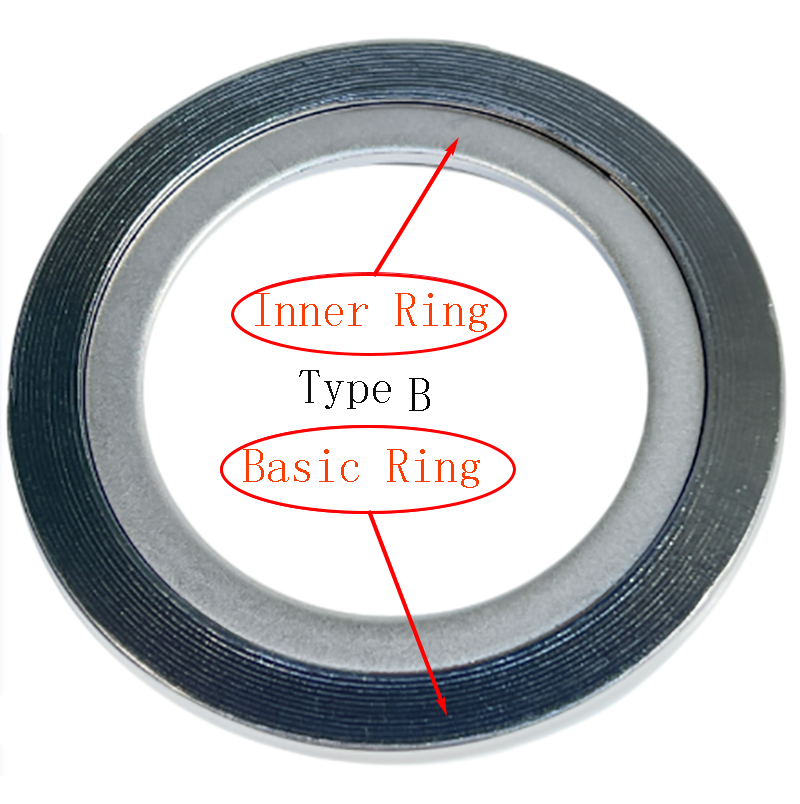
Type B spiral wound gasket: winding and inner ring.
FAQ
Can Type A and Type B spiral wound gaskets be used on the same flange?
No. Type A is a ringless gasket that seats in the groove of a tongue-and-groove facing, while Type B carries an inner ring that needs the recess of a male-and-female facing. Fitted to a tongue-and-groove flange, the inner ring has nowhere to sit and the joint will not seal.
How do I choose between Type A and Type B?
Start from the flange facing: tongue-and-groove calls for Type A, male-and-female calls for Type B. Where the line sees vibration or uneven bolt load, Type B is the better build, because the inner ring keeps the winding centred and limits over-compression.
What are the winding and the filler made of?
The winding is a V-shaped metal strip, most often stainless steel, and the filler is a non-metallic strip such as flexible graphite. The inner ring of Type B is normally the same metal as the winding strip.
How should these gaskets be bolted up?
Seat the gasket centrally in the groove or recess, bring the flanges together evenly, and tighten the bolts in a cross pattern over several passes. Even bolt load matters more than high torque: over-compression crushes the winding and shortens gasket life.
What is the difference between Type C and Type D metal spiral wound gaskets
Understanding ASME ANSI B16.5 Flange Types-A Quick Technical Guide
Related Article


