
What is the difference between Allen bolt and hex bolts
author: www.qishine.com
2026-03-12
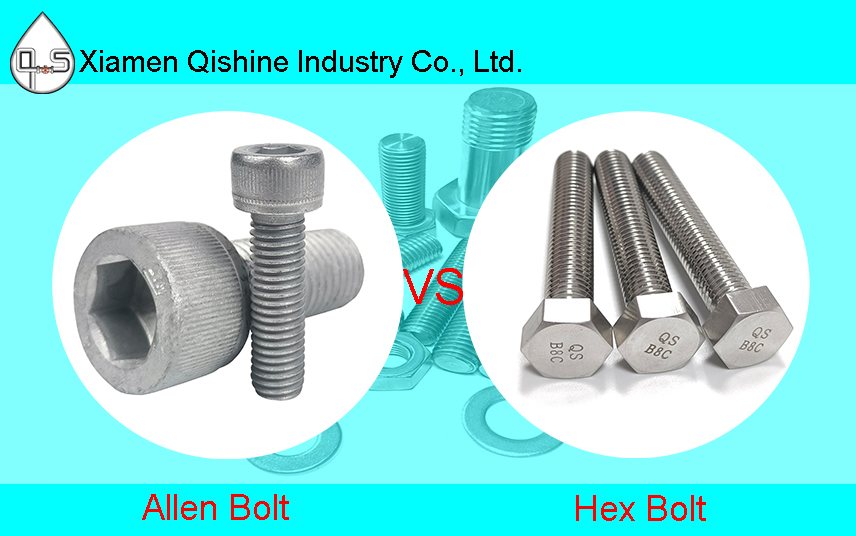
Fastener Duo: Socket Head Cap Screws vs. Hex Head Bolts.
In the world of mechanical design and engineering assembly, fasteners play a crucial role as the "joints." Among them, Socket Head Cap Screws (often referred to as Allen bolts) and Hex Head Bolts (commonly known as Hex bolts) are two of the most frequently used threaded fasteners. Due to their unique structural characteristics and performance advantages, they are widely applied across various industries. As a supplier long engaged with these "industrial grains," Qishine will compare these two types of bolts from multiple aspects, including appearance features, mechanical properties, production processes, typical applications, and selection considerations.
In the world of mechanical design and engineering assembly, fasteners play a crucial role as the "joints." Among them, Socket Head Cap Screws (often referred to as Allen bolts) and Hex Head Bolts (commonly known as Hex bolts) are two of the most frequently used threaded fasteners. Due to their unique structural characteristics and performance advantages, they are widely applied across various industries. As a supplier long engaged with these "industrial grains," Qishine will compare these two types of bolts from multiple aspects, including appearance features, mechanical properties, production processes, typical applications, and selection considerations.
I. Appearance Structure and Driving Method
The most intuitive difference between the two bolts lies in their head structure and the corresponding driving tools.
The most intuitive difference between the two bolts lies in their head structure and the corresponding driving tools.
Socket Head Cap Screw: Its head is cylindrical, with a precision-machined hexagonal recess in the center of the top surface. This design necessitates the use of a matching hex key (also known as an Allen key) or a hex-shaped pneumatic/electric bit for installation and removal. The driving force is transmitted through the contact surface between the key and the walls of the recess. This recessed driving method allows the bolt head to be completely countersunk into a counterbored hole in the mating part, achieving a flush mounting surface. This provides a neat appearance and, in streamlined designs, effectively reduces wind resistance and the risk of snagging.

Allen bolt and allen key
Hex Head Bolt: Its head is a protruding regular hexagon, representing a very classic and traditional design. It is driven by engaging the external hex head with standard open-end wrenches, combination wrenches, socket wrenches, or adjustable wrenches. The driving force acts directly on the six sides of the bolt head. This exposed design offers a large tool engagement area and reliable contact, especially in situations requiring high torque application. The hex head provides a more secure grip and is less prone to "cam-out" (the disengagement of the tool from the fastener).

Hex Bolt: can withstand relatively large torque
II. Mechanical Properties and Installation
These design differences directly determine their distinct characteristics in terms of mechanical properties and ease of installation.
These design differences directly determine their distinct characteristics in terms of mechanical properties and ease of installation.
Advantages of the Socket Head Cap Screw:
1. High Torque Transmission Efficiency: The hexagonal recess design allows for surface contact between the key and the recess walls. Compared to other internal driving methods (like Phillips or slotted drives), it can transmit higher torque, enabling more secure tightening.
1. High Torque Transmission Efficiency: The hexagonal recess design allows for surface contact between the key and the recess walls. Compared to other internal driving methods (like Phillips or slotted drives), it can transmit higher torque, enabling more secure tightening.
2. Good Space Adaptability: The cylindrical head design makes it ideal for use in confined spaces where traditional wrenches cannot swing. An L-shaped hex key can easily operate in tight areas.
3. Aesthetics and Safety: The countersunk installation is not only visually appealing but also prevents the protruding bolt head from snagging on clothing, wires, or moving parts, enhancing equipment safety.
4. Tamper-Resistance: In applications where disassembly by unauthorized personnel needs to be prevented, using non-standard sizes or recesses with special features (e.g., pins, slots) can provide a degree of tamper resistance.
Advantages of the Hex Head Bolt:
1. Versatility and Convenience: This is its greatest strength. The mating wrenches are among the most common and popular tools globally, found in almost any maintenance situation. This significantly lowers the barrier for installation and maintenance.
1. Versatility and Convenience: This is its greatest strength. The mating wrenches are among the most common and popular tools globally, found in almost any maintenance situation. This significantly lowers the barrier for installation and maintenance.
2. Excellent Load-Bearing Capacity: The larger head size and external load-bearing surfaces enable it to withstand extremely high preload forces. In applications requiring high strength and reliable connections, such as bridges and heavy machinery, hex head bolts are the preferred choice.
3. Ease of Applying High Torque: When used with a long-handled wrench or a socket wrench with a cheater bar, operators can easily apply substantial tightening torque, which is critical for large-diameter, high-strength bolt connections.
4. Fatigue Resistance: For the same specification and material grade, the fillet radius (transition radius) between the head and the shank can be designed larger. This reduces stress concentration, thereby improving the bolt's fatigue life under cyclic loading.
Qishine is ideal choice for EPC companies and project contractors.
Website: www.qishine.com
Email: qishine@qishine.com
Tel: 0592-5225595
WhatsApp: +86 15960259563
+86 15985833169
Website: www.qishine.com
Email: qishine@qishine.com
Tel: 0592-5225595
WhatsApp: +86 15960259563
+86 15985833169
III. Production Process
Forming: Both types are now commonly formed in one step using cold heading (cold extrusion). This process offers high material utilization, intact grain flow, and superior mechanical properties. For large sizes or bolts with special requirements, hot forging or machining is used.
Forming: Both types are now commonly formed in one step using cold heading (cold extrusion). This process offers high material utilization, intact grain flow, and superior mechanical properties. For large sizes or bolts with special requirements, hot forging or machining is used.
Threading: Small-diameter bolts typically use thread rolling (flat dies), while larger ones use cylindrical die rolling. Both are cold working plastic deformation processes that enhance thread strength and surface finish.
Key Difference: After head formation, socket head cap screws require an additional process of punching the hexagon recess. This step demands extremely high precision in tooling and high equipment stability, directly impacting the smoothness of key insertion and the reliability of torque transmission. For hex head bolts, the external hex shape is formed directly by the die during cold heading; subsequent processes mainly involve necessary surface treatments.
Key Difference: After head formation, socket head cap screws require an additional process of punching the hexagon recess. This step demands extremely high precision in tooling and high equipment stability, directly impacting the smoothness of key insertion and the reliability of torque transmission. For hex head bolts, the external hex shape is formed directly by the die during cold heading; subsequent processes mainly involve necessary surface treatments.
Both types can be manufactured from various grades of carbon steel (e.g., 40Cr, 35CrMo, 45# steel for grades like 10.9, 8.8), alloy steel, stainless steel (e.g., 304, 316), as well as specialized materials like titanium alloy and brass. Material selection depends entirely on the application's requirements for strength, corrosion resistance, temperature resistance, etc.
IV. Application Scenarios
Their application fields overlap but also have distinct focuses.
Their application fields overlap but also have distinct focuses.
Applications of Socket Head Cap Screws:
Precision Machinery and Instruments: Such as CNC machine tools, robots, and automation equipment, requiring compactness, aesthetics, and high-precision connections.
Precision Machinery and Instruments: Such as CNC machine tools, robots, and automation equipment, requiring compactness, aesthetics, and high-precision connections.
Automotive Industry: Widely used in engines, transmissions, chassis, and suspensions – areas with confined space and complex loads.
Aerospace and Bicycles: Fields pursuing lightweight construction, high strength, and aerodynamic design.
Applications of Hex Head Bolts:
Construction and Steel Structures: For connecting steel beams and columns, securing large structures like tower cranes and bridges; they are core components bearing gravitational loads.
Construction and Steel Structures: For connecting steel beams and columns, securing large structures like tower cranes and bridges; they are core components bearing gravitational loads.
Heavy Machinery and Mining Equipment: Such as crushers, excavators, and presses, needing to withstand significant vibration and impact loads.
Infrastructure: Including pipe flange connections, railway track fastening, and wind turbine tower assembly.
General Industrial Maintenance: Due to their versatility, they are essential standard parts in factory maintenance toolkits and construction sites.
General Industrial Maintenance: Due to their versatility, they are essential standard parts in factory maintenance toolkits and construction sites.
Conclusion
Socket head cap screws and hex head bolts are like two masters in the fastener family. One is known for its internal, compact design and adaptability; the other is recognized for its external, reliable nature and excellent load-bearing capacity. The choice between them is not simply a matter of one being superior to the other, but rather selecting the optimized solution for different application scenarios. Understanding their structural characteristics, mechanical principles, and application boundaries is a fundamental skill for every mechanical engineer and assembly technician. It is also key to ensuring reliable product design and convenient maintenance. In practical engineering, only by adapting to the specific situation can these small fasteners realize their maximum value.
Socket head cap screws and hex head bolts are like two masters in the fastener family. One is known for its internal, compact design and adaptability; the other is recognized for its external, reliable nature and excellent load-bearing capacity. The choice between them is not simply a matter of one being superior to the other, but rather selecting the optimized solution for different application scenarios. Understanding their structural characteristics, mechanical principles, and application boundaries is a fundamental skill for every mechanical engineer and assembly technician. It is also key to ensuring reliable product design and convenient maintenance. In practical engineering, only by adapting to the specific situation can these small fasteners realize their maximum value.
Website: www.qishine.com
Email: qishine@qishine.com
Tel: 0592-5225595
WhatsApp: +86 15960259563
+86 15985833169
The Difference Between Chrome-Plated and Zinc-Plated Fasteners
How Many Main Categories Are Gaskets Divided Into
Related Article

Insights from a Case Study on Exporting B8M Fasteners.Recently, during our final outgoing inspection of a batch of B8M stainless steel fasteners destined for Portugal, we discovered varying degrees of burrs on the edges of the bolt hex heads.
How to Efficiently Remove Burrs from Bolt Edges

Insulating Gasket Procurement Pitfalls: From "Price Traps" to "Supplier Selection"
What pitfalls should you watch out for when purchasing insulating gaskets

As a classic modified PTFE gasket material from Garlock, Gylon 3500 is widely used in petrochemical, chemical, and other industries for its excellent resistance to strong acids, solvents, and anti-creep properties.
How to Buy Genuine Gylon 3500 Insulating Gaskets at Competitive Prices in China

