
What is a Weld Neck Flange
author: www.qishine.com
2026-04-05

As a critical connecting component in piping systems, the weld neck flange is widely used in high-pressure, high-temperature, and demanding industrial applications due to its excellent mechanical properties and reliable sealing capabilities. The following explanation provides a systematic, professional overview from three aspects: product appearance, installation and connection methods, and application environments.
I. Product Appearance
The weld neck flange features a distinctive "tapered neck" structure and is generally disc-shaped. Its geometric configuration consists of several key parts:
The weld neck flange features a distinctive "tapered neck" structure and is generally disc-shaped. Its geometric configuration consists of several key parts:
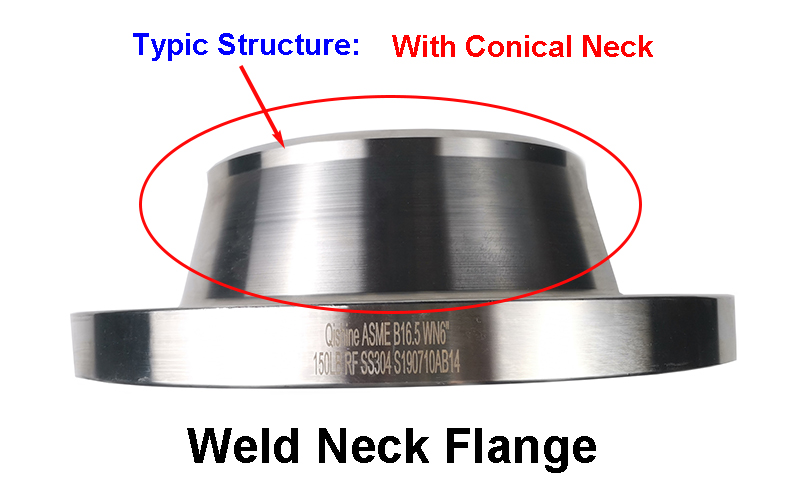
Weld Neck Flange: With Conical Neck
1. Flange Body: The outer ring forms the disc-shaped base, with uniformly distributed bolt holes for tightening with a mating flange using bolts.
2. Tapered Neck: This is the most notable feature distinguishing the weld neck flange from other types (such as slip-on or lap joint flanges). The neck has a gradually tapering transition, with wall thickness uniformly decreasing from the flange ring towards the pipe connection end, where the wall thickness typically matches that of the pipe. This design effectively disperses concentrated stress at the flange-pipe junction, provides high structural rigidity, and significantly reduces stress levels under bending moments.
3. Sealing Face: Located on the upper face of the flange bore, common types include Raised Face (RF), Male & Female Face (MFM), Tongue & Groove Face (TG), and Ring Type Joint (RTJ), selected based on the medium and pressure rating.
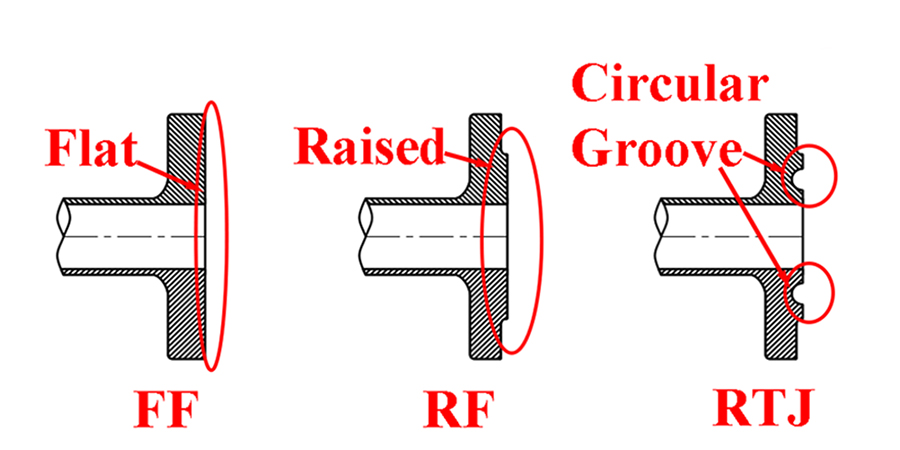
Types of Sealing Face: Flat, Raised, Circular Groove
4. Butt Weld Bevel: The end of the flange neck is machined with a bevel (typically V-shaped or U-shaped) matching the pipe's outer diameter, designed for full-penetration butt welding to the pipe.
Common materials include carbon steel (e.g., A105), stainless steel (e.g., F304/F316), and alloy steel (e.g., F11/F22), chosen to meet specific requirements for corrosion resistance, temperature tolerance, and strength.
II. Installation Method and Pipe Connection
The connection between a weld neck flange and a pipe utilizes butt welding, which is central to its superior structural strength compared to other flanges. Key installation procedures and technical points are as follows:
The connection between a weld neck flange and a pipe utilizes butt welding, which is central to its superior structural strength compared to other flanges. Key installation procedures and technical points are as follows:
1. Alignment and Positioning: Before installation, ensure precise alignment between the pipe end and the flange neck bevel. Internal or external diameter alignment methods are typically used to ensure the pipe's inner diameter is flush with the flange's inner bore, preventing internal steps that could cause media turbulence or corrosion accumulation. During alignment, use a try square to check the perpendicularity between the flange sealing face and the pipe axis; deviations must be controlled within allowable limits.
2. Welding Process: The weld neck flange is joined to the pipe using full-penetration butt welding. Multi-pass welding techniques are commonly employed, strictly following the qualified Procedure Qualification Record (PQR). Compared to slip-on flanges (which use fillet welds), the weld root of a weld neck flange achieves complete penetration, and because the neck thickness closely matches the pipe wall, the weld area experiences uniform stress without abrupt cross-section changes.

Positioning and Welding: Use full penetration butt welding
3. Post-Weld Heat Treatment and Non-Destructive Examination: For alloy steel or thick-walled pipes, Post-Weld Heat Treatment (PWHT) is often required after welding, based on the material, to relieve residual stresses. Subsequently, Radiographic Testing (RT) or Ultrasonic Testing (UT) is typically performed on the weld to ensure it is free from internal defects like cracks or lack of fusion.
4. Tightening and Sealing: When connecting to the mating flange, use specified grades of bolts and gaskets. Employ a torque wrench to tighten bolts gradually in a star pattern and in multiple stages to ensure uniform compression of the sealing face, guaranteeing a leak-free piping system.
Connection Characteristics: As the weld quality is equivalent to the base material and the tapered neck provides flexibility, this connection method offers high fatigue resistance when subjected to thermal expansion, pressure pulsations, and external piping loads.
Qishine is ideal choice for EPC companies and project contractors.
Website: www.qishine.com
Email: qishine@qishine.com
Tel: 0592-5225595
WhatsApp: +86 15960259563
+86 15985833169
Website: www.qishine.com
Email: qishine@qishine.com
Tel: 0592-5225595
WhatsApp: +86 15960259563
+86 15985833169
III. Application Environments
Weld neck flanges are primarily used in demanding industrial piping systems. Their superior mechanical performance makes them the specified choice for the following scenarios:
1. High-Temperature and High-Pressure Environments: In applications such as petroleum refining, catalytic cracking, hydroprocessing units, and main steam lines in thermal power plants, media temperatures often exceed 400°C (752°F) and pressures reach Class 900 (15.0 MPa) or even Class 2500 (42.0 MPa) and above. The smooth transition of the tapered neck allows the weld neck flange to effectively withstand thermal expansion stresses at high temperatures, preventing joint leakage caused by thermal gradients.
Weld neck flanges are primarily used in demanding industrial piping systems. Their superior mechanical performance makes them the specified choice for the following scenarios:
1. High-Temperature and High-Pressure Environments: In applications such as petroleum refining, catalytic cracking, hydroprocessing units, and main steam lines in thermal power plants, media temperatures often exceed 400°C (752°F) and pressures reach Class 900 (15.0 MPa) or even Class 2500 (42.0 MPa) and above. The smooth transition of the tapered neck allows the weld neck flange to effectively withstand thermal expansion stresses at high temperatures, preventing joint leakage caused by thermal gradients.
2. Highly Toxic, Flammable, or Explosive Media: In chemical and natural gas transmission systems handling hazardous media (such as hydrogen sulfide, hydrogen, toluene, etc.), the weld neck flange connection uses a "leak-proof" butt weld. This inherently reduces potential leak paths (the only remaining potential leak point is the gasketed sealing face, not the weld itself), significantly enhancing system safety. This is particularly critical for RTJ (Ring Type Joint) weld neck flanges, whose metal gasket design ensures tight sealing even under extreme pressure fluctuations.
3. Piping Subjected to Complex External Loads: At the nozzles of dynamic equipment like pumps, compressors, and large valves, or in locations like offshore platforms subjected to wind and wave loads, piping systems experience significant vibration, bending moments, and axial tensile forces. The integral structural strength of the weld neck flange effectively distributes these loads to the pipe, preventing root fractures or seal failure.
4. Low-Temperature and Cryogenic Environments: In cryogenic applications such as Liquefied Natural Gas (LNG) and air separation units (operating down to -196°C / -321°F), weld neck flanges are typically manufactured from austenitic stainless steel or low-temperature carbon steel. Their tapered neck design effectively reduces stress concentration caused by cryogenic contraction, preventing low-temperature brittle fracture.
IV. Conclusion
In summary, the weld neck flange holds an irreplaceable position in piping engineering due to its unique tapered neck configuration and full-penetration butt-weld connection method. Although its manufacturing cost and installation requirements are higher than those of standard slip-on or lap joint flanges, the structural integrity, fatigue resistance, and sealing reliability it provides make it the preferred choice for ensuring long-term, safe, and stable operation of piping systems in applications involving high temperature, high pressure, hazardous media, or critical equipment connections. During engineering design and selection, it is recommended to comprehensively consider operating parameters, safety requirements, and life-cycle costs, prioritizing weld neck flange products that comply with standards such as ASME B16.5, ASME B16.47, or GB/T 9124.
In summary, the weld neck flange holds an irreplaceable position in piping engineering due to its unique tapered neck configuration and full-penetration butt-weld connection method. Although its manufacturing cost and installation requirements are higher than those of standard slip-on or lap joint flanges, the structural integrity, fatigue resistance, and sealing reliability it provides make it the preferred choice for ensuring long-term, safe, and stable operation of piping systems in applications involving high temperature, high pressure, hazardous media, or critical equipment connections. During engineering design and selection, it is recommended to comprehensively consider operating parameters, safety requirements, and life-cycle costs, prioritizing weld neck flange products that comply with standards such as ASME B16.5, ASME B16.47, or GB/T 9124.
What is an RTJ flange
What is a High-Strength Bolt
Related Article

Insights from a Case Study on Exporting B8M Fasteners.Recently, during our final outgoing inspection of a batch of B8M stainless steel fasteners destined for Portugal, we discovered varying degrees of burrs on the edges of the bolt hex heads.
How to Efficiently Remove Burrs from Bolt Edges

Insulating Gasket Procurement Pitfalls: From "Price Traps" to "Supplier Selection"
What pitfalls should you watch out for when purchasing insulating gaskets

As a classic modified PTFE gasket material from Garlock, Gylon 3500 is widely used in petrochemical, chemical, and other industries for its excellent resistance to strong acids, solvents, and anti-creep properties.
How to Buy Genuine Gylon 3500 Insulating Gaskets at Competitive Prices in China

