
What Is a Washer - A Complete Guide to Types Materials and Applications
author: www.qihsine.com
2026-03-09

The Core Guide to Washer Selection: A Detailed Look at 6 Common Types
Introduction: The Underrated Critical Component
In the field of mechanical assembly, the most headache-inducing problems are often not the design of large components, but the selection errors of seemingly insignificant small parts. I have personally witnessed equipment worth hundreds of thousands malfunction due to the wrong washer choice, experiencing a chain reaction of bolt loosening and increased vibration after just two weeks of operation. This small component—the washer—is like the "silent guardian" of the mechanical world. Though inconspicuous, it carries critical tasks such as distributing pressure, preventing loosening, sealing, and insulating.
Introduction: The Underrated Critical Component
In the field of mechanical assembly, the most headache-inducing problems are often not the design of large components, but the selection errors of seemingly insignificant small parts. I have personally witnessed equipment worth hundreds of thousands malfunction due to the wrong washer choice, experiencing a chain reaction of bolt loosening and increased vibration after just two weeks of operation. This small component—the washer—is like the "silent guardian" of the mechanical world. Though inconspicuous, it carries critical tasks such as distributing pressure, preventing loosening, sealing, and insulating.

Types of Washers: Flat, Fender, Split lock, ExTernal tooth lock, square, Internal tooth lock
Today, I will provide a detailed explanation of six of the most common and crucial washer types to help you make precise decisions in your next selection.
1. The Foundational King: Flat Washer
The flat washer is the most basic and widely used member of the washer family.
The flat washer is the most basic and widely used member of the washer family.
What is it?
Imagine a simple metal (or plastic) ring with a hole in the center and a flat surface—that's a flat washer. It is typically a standard circle with uniform thickness.
Imagine a simple metal (or plastic) ring with a hole in the center and a flat surface—that's a flat washer. It is typically a standard circle with uniform thickness.

Flat Washer
Its Core Function:
Pressure distribution is the flat washer's primary task. When you tighten a bolt, the bolt head generates immense concentrated pressure. Tightening a bolt directly onto wood or plastic can easily create indentations or even cause the material to crack. The flat washer "spreads out" this concentrated pressure by increasing the contact area, much like wearing snowshoes on snow to prevent sinking.
Pressure distribution is the flat washer's primary task. When you tighten a bolt, the bolt head generates immense concentrated pressure. Tightening a bolt directly onto wood or plastic can easily create indentations or even cause the material to crack. The flat washer "spreads out" this concentrated pressure by increasing the contact area, much like wearing snowshoes on snow to prevent sinking.
2. The Locking Expert: Spring Washer
If the flat washer is the "stabilizer," then the spring washer is the "anti-loosening guard."
If the flat washer is the "stabilizer," then the spring washer is the "anti-loosening guard."
What is it?
Spring washers are usually made of spring steel and possess elastic characteristics. The most common split lock washer looks like a ring that has been cut and twisted, forming a helical ramp.
Spring washers are usually made of spring steel and possess elastic characteristics. The most common split lock washer looks like a ring that has been cut and twisted, forming a helical ramp.

Spring Washer
How it Works:
The magic of the spring washer lies in its continuous spring force. When the bolt is tightened, the washer is flattened, but its material properties cause it to constantly try to return to its original shape. This continuous spring force translates into continuous pressure on the bolt, effectively resisting loosening caused by vibration.
The magic of the spring washer lies in its continuous spring force. When the bolt is tightened, the washer is flattened, but its material properties cause it to constantly try to return to its original shape. This continuous spring force translates into continuous pressure on the bolt, effectively resisting loosening caused by vibration.
Imagine pressing down on a spring—your hand needs continuous force to keep it compressed. Similarly, vibration finds it difficult to "overcome" the spring washer's constant rebounding force, so the bolt stays tight.
3. The Custom Solution: Non-Standard Flat Washer
When standard flat washers don't meet the need, the non-standard flat washer takes the stage.
When standard flat washers don't meet the need, the non-standard flat washer takes the stage.
What is it?
Any flat washer with dimensions, shape, thickness, or material that does not conform to standard specifications falls into this category. They are custom-made to solve specific engineering problems.
Any flat washer with dimensions, shape, thickness, or material that does not conform to standard specifications falls into this category. They are custom-made to solve specific engineering problems.

Why is it needed?
Special Size Requirements: Your bolt hole might not be a standard size, or you might need a specific outer diameter to match a special interface.
Special Material Requirements: You might need a specific alloy for extreme temperatures (e.g., aerospace applications) or food-grade materials for food processing equipment.
Special Shape Requirements: Sometimes an oval shape, notches for positioning, or other special contours are needed to fit a unique design.
Special Size Requirements: Your bolt hole might not be a standard size, or you might need a specific outer diameter to match a special interface.
Special Material Requirements: You might need a specific alloy for extreme temperatures (e.g., aerospace applications) or food-grade materials for food processing equipment.
Special Shape Requirements: Sometimes an oval shape, notches for positioning, or other special contours are needed to fit a unique design.
4. The Pipe Specialist: Saddle Washer (Pipe Clamp Washer)
This is an "expert-type" washer designed for a specific task.
This is an "expert-type" washer designed for a specific task.
What is it?
A saddle washer looks like half a flat washer, with a flat bottom and a curved, arched top, shaped like a saddle (hence the name).
A saddle washer looks like half a flat washer, with a flat bottom and a curved, arched top, shaped like a saddle (hence the name).

Camber Washer
Its Unique Design Purpose:
This design has one specialized purpose: to securely fasten pipes or cables to a flat surface.
This design has one specialized purpose: to securely fasten pipes or cables to a flat surface.
The curved surface perfectly conforms to the outer curve of the pipe, while the flat bottom sits flush against the mounting surface. When the bolt is tightened, pressure is distributed evenly, securing the pipe while preventing damage to its surface.
5. The Anti-Rotation Pro: Square Flat Washer
The square flat washer is the "non-slip version" of the flat washer.
The square flat washer is the "non-slip version" of the flat washer.
What is it?
It functions the same as a regular round flat washer but is shaped like a square (sometimes a rectangle) with a round center hole.
It functions the same as a regular round flat washer but is shaped like a square (sometimes a rectangle) with a round center hole.


Square Flat Washer
Its Unique Advantage:
The anti-rotation design is the square flat washer's biggest feature. When installing a bolt, a regular round flat washer can sometimes spin with the bolt, especially on well-lubricated or smooth materials. The square washer's corners dig into or catch on the material, preventing itself from rotating, ensuring a smoother installation process.
The anti-rotation design is the square flat washer's biggest feature. When installing a bolt, a regular round flat washer can sometimes spin with the bolt, especially on well-lubricated or smooth materials. The square washer's corners dig into or catch on the material, preventing itself from rotating, ensuring a smoother installation process.
6. The Double Lock: External/Internal Serrated Lock Washer
This is the "advanced version" of lock washers, offering double insurance.
This is the "advanced version" of lock washers, offering double insurance.
What is it?
This washer has sharp serrations on both sides—one side has external teeth (serrations facing the outer edge), and the other has internal teeth (serrations facing the center hole). Some versions even have both external and internal teeth simultaneously.
This washer has sharp serrations on both sides—one side has external teeth (serrations facing the outer edge), and the other has internal teeth (serrations facing the center hole). Some versions even have both external and internal teeth simultaneously.

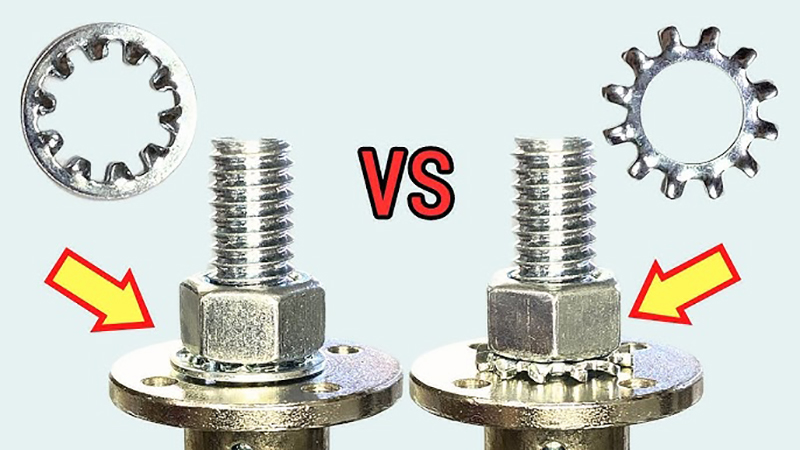
External/Internal Serrated Lock Washer
Its Advanced Working Principle:
A dual biting mechanism makes this washer exceptionally effective:
- The external teeth bite into the surface of the connected part (e.g., metal plate).
- The internal teeth bite into the underside of the bolt head or nut.
A dual biting mechanism makes this washer exceptionally effective:
- The external teeth bite into the surface of the connected part (e.g., metal plate).
- The internal teeth bite into the underside of the bolt head or nut.
This dual bite creates powerful resistance to rotation. Even under severe vibration, the washer's serrations on both sides would need to simultaneously "slip out" of their bitten positions, which is almost impossible.
Quick Selection Reference Chart
| Washer Type | Primary Function | Best Application Scenario | Key Considerations |
| Flat Washer | Distribute pressure, protect surface | General connections, soft material surfaces | Ensure size matches, outer diameter is sufficient |
| Spring Washer | Prevent vibration loosening | Vibrating environments, areas with temperature changes | Provides continuous spring force, not a permanent solution |
| Non-Standard Flat Washer | Meet special requirements | Non-standard dimensions/materials/shapes | Higher cost, longer lead time |
| Saddle Washer | Secure round objects | Pipe, cable fastening | Matching pipe diameter is key |
| Square Flat Washer | Prevent self-rotation | Wood installation, automated assembly | Effectiveness weakens on hard surfaces |
| Serrated Lock Washer | High-strength anti-loosening | High vibration, safety-critical applications | Damages surfaces, difficult to remove |
Conclusion: The Big Wisdom in Small Parts
Choosing the right washer is like selecting the right "shoes" for a mechanical connection—the flat washer is the comfortable everyday shoe, the spring washer is the anti-slip sports shoe, and the serrated lock washer is the professional climbing boot used for rock climbing.
Choosing the right washer is like selecting the right "shoes" for a mechanical connection—the flat washer is the comfortable everyday shoe, the spring washer is the anti-slip sports shoe, and the serrated lock washer is the professional climbing boot used for rock climbing.
Remember this simple principle: First, clarify your primary need (is it anti-loosening, pressure distribution, or securing a specific object?). Then, assess the operating environment (vibration, temperature, corrosiveness). Finally, consider practical constraints (cost, installation convenience, need for disassembly).
Each washer type is designed to solve a specific problem. By understanding their "specialties," you can choose the most suitable "guardian" for each connection point, ensuring your equipment runs more stably, safely, and durably.
The next time you face a box of mixed washers, may this guide help you confidently select the right one, just like an expert.
Qishine is ideal choice for EPC companies and project contractors.
Website: www.qishine.com
Email: qishine@qishine.com
Tel: 0592-5225595
Email: qishine@qishine.com
Tel: 0592-5225595
WhatsApp: +86 15960259563
+86 15985833169
How to Quickly Distinguish Stainless Steel from Carbon Steel Bolts
How to Distinguish Different Types of Nuts
Related Article

Insights from a Case Study on Exporting B8M Fasteners.Recently, during our final outgoing inspection of a batch of B8M stainless steel fasteners destined for Portugal, we discovered varying degrees of burrs on the edges of the bolt hex heads.
How to Efficiently Remove Burrs from Bolt Edges

Insulating Gasket Procurement Pitfalls: From "Price Traps" to "Supplier Selection"
What pitfalls should you watch out for when purchasing insulating gaskets

As a classic modified PTFE gasket material from Garlock, Gylon 3500 is widely used in petrochemical, chemical, and other industries for its excellent resistance to strong acids, solvents, and anti-creep properties.
How to Buy Genuine Gylon 3500 Insulating Gaskets at Competitive Prices in China

