
What is a rolling shutter door

A Diagrammatic Breakdown of Roller Shutter Doors: From "Skeleton" to "Heart"
Though a roller shutter door may appear to be nothing more than a curtain that moves up and down, it plays a vital role in safeguarding modern commercial buildings, industrial facilities, and garages. As the diagram clearly shows, a compliant, safe roller shutter door is far more than just a few pieces of sheet metal bolted together—it is underpinned by a rigorous mechanical support system and an electromechanical drive train.
Though a roller shutter door may appear to be nothing more than a curtain that moves up and down, it plays a vital role in safeguarding modern commercial buildings, industrial facilities, and garages. As the diagram clearly shows, a compliant, safe roller shutter door is far more than just a few pieces of sheet metal bolted together—it is underpinned by a rigorous mechanical support system and an electromechanical drive train.

Rolling Shutter Door Assembly Drawing
I. The Solid "Skeleton": Load-Bearing and Mounting System
Weighing several hundred kilograms, the entire door assembly relies on the end plates (Check Plates) as its core load-bearing components.
Weighing several hundred kilograms, the entire door assembly relies on the end plates (Check Plates) as its core load-bearing components.
- End Plates (both sides): The "brake-side end plate" (left) and "motor-side end plate" (right) in the diagram are not ordinary steel plates; they are high-strength load-bearing plates engineered through stress analysis. During installation, they must be securely anchored to the building's load-bearing walls or concrete columns/beams using an adequate number of expansion bolts or embedded anchors. Only when the end plates' load capacity meets specifications can the shutter operate smoothly without vibration or wobble.
- Flag Posts (Vertical Columns): The vertical "flag posts" shown on both sides—often referred to in engineering as guide rail columns or angle-iron brackets—serve both as extensions supporting the end plates and as fixing bases for the guide rails. In practice, it is essential to ensure the verticality (coplanarity) of these posts; any deviation can impair the smooth travel of the curtain, causing jamming, sticking, or abnormal friction noise during operation.
II. The Powerful "Heart": Power and Transmission System
Looking inside the end plates reveals the door's most critical power zone.
Looking inside the end plates reveals the door's most critical power zone.
- Roller Assembly (Roller Shaft): The entire curtain is wound around a "roller tube"—a thick steel pipe that must maintain exceptional concentricity. Even a slight bend in the roller tube can generate significant centrifugal force at high speeds, leading to door vibration or even motor damage.
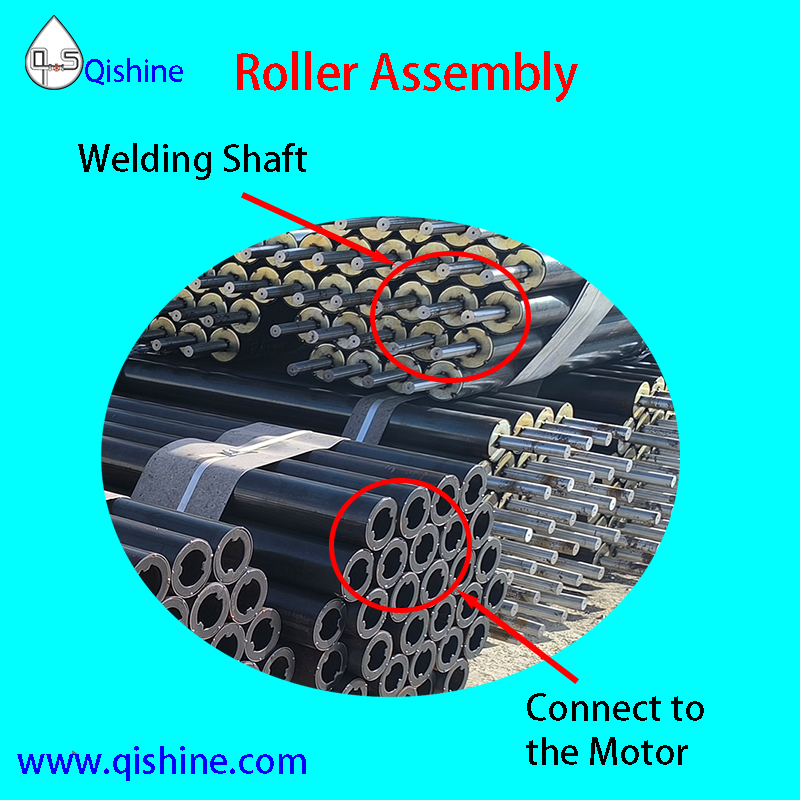
Roller Assembly
- Tubular Motor: Concealed inside the roller tube is the "built-in" tubular motor—the core driving source. It incorporates a built-in travel limit device (noted as "Lath Fixing" in the diagram) for precise control of the fully open and fully closed positions, along with an operating brake to ensure the door stays suspended at any position without slipping under its own weight. Additionally, the manual operation hole reserved at the left end (shown in the diagram) is a crucial feature: in the event of a power outage, users can operate the door manually using a dedicated crank handle to ensure emergency access.
- Safety Brake (Safety Brake): This is the most critical "life-saving" device on the entire door, often overlooked by ordinary users. The "1 Series Brake" shown on the left side is a purely mechanical centrifugal brake. It operates independently of electricity. In extreme situations—such as motor failure, drive gear fracture, or operating brake malfunction—that could cause the shutter to "run away" or plummet, the safety brake instantly engages mechanically, forcibly stopping the door to prevent injury or damage. Important: Once triggered, this safety device typically requires a qualified engineer to manually reset or replace components; do not attempt to unlock it by striking or prying.
III. The Smooth "Musculature": Running and Opening/Closing System
- Guides (Guide Rails): The U-shaped guide rails on both sides act like railway tracks, strictly constraining the curtain's travel path. The clearance (tolerance) design is highly precise: too wide, and the door will rattle and leak air under strong winds (especially critical in high-wind-load environments); too narrow, and friction increases, shortening motor life.
- Guides (Guide Rails): The U-shaped guide rails on both sides act like railway tracks, strictly constraining the curtain's travel path. The clearance (tolerance) design is highly precise: too wide, and the door will rattle and leak air under strong winds (especially critical in high-wind-load environments); too narrow, and friction increases, shortening motor life.
- Curtain (Shutter Slats): The main body consists of aluminum or steel slats rolled and interlocked to form a flexible yet tough "iron curtain." For wide openings, the slats must also incorporate wind-load reinforcement ribs.
- Bottom Rail: The heavy-duty component at the very bottom (shown in the diagram) serves multiple important purposes. On one hand, it acts as a counterweight, allowing the curtain to descend smoothly into the guides; on the other, its T- or L-shaped cross-section enhances bending stiffness. A rubber sealing strip along the bottom ensures a tight fit with the floor, providing protection against wind, water, and pests/rodents.
IV. The Protective "Outer Shell": Guards and Surface Finishing
- Canopy Cover (Hood): Although not shown in the diagram, in actual projects, a top metal hood is usually installed to enclose the exposed roller system at the top. Note that, per safety regulations, when the motor or roller tube is mounted at a height below 2.5 meters, a canopy cover is mandatory to prevent fingers from being caught or entangled. It also provides effective dust and moisture protection.
- Canopy Cover (Hood): Although not shown in the diagram, in actual projects, a top metal hood is usually installed to enclose the exposed roller system at the top. Note that, per safety regulations, when the motor or roller tube is mounted at a height below 2.5 meters, a canopy cover is mandatory to prevent fingers from being caught or entangled. It also provides effective dust and moisture protection.
- Surface Treatment and Coating: Whether made of galvanized steel or aluminum alloy, the components undergo rigorous anti-corrosion treatment before leaving the factory. We commonly use polyester powder coating—this is not simple spray painting, but a process that uses electrostatic attraction to uniformly adhere dry powder particles to the metal surface, followed by high-temperature curing at over 200°C. The resulting coating offers excellent adhesion, scratch resistance, UV resistance, and chemical corrosion resistance—far superior to conventional liquid paints. This ensures that the roller shutter door remains rust-free and colorfast for years outdoors.
Professional Advice for Buyers and Maintenance Personnel:
When purchasing or maintaining a roller shutter door, we—as professional suppliers—offer the following recommendations:
When purchasing or maintaining a roller shutter door, we—as professional suppliers—offer the following recommendations:
- Don't focus solely on price. Pay greater attention to:
- The reliability of end plate anchoring;
- The brand and torque rating of the tubular motor, ensuring it matches the door's specifications; and
- Most critically, whether the safety brake is included as standard equipment and confirmed to be in proper working order.
- The reliability of end plate anchoring;
- The brand and torque rating of the tubular motor, ensuring it matches the door's specifications; and
- Most critically, whether the safety brake is included as standard equipment and confirmed to be in proper working order.
After all, a roller shutter door is not just a barrier—it is a safeguard for the absolute safety of people and vehicles passing through.
Qishine is ideal choice for EPC companies and project contractors.
Website: www.qishine.com
Email: qishine@qishine.com
Tel: 0592-5225595
WhatsApp: +86 15960259563
+86 15985833169
Website: www.qishine.com
Email: qishine@qishine.com
Tel: 0592-5225595
WhatsApp: +86 15960259563
+86 15985833169
5 Hidden Costs of Sourcing Insulating Gasket Kits from China And How to Avoid Them
Difference Between Bolt Thread Rolling and Thread Cutting
Related blog


