
How a 4-Inch Pipe Mix-Up in Argentina Turned into a Full-Payment Order
Customer info — Region/Role: Argentina, company owner (end user).
Product type & name — Product: Rolling door main beam.
Product type & name — Product: Rolling door main beam.
Use: Rolling door (Rolling Door) reel assembly.
One-Minute Overview
An Argentine customer originally wanted 800 steel pipes with an OD of 101.6mm.
An Argentine customer originally wanted 800 steel pipes with an OD of 101.6mm.
He thought the price was too high, but said if we could help weld the fittings, he'd accept it.
We used a "volume for price" approach to bump the order up to 1,600 pipes and threw in welding and anti-rust services.
After we received the fittings, we found they wouldn't fit — the customer thought 4 inches = 101.6mm,
but a real 4-inch pipe is actually 114.3mm. We proactively investigated and corrected the mistake.
In the end, we agreed on 1,500 pipes, spec OD 114.3mm × ID 110mm × 2mm × 3m, shipped in two batches.
The customer paid in full upfront, and we produced, welded, oiled, and shipped on time.
How the Conversation Went
The customer initially came to us with a regular inquiry,
The customer initially came to us with a regular inquiry,
planning to purchase 800 pieces of hot-rolled pipes with an OD of 101.6mm,
wall thickness 2mm, and length 3 meters.
To us, that was a clear spec, so we quoted based on it.
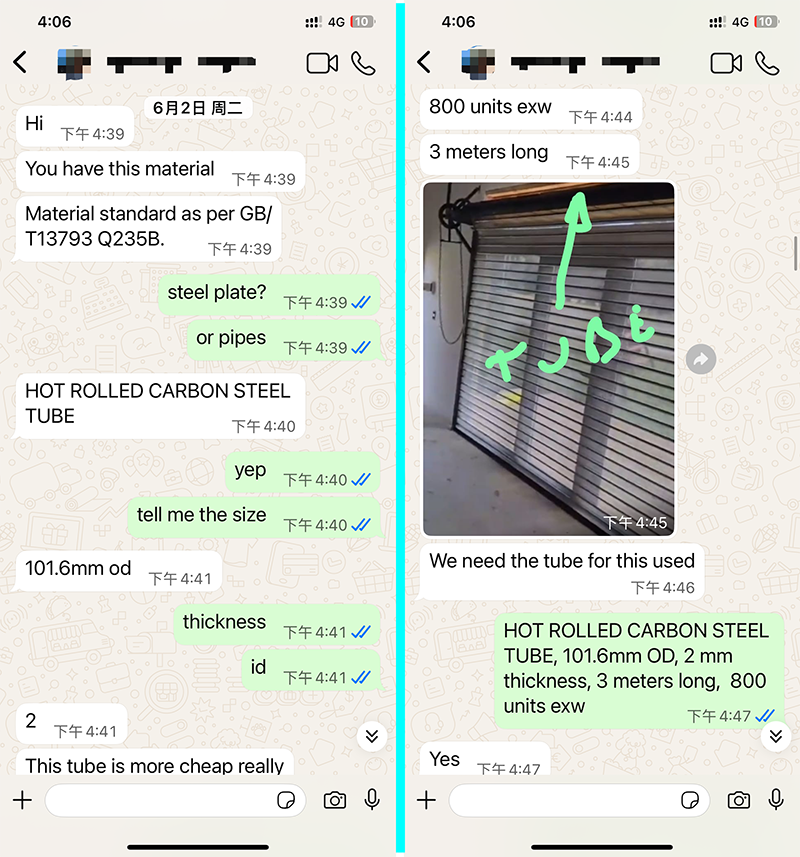
After I sent the quotation, the customer thought the price is higher,
but said they would accept it if we could help weld fittings onto both ends.
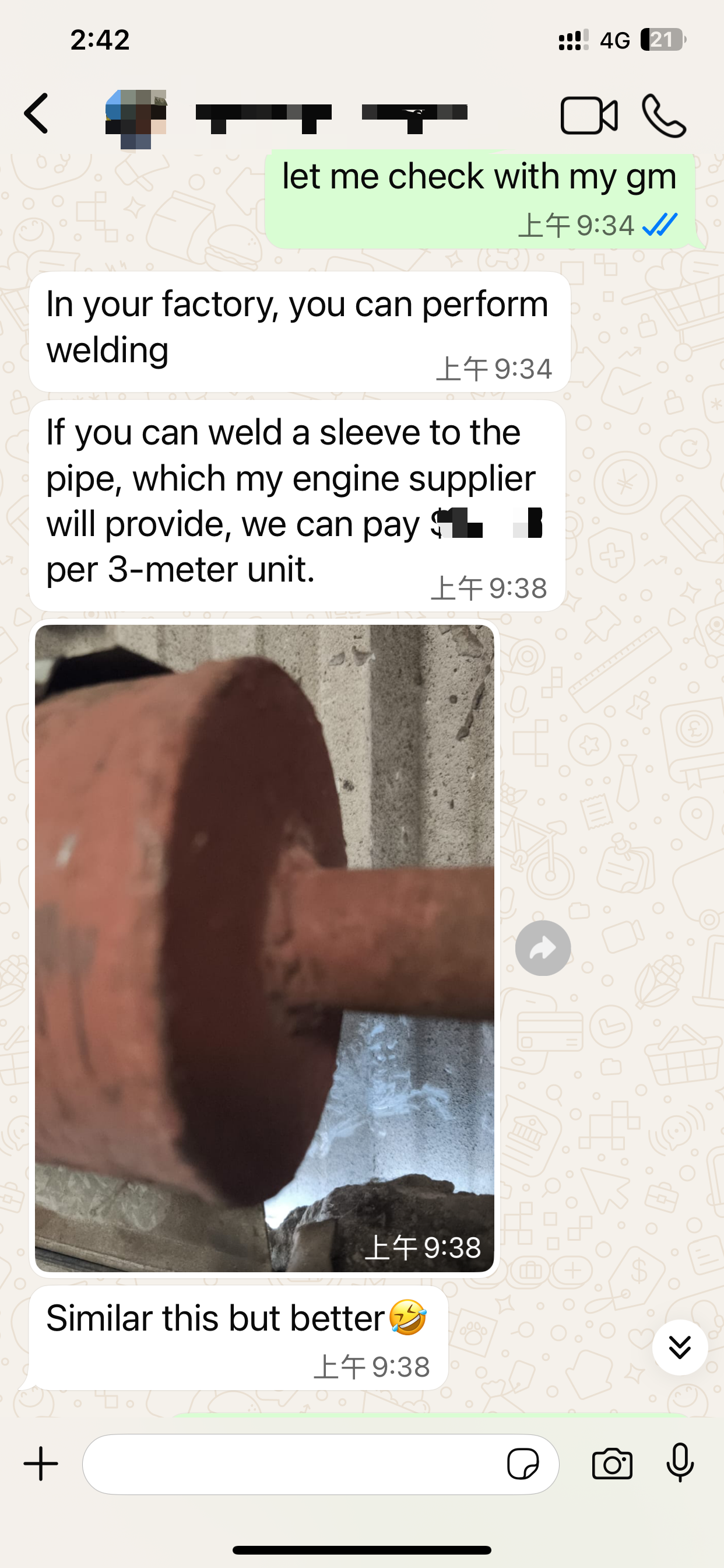
To close the deal and help him save costs,
we proposed a "volume for price" plan: if he increased the order to over 20 tons (about 1,600 pipes),
we'd not only give him a better price but also add welding and anti-rust oil coating as value-added services.
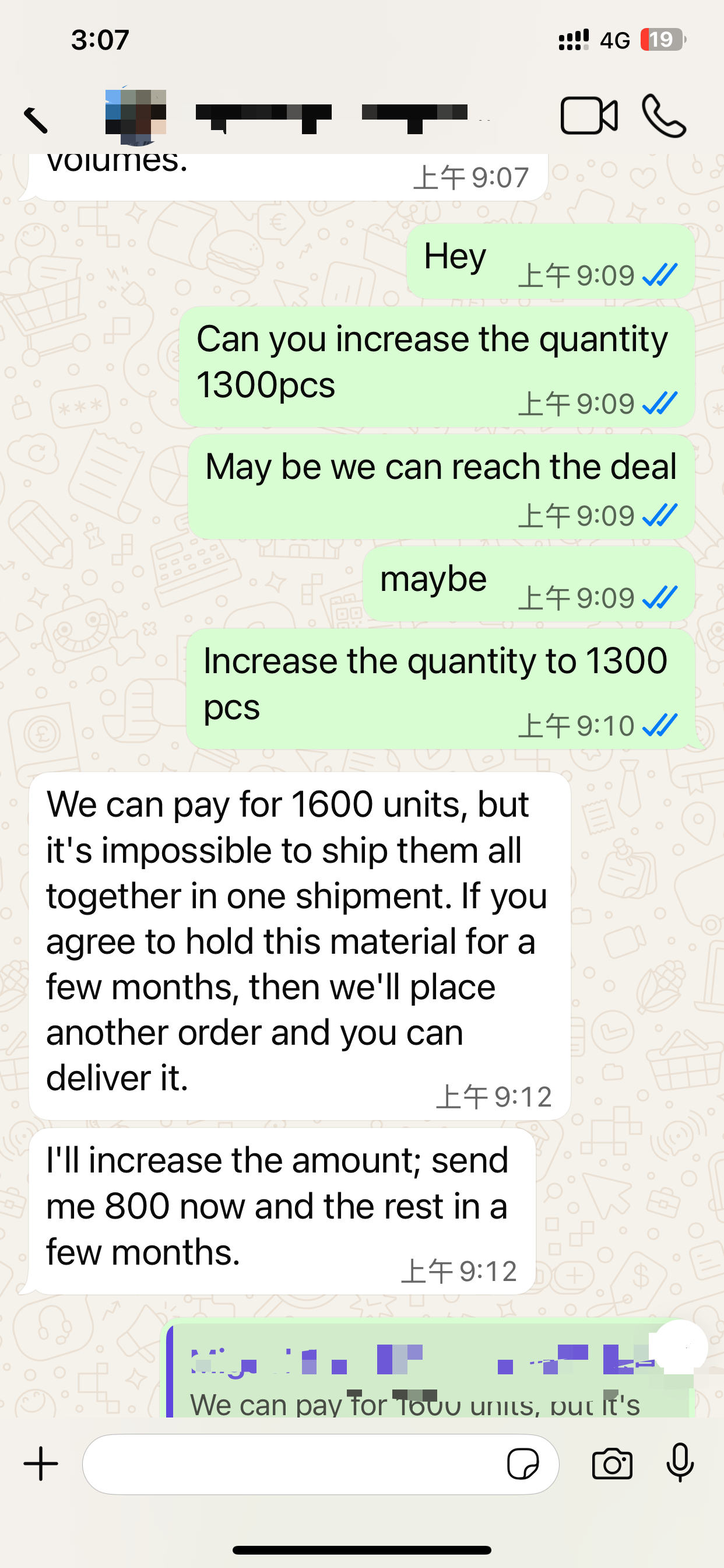
The customer accepted, agreed to pay in full,
and only requested shipment in two batches and asked me to send the PI.

After the contract was signed,
we proactively reached out to the customer's fitting supplier and got samples to test the fit in advance.
But when the fittings (rings) arrived, we measured them and found the OD was 108mm.
That ring was meant for a 114.3mm (4-inch) pipe, while the customer's pipe was 101.6mm OD.
The two could not match at all.
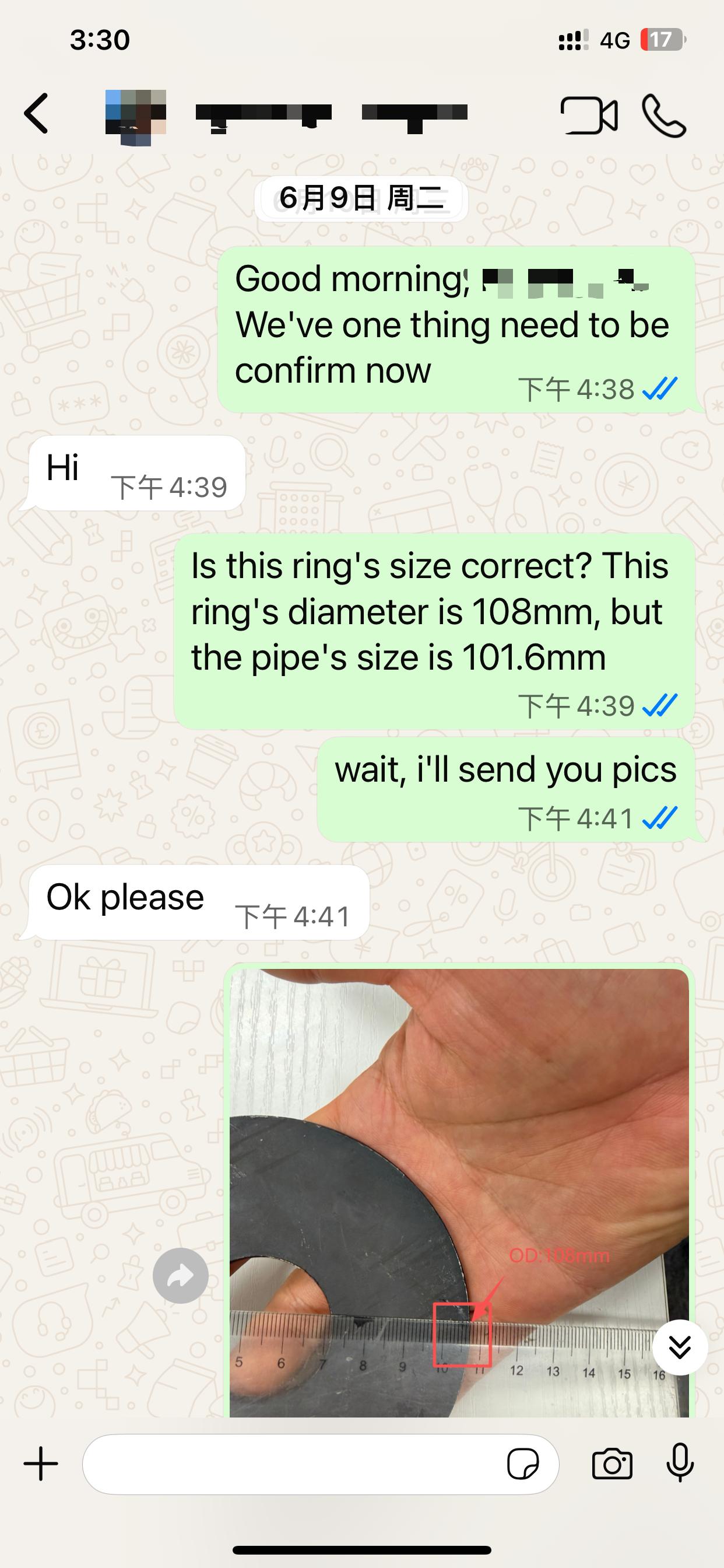
We immediately reported this to the customer.
But he said, "Just weld it on," or suggested using 100mm fittings instead.
However, the supplier didn't have that size.
We then proposed two backup plans: one, we'd only weld part of the fittings and the customer would handle the rest locally;
two, we'd pay out of pocket to turn down the ring's OD.
But the customer rejected both — because the welding was only meant to satisfy a special Argentine regulation about "importing engines."
Once the goods arrived in Argentina, all the welded parts would be removed and redone.
The customer didn't want to spend any extra money.

Seeing the deal stalling, we went back and checked the root cause.
That's when we found the real issue: an imperial-to-metric conversion mistake.
- The customer thought 4 inches = 25.4mm × 4 = 101.6mm.
- The customer thought 4 inches = 25.4mm × 4 = 101.6mm.
So the ring he provided was actually made for the international standard 4-inch pipe (actual OD 114.3mm).
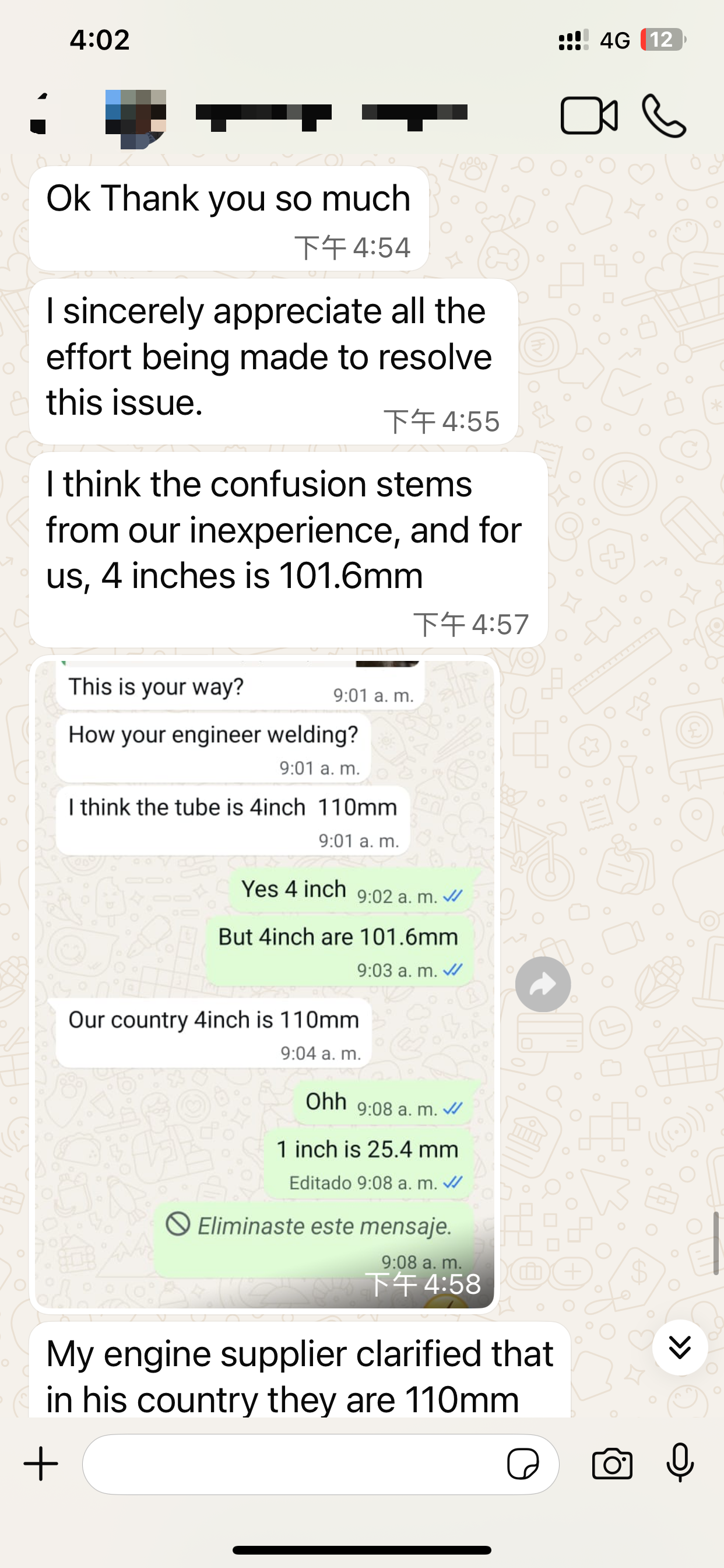
- But in fact, a pipe with an OD of 101.6mm is a 3.5-inch spec.
A true 4-inch pipe has a nominal OD of 114.3mm, according to ASME B36.10.

Once the misunderstanding was cleared up, we negotiated and kept the order value the same:
- Changed the quantity from 1,600 to 1,500 pipes.
- Changed the pipe spec to OD 114.3mm × ID 110mm × 2mm × 3m.
- Shipped in two batches (750 + 750).
- Changed the quantity from 1,600 to 1,500 pipes.
- Changed the pipe spec to OD 114.3mm × ID 110mm × 2mm × 3m.
- Shipped in two batches (750 + 750).

After receiving payment, we immediately bought raw materials and arranged production.
We kept the customer updated and sent a video of the finished welding for confirmation.

Once production was done,
we coated the pipes with anti-rust oil and worked with the customer's designated freight forwarder to load and ship.

Tip: Once steel pipes are welded, they become components — which can also save the customer some tax fees and comply with Argentine import regulations.
Why did the customer choose us?
1. We solved his core pain point — import/export compliance (the most critical part).
The customer didn't really need a beautiful product.
1. We solved his core pain point — import/export compliance (the most critical part).
The customer didn't really need a beautiful product.
He just needed pipes + welded parts to get through customs import policy (which would actually be removed after arrival).
We caught that key need and provided "spot welding" as a value-added service. That sealed the deal.
2. Trust built through professionalism.
When we found the size mismatch, we didn't blindly follow the customer's "just weld it" instruction.
When we found the size mismatch, we didn't blindly follow the customer's "just weld it" instruction.
We professionally pointed out the risk (pipe bending and deformation)
and proactively traced the cause — discovering the fatal gap
between the imperial standard (4 inches = 114.3mm) and the customer's understanding (101.6mm).
That attitude of finding and solving problems made the customer feel we were extremely reliable — even that "you know my product better than I do."
3. Flexible business negotiation (volume for price).
When facing a non-standard size, we used volume to spread the tooling cost — protecting our profit while giving the customer a lower price.
When facing a non-standard size, we used volume to spread the tooling cost — protecting our profit while giving the customer a lower price.
That pushed the order from 800 to 1,600 pipes.
4. Full payment + partial shipment sincerity.
To make the deal happen, the customer accepted full prepayment and partial delivery.
To make the deal happen, the customer accepted full prepayment and partial delivery.
We kept production and the first shipment on schedule, and our trustworthy attitude gave the customer peace of mind.
One-sentence summary:
The customer didn't buy just because the price was low.
The customer didn't buy just because the price was low.
They bought because we not only solved their production problem but also saved them from scrap and customs risks caused by not understanding industry standards.
That kind of "nanny-style" after-sales service is our absolute ace for closing deals.
FAQ
Q1: Is 4 inch pipe 101.6mm or 114.3mm?
A: 4-inch pipe is 114.3mm OD (ASME B36.10). 101.6mm is actually 3.5-inch pipe. This common confusion often causes fitting mismatch.
Q1: Is 4 inch pipe 101.6mm or 114.3mm?
A: 4-inch pipe is 114.3mm OD (ASME B36.10). 101.6mm is actually 3.5-inch pipe. This common confusion often causes fitting mismatch.
Q2: What is the OD of 4-inch steel pipe?
A: The standard outer diameter of a 4-inch steel pipe is 114.3mm (4.5 inches actual OD). 101.6mm is the OD for 3.5-inch pipe.
A: The standard outer diameter of a 4-inch steel pipe is 114.3mm (4.5 inches actual OD). 101.6mm is the OD for 3.5-inch pipe.
Q3: Can you weld fittings onto a steel pipe that is slightly smaller?
A: Yes, but it is risky. Welding a 108mm ring onto a 101.6mm pipe leaves a gap and may cause pipe deformation or weak welds. Correct sizing is always recommended.
A: Yes, but it is risky. Welding a 108mm ring onto a 101.6mm pipe leaves a gap and may cause pipe deformation or weak welds. Correct sizing is always recommended.
Q4: What is the "quantity for price" negotiation in steel pipe trading?
A: It means increasing order quantity (e.g., from 800 to 1600 pipes) to get a lower unit price and extra services like welding or anti-rust oil.
A: It means increasing order quantity (e.g., from 800 to 1600 pipes) to get a lower unit price and extra services like welding or anti-rust oil.
Q5: Why do Argentine importers need welded parts on steel pipes?
A: Some Argentine import regulations require welded components for customs clearance, even if the welding is temporary and removed after import.
A: Some Argentine import regulations require welded components for customs clearance, even if the welding is temporary and removed after import.
Q6: What is the common pipe size confusion between metric and imperial?
A: Many buyers think 4 inches = 101.6mm (25.4 × 4). But standard pipe sizing uses nominal OD, where 4-inch pipe = 114.3mm.
A: Many buyers think 4 inches = 101.6mm (25.4 × 4). But standard pipe sizing uses nominal OD, where 4-inch pipe = 114.3mm.
Q7: How to avoid pipe and fitting mismatch in international trade?
A: Always confirm OD, ID, wall thickness, and standard (e.g., ASME, GB) before production. Send physical samples or 3D drawings for verification.
A: Always confirm OD, ID, wall thickness, and standard (e.g., ASME, GB) before production. Send physical samples or 3D drawings for verification.
Q8: What does "full payment + partial shipment" mean in export?
A: The buyer pays 100% upfront, and the seller ships in multiple batches (e.g., 750 pipes + 750 pipes) to reduce buyer’s storage pressure.
A: The buyer pays 100% upfront, and the seller ships in multiple batches (e.g., 750 pipes + 750 pipes) to reduce buyer’s storage pressure.
My client took 4 months to pay, and the contract had a hidden “claim clause” — how I got through this Singapore fastener order?
Related blog


