
The Difference Between Chrome-Plated and Zinc-Plated Fasteners
author: www.qishine.com
2026-03-13

As a supplier deeply rooted in the fastener industry for many years, Qishine often encounters customers asking about chrome-plated or zinc-plated fasteners: Screws with chrome and zinc plating both look shiny, so what exactly is the difference between them?
Although both use electroplating to provide a protective layer for fasteners (such as bolts, nuts, and washers), their core functions, performance characteristics, and cost positioning are vastly different. Simply put, zinc plating is primarily for "corrosion protection," while chrome plating is mainly for "decorative appearance."
Below, I will break down the differences in detail for you, covering material structure, appearance characteristics, applications, corrosion resistance, and cost.
I. Material Structure & Working Principle
Although both are electroplated, the coating structure and chemical properties of the two are completely different.
Although both are electroplated, the coating structure and chemical properties of the two are completely different.
Zinc-Plated Fasteners:
Coating Composition: Pure zinc.
Principle: The zinc layer forms a dense oxide film (basic zinc carbonate) in the air, which prevents further oxidation. More importantly, zinc is an anodic coating relative to the steel substrate. This means if the coating is scratched and the steel is exposed, the zinc will corrode preferentially (sacrificially) to protect the steel substrate. We call this cathodic protection.
Coating Composition: Pure zinc.
Principle: The zinc layer forms a dense oxide film (basic zinc carbonate) in the air, which prevents further oxidation. More importantly, zinc is an anodic coating relative to the steel substrate. This means if the coating is scratched and the steel is exposed, the zinc will corrode preferentially (sacrificially) to protect the steel substrate. We call this cathodic protection.

Zinc-Plated Fastener: relatively smooth on the surface
Post-Treatment: Zinc plating usually requires subsequent passivation (e.g., blue-white, yellow iridescent, black passivation) and sealing to improve corrosion resistance and alter the appearance.
Chrome-Plated Fasteners:
Coating Composition: Typically consists of three layers: first copper (base layer), then nickel (for luster and rust resistance), and finally chromium (top layer, approx. 0.25-0.5 microns).
Coating Composition: Typically consists of three layers: first copper (base layer), then nickel (for luster and rust resistance), and finally chromium (top layer, approx. 0.25-0.5 microns).
Principle: The chromium layer is a cathodic coating. It readily passivates in air, forming an extremely thin oxide film that maintains long-lasting brightness. However, if the coating is damaged, because chromium is less reactive than iron (more noble potential), the exposed iron substrate becomes the anode and will actually rust faster. Therefore, the integrity of the chrome plating layer is crucial.
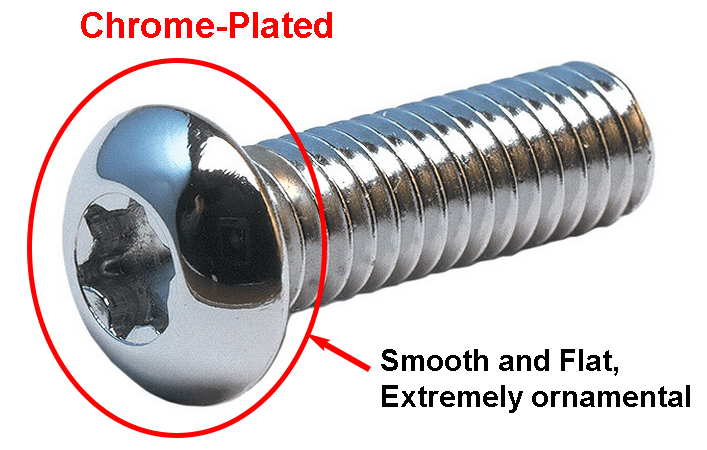
Chrome-Plated fastener: smooth and flat, extremely ornamental
Characteristics: What is commonly referred to as "chrome plating" is actually a "copper-nickel-chromium" composite system. The nickel layer is the main contributor to rust prevention and gloss, while the chromium layer primarily provides high hardness and excellent wear resistance.
II. Appearance
This is the most intuitive difference between the two and an important factor influencing selection.
This is the most intuitive difference between the two and an important factor influencing selection.
Zinc Plating:
Luster: Silvery-white, but the gloss is cooler-toned and slightly soft, usually not glaring. Depending on the passivation process, it can appear blue-white, yellow iridescent (rainbow color), black, or even olive drab.
Texture: The surface is relatively fine, but over time (especially outdoors), the gloss will diminish and gradually become dull and gray.
Luster: Silvery-white, but the gloss is cooler-toned and slightly soft, usually not glaring. Depending on the passivation process, it can appear blue-white, yellow iridescent (rainbow color), black, or even olive drab.
Texture: The surface is relatively fine, but over time (especially outdoors), the gloss will diminish and gradually become dull and gray.
Chrome Plating:
Luster: Mirror-like brightness with extremely high reflectivity. The color tone is warmer (with a slight bluish tint), and the visual effect is very striking and noticeable.
Luster: Mirror-like brightness with extremely high reflectivity. The color tone is warmer (with a slight bluish tint), and the visual effect is very striking and noticeable.
Texture: The surface is very smooth, flat, and highly decorative. Even after many years, as long as the coating doesn't peel off, it remains bright and new-looking.
III. Applications & Suitable Scenarios
Based on their characteristics, they have distinct roles in industrial applications.
Zinc-Plated Fasteners (Main Function: Anti-corrosion, Cost-effective):
Application Areas: Electrical infrastructure, outdoor construction, automotive chassis, interior of home appliances, general machinery.
Based on their characteristics, they have distinct roles in industrial applications.
Zinc-Plated Fasteners (Main Function: Anti-corrosion, Cost-effective):
Application Areas: Electrical infrastructure, outdoor construction, automotive chassis, interior of home appliances, general machinery.
Characteristics: Requires long-term rust prevention, but aesthetic requirements are low, or they are used in internal, unseen locations. Examples: Expansion bolts for fixing electrical boxes, screws for assembling storage racks.
Chrome-Plated Fasteners (Focus: Decorative Aesthetics, plus Wear Resistance):
Application Areas: Motorcycle customization parts, high-end bicycles, bathroom hardware, stage lighting equipment, furniture fittings, precision instrument panels.
Application Areas: Motorcycle customization parts, high-end bicycles, bathroom hardware, stage lighting equipment, furniture fittings, precision instrument panels.
Characteristics: Used in exposed, visible locations where they contribute significantly to the overall aesthetic appeal and visual quality of the product. Examples: Engine case screws on Harley-Davidson motorcycles, fixing screws in front of bathroom mirrors, decorative rivets on high-end leather goods.
IV. Corrosion Resistance & Wear Resistance
Corrosion Resistance (Salt Spray Test Performance):
Zinc Plating: Standard zinc plating (blue-white) can achieve 48-72 hours of salt spray resistance; with yellow iridescent passivation or added sealing, it can reach over 120-200 hours. Due to the sacrificial anodic action of zinc, it provides rust protection even if the coating is damaged.
Corrosion Resistance (Salt Spray Test Performance):
Zinc Plating: Standard zinc plating (blue-white) can achieve 48-72 hours of salt spray resistance; with yellow iridescent passivation or added sealing, it can reach over 120-200 hours. Due to the sacrificial anodic action of zinc, it provides rust protection even if the coating is damaged.
Chrome Plating: The rust resistance of decorative chrome plating depends entirely on the thickness of the intermediate nickel layer. If the nickel layer is too thin, moisture penetrating through micro-pores in the chromium layer can quickly cause rust spots (red rust) on the base material. Once rust starts, because the chromium layer is cathodic, corrosion can spread rapidly underneath. In harsh outdoor environments, the corrosion resistance of chrome plating is often inferior to that of zinc plating.
Wear Resistance & Hardness:
Chrome Plating: The chromium layer has extremely high hardness (HV 800-1000) and a very low coefficient of friction. It is suitable for fasteners that require repeated tightening or locking, effectively preventing thread galling and wear.
Chrome Plating: The chromium layer has extremely high hardness (HV 800-1000) and a very low coefficient of friction. It is suitable for fasteners that require repeated tightening or locking, effectively preventing thread galling and wear.
Zinc Plating: The zinc layer is relatively soft, primarily intended to protect the base material, with no special requirements for wear resistance.
V. Cost
This is a very important reference factor for users.
This is a very important reference factor for users.
Zinc Plating: Relatively low cost, quite economical. The process is simpler, and raw material (zinc ingot) costs are controllable. Mass-produced zinc-plated fasteners (like those with zinc plating or Dacromet) are among the most cost-effective anti-corrosion solutions on the market.
Chrome Plating: Relatively expensive. The processing cost is significantly higher than zinc plating.
Reasons include:
1. Multiple Steps: Requires multi-layer plating (copper, nickel, chromium), which is time-consuming and energy-intensive.
1. Multiple Steps: Requires multi-layer plating (copper, nickel, chromium), which is time-consuming and energy-intensive.
2. Expensive Raw Materials: The price of nickel metal is much higher than zinc.
3. High Standards: To achieve a mirror finish, the base material itself needs to be very smooth, pre-treatment requirements are stringent, and the yield rate is generally lower compared to zinc plating.
Summary
As a manufacturer and supplier, here is the advice I typically give to customers:
1. Consider the Environment: If your fasteners will be exposed to rain and sun outdoors and you have a limited budget, choose zinc plating. If they are for dry indoor use and your product is positioned as high-end, pursuing ultimate texture and aesthetics, choose chrome plating.
As a manufacturer and supplier, here is the advice I typically give to customers:
1. Consider the Environment: If your fasteners will be exposed to rain and sun outdoors and you have a limited budget, choose zinc plating. If they are for dry indoor use and your product is positioned as high-end, pursuing ultimate texture and aesthetics, choose chrome plating.
2. Consider the Function: If the core requirement is "rust prevention" (especially rust prevention after scratching), zinc plating is more reliable. If the core requirement is "wear resistance" (e.g., frequent sliding or locking engagement), chrome plating is more suitable.
3. Consider Hydrogen Embrittlement: Pay attention to the risk of hydrogen embrittlement. Both are electroplating processes. For high-strength fasteners of grade 10.9 and above, hydrogen embrittlement relief (baking) is necessary after electroplating to prevent the risk of fracture.
We hope this detailed analysis helps you make the most appropriate decision when choosing coatings for your fasteners. If you have a specific application scenario you'd like to discuss, please feel free to contact us for a conversation.
Qishine is ideal choice for EPC companies and project contractors.
Website: www.qishine.com
Email: qishine@qishine.com
Tel: 0592-5225595
WhatsApp: +86 15960259563
+86 15985833169
Website: www.qishine.com
Email: qishine@qishine.com
Tel: 0592-5225595
WhatsApp: +86 15960259563
+86 15985833169
Electrogalvanized Fastener Quotes Vary by thirty percent - The Money Is Saved in These Unseen Areas
What is the difference between Allen bolt and hex bolts
Related Article

Insights from a Case Study on Exporting B8M Fasteners.Recently, during our final outgoing inspection of a batch of B8M stainless steel fasteners destined for Portugal, we discovered varying degrees of burrs on the edges of the bolt hex heads.
How to Efficiently Remove Burrs from Bolt Edges

Insulating Gasket Procurement Pitfalls: From "Price Traps" to "Supplier Selection"
What pitfalls should you watch out for when purchasing insulating gaskets

As a classic modified PTFE gasket material from Garlock, Gylon 3500 is widely used in petrochemical, chemical, and other industries for its excellent resistance to strong acids, solvents, and anti-creep properties.
How to Buy Genuine Gylon 3500 Insulating Gaskets at Competitive Prices in China

