
IDT UNIFLUOR 7551 Gasket VS Garlock Gylon 3500 Gasket

Two silica-filled modified PTFE sheet gaskets cover the hardest sealing duty in process plants: Garlock Gylon 3500 and IDT UNIFLUOR 7551. They look alike and share the same base chemistry, so buyers comparing flange gaskets for chemical, cryogenic or oxygen service need the differences in numbers, not in adjectives.
Material Background and Core Differences
Both grades are built on biaxially oriented PTFE filled with silica (SiO2). The filler raises mechanical strength and, more important, restrains the cold flow that limits unfilled PTFE under bolt load. The two products diverge in the forming process and in the certified service envelope.
IDT UNIFLUOR 7551
A high-grade biaxially oriented PTFE sealing material with silica filler. It offers excellent chemical resistance across the full pH range, good mechanical strength and improved cold flow resistance, and it is specified for strong acids other than hydrofluoric acid as well as for fuels, steam and chlorine.
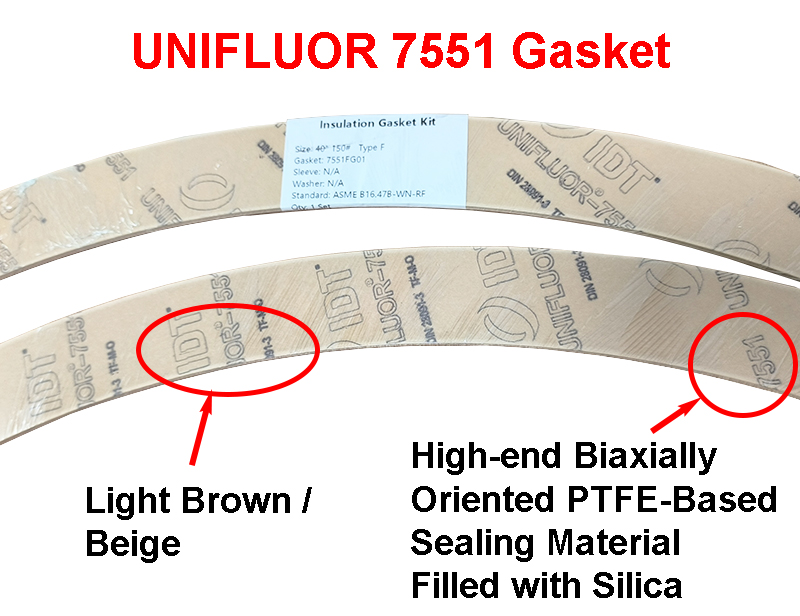
Unifluor 7551 gasket: biaxially oriented PTFE sheet with silica filler
The sheet is non-asbestos and is rated from -200 °C to +250 °C in continuous service, with short-term peaks to +260 °C, and up to 80 bar at 2 mm thickness. FDA, BAM and Germanischer Lloyd approvals cover cryogenic media, highly corrosive chemicals and high-purity oxygen. Typical duty spans petrochemical plants, pharmaceutical and food lines, shipbuilding, power generation and air separation units.
Garlock Gylon 3500
Gylon 3500 combines modified PTFE with silica filler in a compression-molded sheet. The silica reinforcement is what holds bolt load after tightening by resisting the creep of conventional PTFE. It is rated from -268 °C to +250 °C, with short-term exposure to +260 °C, and up to 1200 psi (about 83 bar) at 1.6 mm thickness, for strong acids other than hydrofluoric acid, solvents, hydrocarbons, steam and chlorine.

Gylon 3500 gasket: modified PTFE with silica filler
Approvals include FDA, ABS (American Bureau of Shipping) and USDA, which is why the grade appears on marine, food and pharmaceutical duty as well as in chemical plants.
Side-by-Side Comparison
The two sheets differ in the forming route and in the certified envelope far more than in the base chemistry.
| Comparison point | IDT UNIFLUOR 7551 | Garlock Gylon 3500 |
| Product type | High-performance flat sealing gasket | High-performance sheet or die-cut gasket |
| Material composition | Modified PTFE + silica filler | Modified PTFE + silica filler |
| Manufacturing process | Biaxial orientation | Compression molding |
| Color | Light tan | Tan |
| Temperature range | -200 °C to +250 °C continuous, peaks to +260 °C | -268 °C to +250 °C continuous, peaks to +260 °C |
| Maximum pressure | 80 bar at 2 mm thickness | 1200 psi (about 83 bar) at 1.6 mm thickness |
| Cold flow resistance | Excellent | Excellent (industry benchmark) |
| FDA approval | Yes | Yes |
| Cryogenic service | Down to -200 °C | Down to -268 °C |
| Additional approvals | BAM (oxygen / ethylene oxide), Germanischer Lloyd | ABS, USDA |
| Typical media | Steam, hydrocarbons, strong acids, cryogenic media, oxygen | Strong acids, solvents, chlorine, steam, cryogenic media |

Unifluor 7551 gasket versus Gylon 3500 gasket: composition, limits and approvals
Choosing Between the Two Grades
Flanged joint geometry sets the facing finish, bolt load and pressure class that the sealing element has to survive, so pipe flanges are specified together with the sheet grade. Against that assembly, weigh these six points.
- Cryogenic floor — for liquid nitrogen (-196 °C) or LNG (-162 °C), the -200 °C floor of IDT UNIFLUOR 7551 is sufficient; for liquid hydrogen (-253 °C) or liquid helium, the -268 °C floor of Gylon 3500 is the safer choice.
- High-temperature ceiling — IDT UNIFLUOR 7551 is recommended for continuous duty to 200 °C with short-term peaks to 260 °C, while Gylon 3500 holds 250 °C continuously; the practical difference is small.
- Pressure — 80 bar at 2 mm against 83 bar (1200 psi) at 1.6 mm. The two are effectively equivalent, and the joint rating usually governs the assembly.
- Special approvals — the BAM certification on IDT UNIFLUOR 7551 matters for high-purity oxygen, ethylene oxide and other explosive media.
- Hydrofluoric acid — both sheets contain silica, and silica does not resist HF. Specify unfilled PTFE or carbon fiber filled grades instead.
- Food and pharmaceutical contact — both grades carry FDA approval; Gylon 3500 also holds USDA approval and a longer published service record in pharmaceutical plants.
In short: pick Gylon 3500 when the lower temperature limit or the published torque retention data drives the decision, and pick IDT UNIFLUOR 7551 when a BAM approval is required for oxygen or ethylene oxide duty. On chemical resistance, pH range and food contact the two are effectively level.
Frequently Asked Questions
Which gasket should I use for liquid hydrogen service?
Garlock Gylon 3500 — its lower limit is -268 °C, while IDT UNIFLUOR 7551 stops at -200 °C. For liquid nitrogen or LNG, either grade is adequate.
Can either sheet handle hydrofluoric acid?
No. Both grades are silica-filled, and silica does not resist HF. Specify unfilled PTFE or carbon fiber filled gaskets where hydrofluoric acid is present.
Which grade fits high-purity oxygen service?
IDT UNIFLUOR 7551, because its BAM approval covers oxygen duty. The same approval is the compliance argument for ethylene oxide and other explosive media.
Do both gaskets meet food-contact requirements?
Both carry FDA approval, so either can be used on food contact surfaces. Gylon 3500 also holds USDA approval and a longer published record in pharmaceutical plants.
How do the two grades compare on bolt load retention?
Both resist cold flow well. Gylon 3500 is compression molded with silica reinforcement and is commonly used as the benchmark for torque retention after bolt-up.
Comparison Between Latrolet 45 degree Fitting and Weldolet Fitting
Is KLINGERSIL C-4430 a sealing gasket or an insulating gasket
Related Article


