
How to Set the Torque Value for Pipeline Flange Fastening Bolts
author: www.qishine.com
2026-02-27

How to Scientifically Set the Torque Value for Flange Fastening Bolts: A Comprehensive Guide from Principle to Practice
In industrial pipeline systems, flange connections are like the joints of the human body, and their reliability directly impacts the safety and efficiency of the entire system. Bolt torque is the key parameter determining whether this "joint" functions properly. As a supplier with years of in-depth experience in the petroleum pipeline field, I will systematically analyze the scientific methods and practical key points for setting flange bolt torque in this article.
The Essence of Torque: More Than Just "Tightening"
Torque is essentially a rotational moment. It is converted into axial clamping force through the bolt, compressing the gasket to form a seal. The balance point of this force is extremely delicate: insufficient force leads to leakage, while excessive force can cause bolt stretching, thread damage, or even flange deformation. The correct torque value for a High Strength Bolt must consider multiple factors such as material strength, gasket characteristics, and operating conditions.
Torque is essentially a rotational moment. It is converted into axial clamping force through the bolt, compressing the gasket to form a seal. The balance point of this force is extremely delicate: insufficient force leads to leakage, while excessive force can cause bolt stretching, thread damage, or even flange deformation. The correct torque value for a High Strength Bolt must consider multiple factors such as material strength, gasket characteristics, and operating conditions.
Five Key Variables Affecting Torque Value: 1. Bolt specification and material; 2. Gasket type and compression characteristics; 3. Flange specification and surface condition; 4. Medium and operating conditions; 5. Lubrication condition. Today, we will focus on the reference torque for various gaskets.
Key Points for Torque Setting with Various Gaskets
1. Line Seal Gaskets
These gaskets rely on line contact between metals to form a seal. Torque must be precisely controlled to induce sufficient plastic deformation in the gasket to fill microscopic defects on the sealing surface, but not so excessive as to cause gasket crushing. Staged tightening is typically recommended, and the final torque value should refer to the compression curve provided by the manufacturer.
1. Line Seal Gaskets
These gaskets rely on line contact between metals to form a seal. Torque must be precisely controlled to induce sufficient plastic deformation in the gasket to fill microscopic defects on the sealing surface, but not so excessive as to cause gasket crushing. Staged tightening is typically recommended, and the final torque value should refer to the compression curve provided by the manufacturer.

Torque values for line seal Gasket
2. Spiral Wound Gaskets (Outer Ring Only)
The outer ring provides positioning and prevents over-compression. During initial tightening, the torque should compress the gasket to the thickness of the outer ring, at which point the gasket has generated a basic sealing force. The final torque is usually 20-30% higher than the initial value to ensure sufficient compression of the wound portion.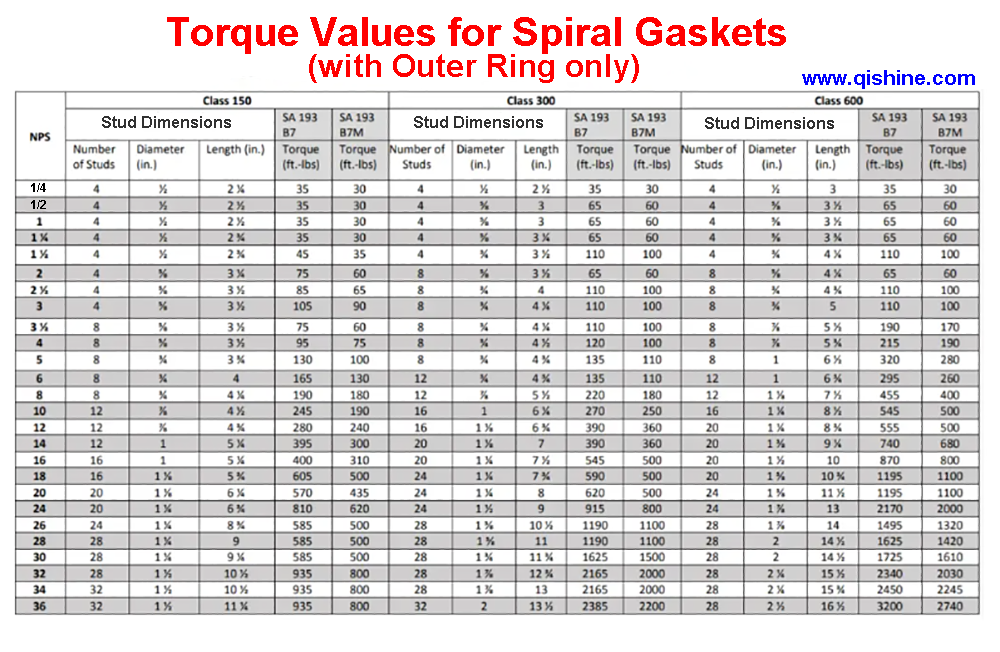
The outer ring provides positioning and prevents over-compression. During initial tightening, the torque should compress the gasket to the thickness of the outer ring, at which point the gasket has generated a basic sealing force. The final torque is usually 20-30% higher than the initial value to ensure sufficient compression of the wound portion.
Torque values for spiral gaskets with outer ring only
3. Spiral Wound Gaskets (Inner & Outer Ring)
The double-ring design provides better anti-blowout capability and compression control. Tightening proceeds with inner ring contact as the marker for the first stage. Continue tightening to 75% of the specified torque, and finally complete the full torque using a criss-cross or star sequence.
The double-ring design provides better anti-blowout capability and compression control. Tightening proceeds with inner ring contact as the marker for the first stage. Continue tightening to 75% of the specified torque, and finally complete the full torque using a criss-cross or star sequence.

Torque values for spiral gaskets with outer and inner ring
4. Non-Metallic Insulating Gaskets (e.g., Klinger C4430, Gylon 3500)
These materials typically have good resilience and chemical resistance. Torque setting must avoid exceeding the material's maximum compression ratio (usually 25-30%). Over-compression can cause gasket extrusion or permanent damage.
These materials typically have good resilience and chemical resistance. Torque setting must avoid exceeding the material's maximum compression ratio (usually 25-30%). Over-compression can cause gasket extrusion or permanent damage.

Torque values for non-metallic insulating gasket
5. Ring Type Joint (RTJ) Gaskets
These are metal-to-metal seals requiring high torque to make the gasket material (usually soft iron, stainless steel, or non-ferrous metal) flow and completely fill the flange groove. The tightening process is usually divided into multiple stages, and the final torque may reach 70-80% of the bolt's yield strength.
These are metal-to-metal seals requiring high torque to make the gasket material (usually soft iron, stainless steel, or non-ferrous metal) flow and completely fill the flange groove. The tightening process is usually divided into multiple stages, and the final torque may reach 70-80% of the bolt's yield strength.

Torque values for RTJS
A Six-Step Method for Scientifically Setting Torque
Step 1: Collect Basic Data
- Bolt specification, material, strength grade
- Gasket type, size, compression ratio
- Flange standard, pressure rating, facing type
- Working pressure, temperature, medium characteristics
Step 1: Collect Basic Data
- Bolt specification, material, strength grade
- Gasket type, size, compression ratio
- Flange standard, pressure rating, facing type
- Working pressure, temperature, medium characteristics
Step 2: Refer to Standards and Codes
Standards such as ASME PCC-1, EN 1591, GB/T 38343 provide the basic framework and recommended values for torque calculation. These codes take safety factors and engineering experience into account.
Standards such as ASME PCC-1, EN 1591, GB/T 38343 provide the basic framework and recommended values for torque calculation. These codes take safety factors and engineering experience into account.
Step 3: Calculate Theoretical Torque
Use the basic formula: T = K × d × F
Where:
T = Torque (N·m)
K = Torque coefficient (affected by lubrication, surface condition, typically 0.15-0.25)
d = Bolt nominal diameter (mm)
F = Target axial force (N), determined by the required gasket seating stress and flange area
Use the basic formula: T = K × d × F
Where:
T = Torque (N·m)
K = Torque coefficient (affected by lubrication, surface condition, typically 0.15-0.25)
d = Bolt nominal diameter (mm)
F = Target axial force (N), determined by the required gasket seating stress and flange area
Step 4: Consider Operational Condition Modifications
- High-temperature applications: Consider differential thermal expansion, may require higher initial torque
- Cyclic loading: Consider using disc springs to maintain torque stability
- Vibratory environments: May require higher torque or anti-loosening measures
- High-temperature applications: Consider differential thermal expansion, may require higher initial torque
- Cyclic loading: Consider using disc springs to maintain torque stability
- Vibratory environments: May require higher torque or anti-loosening measures
Step 5: Develop a Tightening Strategy
- Sequence: Use a criss-cross or star pattern to ensure uniform gasket compression
- Stages: Typically tighten in 3-4 stages (e.g., 30%, 60%, 90%, 100%)
- Re-check: Re-check torque after 24 hours of operation or after the first heat-up cycle
- Sequence: Use a criss-cross or star pattern to ensure uniform gasket compression
- Stages: Typically tighten in 3-4 stages (e.g., 30%, 60%, 90%, 100%)
- Re-check: Re-check torque after 24 hours of operation or after the first heat-up cycle
Step 6: Field Verification and Documentation
- Use calibrated torque tools
- Record the final torque value for each bolt
- For critical connections, consider using bolt elongation measurement or hydraulic tensioners as supplementary verification to torque tightening
- Use calibrated torque tools
- Record the final torque value for each bolt
- For critical connections, consider using bolt elongation measurement or hydraulic tensioners as supplementary verification to torque tightening
Whether you are a design engineer, installation technician, or maintenance supervisor, mastering the scientific method for setting torque is a fundamental skill for ensuring the safe and efficient operation of pipeline systems.
Qishine is ideal choice for EPC companies and project contractors.
Website: www.qishine.com
Email: qishine@qishine.com
Tel: 0592-5225595
Email: qishine@qishine.com
Tel: 0592-5225595
WhatsApp: +86 15960259563
Four Common Types of Pipe Flange Fastener Torque Wrenches
How should we tighten flange bolts
Related Article

Insights from a Case Study on Exporting B8M Fasteners.Recently, during our final outgoing inspection of a batch of B8M stainless steel fasteners destined for Portugal, we discovered varying degrees of burrs on the edges of the bolt hex heads.
How to Efficiently Remove Burrs from Bolt Edges

Insulating Gasket Procurement Pitfalls: From "Price Traps" to "Supplier Selection"
What pitfalls should you watch out for when purchasing insulating gaskets

As a classic modified PTFE gasket material from Garlock, Gylon 3500 is widely used in petrochemical, chemical, and other industries for its excellent resistance to strong acids, solvents, and anti-creep properties.
How to Buy Genuine Gylon 3500 Insulating Gaskets at Competitive Prices in China

