
How to measure the pitch of a bolt thread
author: www.qishine.com
2026-02-28

1. Basic Concept of Pitch
Pitch is a critical parameter of a thread, referring to the axial distance between corresponding points on adjacent threads at the pitch diameter line. The pitch diameter line is a theoretical imaginary cylindrical diameter located between the major and minor diameters of the thread, serving as the reference for defining the thread's geometric relationships.
Pitch is a critical parameter of a thread, referring to the axial distance between corresponding points on adjacent threads at the pitch diameter line. The pitch diameter line is a theoretical imaginary cylindrical diameter located between the major and minor diameters of the thread, serving as the reference for defining the thread's geometric relationships.
Simply put, it is the linear distance from a specific point on one thread to the corresponding point on the adjacent thread.
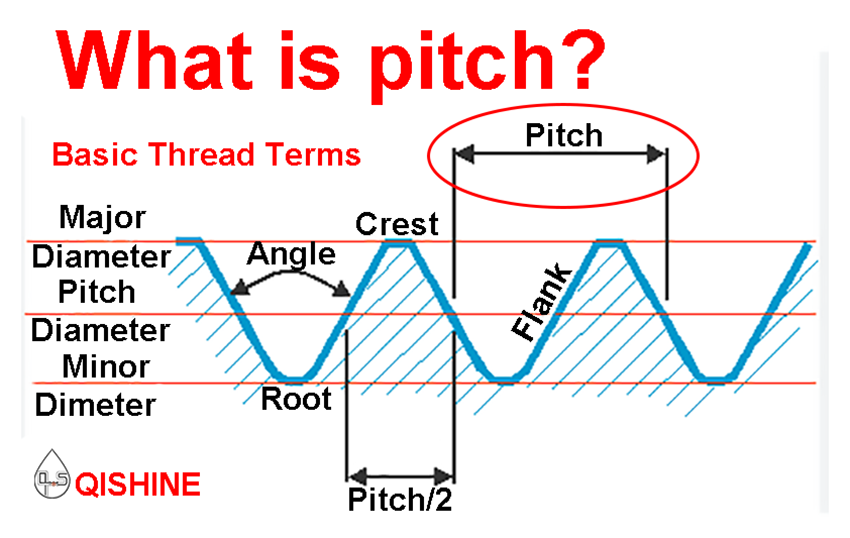
Pitch referring to the axial distance between corresponding points on adjacent threads at the pitch diameter line.
2. Thread Systems and Designations
2.1 Metric Thread (ISO Metric Thread)
- Designation: M[Diameter]×[Pitch] (Unit: mm)
- Coarse Series: Standard pitch, often omitted in designation. E.g., M10 defaults to M10×1.5.
- Fine Series: Pitch is smaller than standard and must be explicitly specified. E.g., M10×1.25, M10×1, M10×0.75.
- Features: Uses a 60° triangular thread profile with symmetrical thread angles, facilitating manufacturing and measurement.
2.1 Metric Thread (ISO Metric Thread)
- Designation: M[Diameter]×[Pitch] (Unit: mm)
- Coarse Series: Standard pitch, often omitted in designation. E.g., M10 defaults to M10×1.5.
- Fine Series: Pitch is smaller than standard and must be explicitly specified. E.g., M10×1.25, M10×1, M10×0.75.
- Features: Uses a 60° triangular thread profile with symmetrical thread angles, facilitating manufacturing and measurement.

"1.25mm" Indicates that the distance between each screw thread is 1.25mm
2.2 Imperial Thread (Unified Thread Series)
- Designation: [Diameter]-[Threads Per Inch] [Series Code]
- Main Series:
- UNC (Unified Coarse): Unified Standard Coarse Thread
- UNF (Unified Fine): Unified Standard Fine Thread
- UNEF (Unified Extra Fine): Unified Extra Fine Thread
- TPI Calculation: TPI = 1 / Pitch (inches)
- Example: 1-8 UNC denotes a coarse thread with a diameter of 1 inch and 8 threads per inch. Pitch = 1/8 = 0.125 inches ≈ 3.175 mm.
- Designation: [Diameter]-[Threads Per Inch] [Series Code]
- Main Series:
- UNC (Unified Coarse): Unified Standard Coarse Thread
- UNF (Unified Fine): Unified Standard Fine Thread
- UNEF (Unified Extra Fine): Unified Extra Fine Thread
- TPI Calculation: TPI = 1 / Pitch (inches)
- Example: 1-8 UNC denotes a coarse thread with a diameter of 1 inch and 8 threads per inch. Pitch = 1/8 = 0.125 inches ≈ 3.175 mm.

"8TPI" indicates that there are eight threads per inch.
2.3 Other Thread Systems
- Pipe Threads: NPT, G series, etc., with specific taper and sealing requirements.
- Trapezoidal Threads: Tr series, used for power transmission, with larger pitches.
- Buttress Threads: Used for unidirectional load-bearing applications.
- Pipe Threads: NPT, G series, etc., with specific taper and sealing requirements.
- Trapezoidal Threads: Tr series, used for power transmission, with larger pitches.
- Buttress Threads: Used for unidirectional load-bearing applications.
3. Methods for Measuring Pitch
How to measure imperial thread pitch TPI (Quickly and accurately)?
- 1/2 Inch Method: Place a ruler along the thread and count the number of thread crests within 1/2 inch. Double this number to get TPI. (Measuring over a longer distance reduces error.)
- Thread Pitch Gauge: Use a TPI gauge for quick confirmation.
- Do not mix systems: If your part specification is metric (e.g., M8×1.25), do not substitute with an American size; fit and strength may be compromised.
How to measure imperial thread pitch TPI (Quickly and accurately)?
- 1/2 Inch Method: Place a ruler along the thread and count the number of thread crests within 1/2 inch. Double this number to get TPI. (Measuring over a longer distance reduces error.)
- Thread Pitch Gauge: Use a TPI gauge for quick confirmation.
- Do not mix systems: If your part specification is metric (e.g., M8×1.25), do not substitute with an American size; fit and strength may be compromised.

The correct usage method of the Screw Pitch gauge
How to measure metric thread pitch?
1) Ten-Pitch Method:
- Measure the total length of 10 pitches (recommended: use calipers to measure from the same point on the 1st thread to the same point on the 11th thread).
- Total length ÷ 10 = Single pitch.
- Advantage: Significantly reduces single-measurement error.
1) Ten-Pitch Method:
- Measure the total length of 10 pitches (recommended: use calipers to measure from the same point on the 1st thread to the same point on the 11th thread).
- Total length ÷ 10 = Single pitch.
- Advantage: Significantly reduces single-measurement error.
For example, a standard pitch M8 screw has 1.25 mm between each thread crest. A useful tip is to measure the distance over 10 threads and then move the decimal point one place to the left—this makes identifying the pitch easier and more accurate than trying to measure a single thread spacing.

Use the metric thread gauge (with the measurement unit in mm) for comparison
2) Direct Measurement of Adjacent Threads:
- Use calipers to measure the axial distance between adjacent thread crests.
- Note: Measurement must be taken parallel to the axis.
- Use calipers to measure the axial distance between adjacent thread crests.
- Note: Measurement must be taken parallel to the axis.
3) Thread Pitch Gauge Method:
- Use a metric thread pitch gauge (calibrated in mm) for comparison.
- Use a metric thread pitch gauge (calibrated in mm) for comparison.
Metric and American fasteners differ significantly and are absolutely not interchangeable. American screws use Threads Per Inch (TPI), while metric screws use thread pitch, which is the distance between two thread crests measured in millimeters. A smaller pitch number indicates a finer thread.
4. Engineering Applications and Selection of Pitch
4.1 Performance Comparison of Coarse vs. Fine Threads
4.1 Performance Comparison of Coarse vs. Fine Threads
| Characteristic | Coarse Thread | Fine Thread |
| Strength | Thicker thread root, high static strength | Thinner thread root, but less weakening of the base material |
| Self-Locking | Larger thread helix angle, poorer self-locking | Smaller thread helix angle, better self-locking |
| Sealing | Average | Smaller thread clearance, better sealing |
| Fatigue Resistance | More severe stress concentration | Less stress concentration, better fatigue resistance |
| Manufacturing | Larger tolerances, easier to manufacture | Higher precision required, more difficult to manufacture |
| Ease of Assembly/Disassembly | Less prone to stripping, easier assembly/disassembly | More prone to stripping, requires precise torque control |
| Typical Applications | General connections, heavy loads, vibrating environments | Thin-walled parts, precise adjustments, sealed connections |
5. Common Misconceptions and Corrections
Misconception 1: Metric/Imperial threads can be approximately interchanged.
Correction: Even if diameters are close, different pitches lead to:
- Only 1-2 threads making contact, severely reducing load-bearing capacity.
- Accelerated wear, potentially causing thread stripping.
- Complete failure of sealing.
Misconception 1: Metric/Imperial threads can be approximately interchanged.
Correction: Even if diameters are close, different pitches lead to:
- Only 1-2 threads making contact, severely reducing load-bearing capacity.
- Accelerated wear, potentially causing thread stripping.
- Complete failure of sealing.
Misconception 2: A smaller pitch means higher strength.
Correction: Fine threads have a smaller root cross-section; the strength of a single thread is lower than that of a coarse thread. Their advantages lie in:
- More effective engaged threads over the same length, leading to more even load distribution.
- Less weakening of the base material, making them suitable for thin-walled parts.
- Better fatigue resistance, not higher static strength.
- More effective engaged threads over the same length, leading to more even load distribution.
- Less weakening of the base material, making them suitable for thin-walled parts.
- Better fatigue resistance, not higher static strength.
Misconception 3: Measuring a single pitch is the most accurate method.
Correction: Affected by manufacturing and measurement errors, a single measurement is not representative. Recommended practice:
- Measure multiple pitches and take the average (e.g., 10 pitches).
- Use dedicated tools like thread pitch gauges.
- Take multiple measurements at different axial positions.
- Measure multiple pitches and take the average (e.g., 10 pitches).
- Use dedicated tools like thread pitch gauges.
- Take multiple measurements at different axial positions.
Qishine is ideal choice for EPC companies and project contractors.
Website: www.qishine.com
Email: qishine@qishine.com
Tel: 0592-5225595
Email: qishine@qishine.com
Tel: 0592-5225595
WhatsApp: +86 15960259563
FOB vs CIF - The Art of Choice in the Oil Pipeline Foreign Trade Industry
Fastener Zinc Coating Thickness The 3-Minute Cheat Sheet for Engineers
Related Article

Insights from a Case Study on Exporting B8M Fasteners.Recently, during our final outgoing inspection of a batch of B8M stainless steel fasteners destined for Portugal, we discovered varying degrees of burrs on the edges of the bolt hex heads.
How to Efficiently Remove Burrs from Bolt Edges

Insulating Gasket Procurement Pitfalls: From "Price Traps" to "Supplier Selection"
What pitfalls should you watch out for when purchasing insulating gaskets

As a classic modified PTFE gasket material from Garlock, Gylon 3500 is widely used in petrochemical, chemical, and other industries for its excellent resistance to strong acids, solvents, and anti-creep properties.
How to Buy Genuine Gylon 3500 Insulating Gaskets at Competitive Prices in China

