
How to Help Customers Quickly Understand Fastener Standards
author: www.qishine.com
2025-11-29

As foreign trade salespeople, we often encounter situations where customers don't know the specific standards for the fasteners they need. So, as experienced sales staff, how can we efficiently guide customers to quickly select the product they require?
For a foreign trade salesperson, the ability to efficiently guide customers unfamiliar with standards directly determines the conversion rate of inquiries and projects a professional image. Below is a proven, systematic methodology and set of experiences, hoping to provide a clear action guide for new salespeople.
Core Philosophy: Shift from "Passive Order Taker" to "Active Guide"
Do not wait for the customer to tell you the standard. Instead, actively assume the role of a "technical consultant." Use systematic questioning and guidance to help customers clarify their needs and jointly identify the standard. This process itself is the best way to build trust and demonstrate professionalism.
Do not wait for the customer to tell you the standard. Instead, actively assume the role of a "technical consultant." Use systematic questioning and guidance to help customers clarify their needs and jointly identify the standard. This process itself is the best way to build trust and demonstrate professionalism.
Step 1: Establish a Communication Framework – Use a "Question Tree" to Pinpoint Needs
When you receive a vague inquiry like "I need some screws for the construction industry," don't directly ask "What standard do you need?" This can confuse the customer. Instead, send a structured "Question Tree," breaking down complex technical issues into a few simple multiple-choice questions.
When you receive a vague inquiry like "I need some screws for the construction industry," don't directly ask "What standard do you need?" This can confuse the customer. Instead, send a structured "Question Tree," breaking down complex technical issues into a few simple multiple-choice questions.
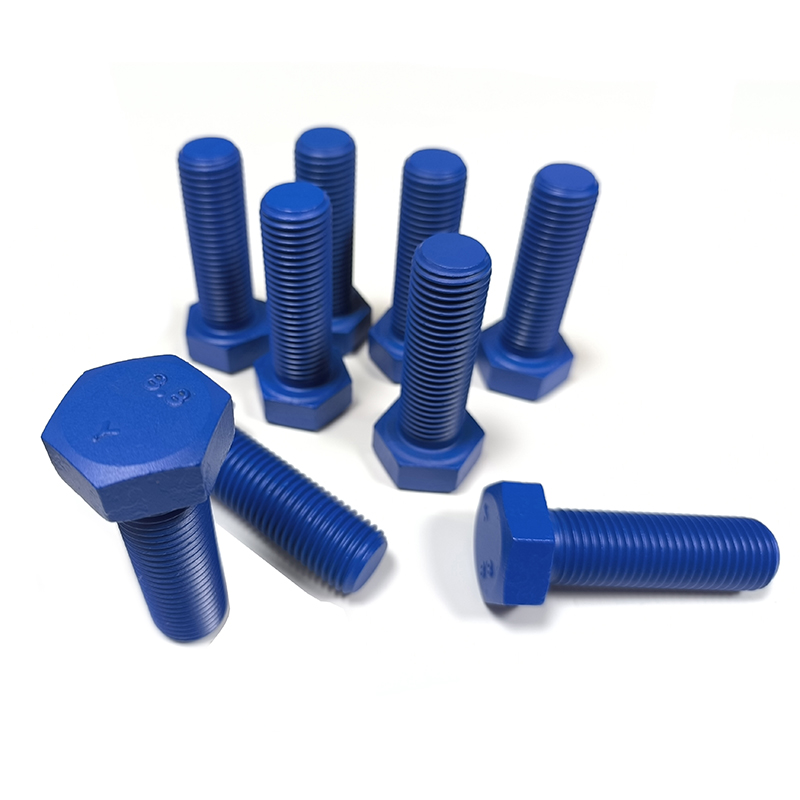
Class 8.8 PTFE Coating Bolts
This "Question Tree" should revolve around several core dimensions of fasteners:
1. Application Scenario & Performance Requirements (The most important starting point)
Example Questions:
"Could you tell us what product or project these fasteners will be used in? (e.g., steel structure building, machinery equipment, furniture, automotive repair)"
"What is the main type of force they need to withstand? (e.g., tensile force, or shear force?)"
Example Questions:
"Could you tell us what product or project these fasteners will be used in? (e.g., steel structure building, machinery equipment, furniture, automotive repair)"
"What is the main type of force they need to withstand? (e.g., tensile force, or shear force?)"
"What is the usage environment like? (Indoors, outdoors, coastal area, chemical plant with corrosive atmosphere?)"
Guiding Logic:
Steel Structure Building -> Directly points to high-strength structural bolts like ASTM A325/A490 (US Std) or ISO 7411/7412 (Euro Std).
Steel Structure Building -> Directly points to high-strength structural bolts like ASTM A325/A490 (US Std) or ISO 7411/7412 (Euro Std).
Outdoor/Corrosive Environment -> Leads to discussions about material (Stainless Steel A2/A4-70/80) or surface treatment (Hot Dip Galvanized), subsequently linking to relevant standards.
General Machinery Equipment -> More commonly uses ISO 4014/4017 (Hex Head Bolts) or DIN 933/931 (German Std).
2. Key Dimensions & Specifications (Making Needs Specific)
Example Questions:
"Do you have a drawing or sample? That is the most accurate way."
"If not, could you provide some key dimensions? For example: Thread Diameter (e.g., M10, 1/2"), Length (e.g., 30mm, 2"), Head Type (Hex Head, Socket Head, Pan Head, etc.)?"
Example Questions:
"Do you have a drawing or sample? That is the most accurate way."
"If not, could you provide some key dimensions? For example: Thread Diameter (e.g., M10, 1/2"), Length (e.g., 30mm, 2"), Head Type (Hex Head, Socket Head, Pan Head, etc.)?"
Guiding Logic:
Customer says "M10" -> You know they use Metric, likely ISO or DIN standards.
Customer says "1/2"-13" -> You know they use Imperial UNC thread, likely ANSI/ASME or SAE standards.
Customer says "M10" -> You know they use Metric, likely ISO or DIN standards.
Customer says "1/2"-13" -> You know they use Imperial UNC thread, likely ANSI/ASME or SAE standards.
Head Type directly corresponds to standards: Socket Head Cap Screw is ISO 4762 or DIN 912; Socket Countersunk Head Screw is ISO 10642.
3. Existing Reference or Substitute (Leveraging the Customer's Existing Knowledge)
Example Questions:
"Which country's standards or brand's similar products have you used before?"
"Are you replacing an existing part? If yes, are there any markings or identifiers on the old part?"
Example Questions:
"Which country's standards or brand's similar products have you used before?"
"Are you replacing an existing part? If yes, are there any markings or identifiers on the old part?"
Guiding Logic:
Customer says "Previously used on German equipment" -> You can prioritize recommending DIN standards.
Customer says "Previously used on German equipment" -> You can prioritize recommending DIN standards.
Customer says "Replacing a bolt on an American machine, head marked with 'A2C' or three dashes" -> You can identify it as an ASTM A325 bolt.
This is an excellent entry point; asking the customer to take a photo is the most efficient identification method.
Step 2: Provide Visual Tools – Lower the Technical Barrier
Text descriptions can be insufficient; images and physical objects help customers understand instantly.
Text descriptions can be insufficient; images and physical objects help customers understand instantly.
1. Create "Standard Cross-Reference Quick Charts"
Create a simple PDF or webpage correlating the most common application scenarios, head types, property classes, and standard codes, presented in a table or infographic format.
Create a simple PDF or webpage correlating the most common application scenarios, head types, property classes, and standard codes, presented in a table or infographic format.
Example Table Snippet:
| Application Scenario | Performance Requirement | Common Head Type | Recommended Standard (Metric) | Recommended Standard (US/Imperial) |
| Steel Structure Connection | High Strength, Shear Resistance | Hex Head (with washer face) | ISO 7412 (Grade 8.8/10.9) | ASTM A325 / A490 |
| Machinery Equipment | General Purpose, Easy Disassembly | Socket Head Cap Screw | Socket Head Cap Screw | ISO 4762 (Grade 12.9) | ANSI B18.3 (Grade 8) |
| Furniture Assembly | Aesthetics, Vibration Resistance | Pan Head / Countersunk Head | ISO 7046 (PZ Cross Recess) | ANSI/ASME B18.6.3 |
| Outdoor Guardrails | Corrosion Resistance | Hex Head (HDG) | DIN 933 (A4-80) | ASTM A153 (Grade D) |
2. Utilize the "Image Annotation Method"
On images sent to customers, use arrows and text to clearly label the names and key parameters of each part.
On images sent to customers, use arrows and text to clearly label the names and key parameters of each part.
Example: Send a picture of a hex head bolt, marking "Width Across Flats S", "Head Height K", "Nominal Diameter d", "Length L", "Thread Length b". Then tell the customer: "You just need to measure these few dimensions, and we can help you find the exact matching product." This is much more professional than plain text.
3. Build a "Sample Library"
For common standards (e.g., DIN 912, ISO 4014, ASTM A193 B7), prepare some physical samples with clear labels. When a customer is hesitant, proactively offer: "We can send you a few samples of the products we believe best fit your needs for confirmation before mass production." This action is highly persuasive.
For common standards (e.g., DIN 912, ISO 4014, ASTM A193 B7), prepare some physical samples with clear labels. When a customer is hesitant, proactively offer: "We can send you a few samples of the products we believe best fit your needs for confirmation before mass production." This action is highly persuasive.
Step 3: Practical Case Simulations – See How Experts Communicate
Let's simulate two complete customer interaction processes.
Let's simulate two complete customer interaction processes.
Case 1: Vague Machinery Equipment Inquiry
Customer Email: "We need some bolts for our machine. Please quote."
Your Reply:
> "Dear [Client Name],
>
> Thank you for your inquiry.
>
> To provide you with the most suitable and cost-effective bolts, could you kindly help us with the following information?
Customer Email: "We need some bolts for our machine. Please quote."
Your Reply:
> "Dear [Client Name],
>
> Thank you for your inquiry.
>
> To provide you with the most suitable and cost-effective bolts, could you kindly help us with the following information?
> 1. Application: What is the specific function of this bolt in the machine? (e.g., connecting two heavy plates, fastening a cover)
> 2. Key Dimensions: Do you have a drawing or sample? If not, could you measure:
> Thread Diameter (e.g., M8, M12, 5/16”)
> Length (under head)
> Head Type (e.g., Hex Head, Socket Head)
> Thread Diameter (e.g., M8, M12, 5/16”)
> Length (under head)
> Head Type (e.g., Hex Head, Socket Head)
> 3. Grade/Strength: Any special requirement for strength? For machine building, Grade 8.8 or Grade 12.9 are common choices.
>
> Based on your answers, we can identify the correct standard (like ISO 4014 for hex head bolts or ISO 4762 for socket head cap screws).
>
> Attached is a quick guide for your reference. Looking forward to your feedback.
>
> Best regards,
> [Your Name]"
>
> Based on your answers, we can identify the correct standard (like ISO 4014 for hex head bolts or ISO 4762 for socket head cap screws).
>
> Attached is a quick guide for your reference. Looking forward to your feedback.
>
> Best regards,
> [Your Name]"
Case 2: Replacement Need with a Reference Object
Customer Email: "I need to replace a bolt on my truck. The old one is broken."
Your Reply:
> "Dear [Client],
>
> No problem, we can help you find the exact replacement.
>
> The fastest way is if you could take a clear photo of the broken bolt, especially focusing on:
> The head marking (any numbers or symbols).
> The head shape.
>
> Meanwhile, if you can measure the thread diameter and length, that would be perfect.
>
> For truck applications, common standards are SAE J429 for Grade 5 or 8, or ASTM A574 for high-strength socket head bolts. A photo will tell us exactly.
>
> We are here to help.
>
> Best,
> [Your Name]"
Customer Email: "I need to replace a bolt on my truck. The old one is broken."
Your Reply:
> "Dear [Client],
>
> No problem, we can help you find the exact replacement.
>
> The fastest way is if you could take a clear photo of the broken bolt, especially focusing on:
> The head marking (any numbers or symbols).
> The head shape.
>
> Meanwhile, if you can measure the thread diameter and length, that would be perfect.
>
> For truck applications, common standards are SAE J429 for Grade 5 or 8, or ASTM A574 for high-strength socket head bolts. A photo will tell us exactly.
>
> We are here to help.
>
> Best,
> [Your Name]"

PTFE Coating Hex head bolt
Step 4: Become the Customer's Knowledge Backstop – Adding Value Beyond Sales
When the customer has found the right product with your guidance, your service has just begun.
When the customer has found the right product with your guidance, your service has just begun.
1. Explain the Meaning Behind the Standard: Tell the customer, "The Grade 12.9 Stud Bolt you selected has a '12.9' indicating a tensile strength of 1200 MPa and a yield ratio of 0.9, making it very suitable for your high-load equipment." This makes the customer feel their choice is wise and that you are very professional.
2. Remind About Matching Components and Precautions: "If you use this ASTM A325 structural bolt, please be sure to use the corresponding hard washer (ASTM F436) and nut (ASTM A563), and tighten according to the specified torque to ensure the connection performance."
3. Archive Customer Information: Create a simple file for each successfully transacted customer, recording the final confirmed product standards and applications. The next time they have a need, you can directly say: "According to our last record, do you need to restock the M10x50 ISO 4762 bolts used for your XX equipment?" This level of service is unparalleled.
Summary
Helping customers quickly understand fastener standards is not a simple Q&A session, but a systematic process of guidance, visual assistance, and building professional trust.
Helping customers quickly understand fastener standards is not a simple Q&A session, but a systematic process of guidance, visual assistance, and building professional trust.
Core Weapon: The "Question Tree" communication method.
Key Tools: Images, Quick Charts, Samples.
Ultimate Goal: Upgrade from being a "Supplier" to the customer's "Fastener Technical Consultant."
Ultimate Goal: Upgrade from being a "Supplier" to the customer's "Fastener Technical Consultant."
For new salespeople, mastering this process and continuously accumulating knowledge of the typical applications corresponding to various standards will allow you to navigate complex inquiries with ease and stand out. Remember, your professionalism is the most important reason for customers to place orders with confidence.
Qishine is ideal choice for EPC companies and project contractors.
Website: www.qishine.com
Email: qishine@qishine.com
Tel: 0592-5225595
WhatsApp: +86 15960259563
+86 15985833169
Website: www.qishine.com
Email: qishine@qishine.com
Tel: 0592-5225595
WhatsApp: +86 15960259563
+86 15985833169
Hot-Rolled Steel Plate vs. Cold-Rolled Steel Plate - What Are the Differences
Martensitic Stainless Steel Fasteners Overcome Material Cracking Problem Achieve Import Substitution
Related Article

Insights from a Case Study on Exporting B8M Fasteners.Recently, during our final outgoing inspection of a batch of B8M stainless steel fasteners destined for Portugal, we discovered varying degrees of burrs on the edges of the bolt hex heads.
How to Efficiently Remove Burrs from Bolt Edges

Insulating Gasket Procurement Pitfalls: From "Price Traps" to "Supplier Selection"
What pitfalls should you watch out for when purchasing insulating gaskets

As a classic modified PTFE gasket material from Garlock, Gylon 3500 is widely used in petrochemical, chemical, and other industries for its excellent resistance to strong acids, solvents, and anti-creep properties.
How to Buy Genuine Gylon 3500 Insulating Gaskets at Competitive Prices in China

