
How to Distinguish Type E and Type F Insulation Gaskets
author: www.qishine.com
2026-02-24

Comparative Analysis of Type E and Type F Insulation Gaskets: Selection, Application, and Installation Guide
As a long-term supplier in the field of insulation gaskets, we are often asked: "What exactly is the difference between Type E and Type F insulation gaskets?" Although both gaskets are used to prevent electrochemical corrosion between flanges, their design concepts and application scenarios have different emphases. Below, QISHINE will provide a comprehensive analysis of the differences and applications of these two insulation gaskets from a professional perspective.
I. Differences in Appearance and Structure: Distinctions at a Glance
The most notable feature of the Type E insulation gasket is its evenly distributed bolt holes. This design allows the gasket to be directly fitted onto the flange bolts, with the bolts passing through the gasket holes, integrating the entire insulation system (including the gasket, sleeves, and washers) into one unit.
The most notable feature of the Type E insulation gasket is its evenly distributed bolt holes. This design allows the gasket to be directly fitted onto the flange bolts, with the bolts passing through the gasket holes, integrating the entire insulation system (including the gasket, sleeves, and washers) into one unit.

Type E Insulation Gasket Product display image
The Type F insulation gasket, on the other hand, has no bolt holes. It is a complete ring-shaped gasket installed between the flange sealing surfaces, with the bolts separated from the gasket via individual insulation sleeves.

Type F Insulation Gasket Product display image
This structural difference directly determines their installation methods and applicable scenarios.
II. Performance Characteristics and Pros and Cons Comparison
Type E Insulation Gasket
Advantages:
1. Easy and quick installation: The integrated design reduces the number of components, eliminating the need to align multiple insulation parts separately during installation.
2. Accurate positioning: Bolt holes ensure the gasket does not shift during installation, guaranteeing insulation continuity.
3. Compact space usage: Particularly suitable for compact flange connections with small bolt spacing.
4. Error-proof design: Clear orientation reduces the likelihood of installation errors.
Type E Insulation Gasket
Advantages:
1. Easy and quick installation: The integrated design reduces the number of components, eliminating the need to align multiple insulation parts separately during installation.
2. Accurate positioning: Bolt holes ensure the gasket does not shift during installation, guaranteeing insulation continuity.
3. Compact space usage: Particularly suitable for compact flange connections with small bolt spacing.
4. Error-proof design: Clear orientation reduces the likelihood of installation errors.

Type E Insulating Gasket Assembly Drawing
Disadvantages:
1. Lower flexibility: The hole design may affect sealing performance under uneven pressure.
2. Pressure limitations: Under extremely high pressure, areas around the bolt holes may become stress concentration points.
3. Higher customization costs: Requires precise matching of the flange's bolt hole spacing and dimensions.
1. Lower flexibility: The hole design may affect sealing performance under uneven pressure.
2. Pressure limitations: Under extremely high pressure, areas around the bolt holes may become stress concentration points.
3. Higher customization costs: Requires precise matching of the flange's bolt hole spacing and dimensions.
Type F Insulation Gasket
Advantages:
1. Excellent sealing performance: The complete ring structure provides more even distribution of sealing pressure.
2. High-pressure resistance: The hole-free structure avoids local stress concentration, making it suitable for high-pressure environments.
3. Greater adaptability: The same-sized gasket can accommodate slight variations in flange alignment.
4. Better cost-effectiveness: Higher standardization simplifies inventory management.
Advantages:
1. Excellent sealing performance: The complete ring structure provides more even distribution of sealing pressure.
2. High-pressure resistance: The hole-free structure avoids local stress concentration, making it suitable for high-pressure environments.
3. Greater adaptability: The same-sized gasket can accommodate slight variations in flange alignment.
4. Better cost-effectiveness: Higher standardization simplifies inventory management.
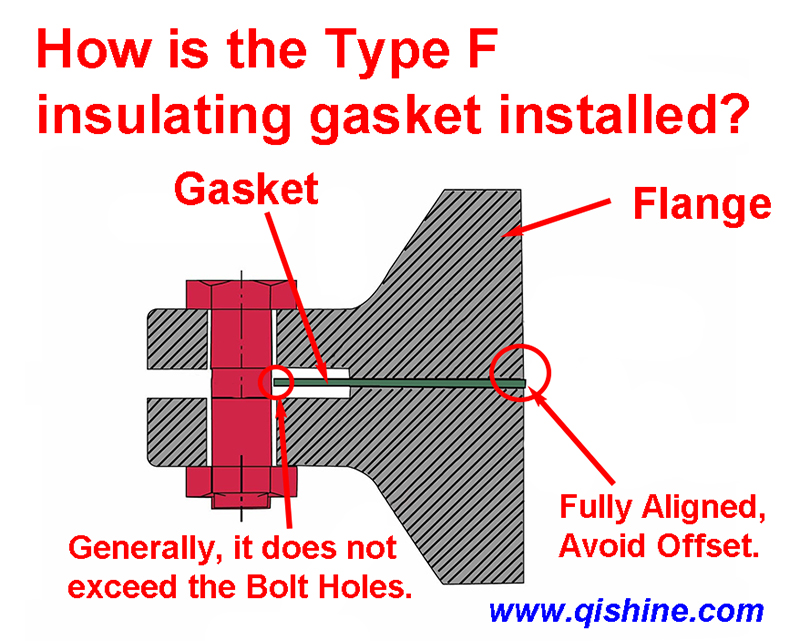
Type F Insulating Gasket Assembly Drawing
Disadvantages:
1. Complex installation: Requires coordination with insulation sleeves, washers, and other components, involving more installation steps.
2. High alignment requirements: Careful alignment during installation is necessary to avoid compromising insulation effectiveness.
3. Larger space usage: Additional axial space is required to accommodate insulation sleeve components.
1. Complex installation: Requires coordination with insulation sleeves, washers, and other components, involving more installation steps.
2. High alignment requirements: Careful alignment during installation is necessary to avoid compromising insulation effectiveness.
3. Larger space usage: Additional axial space is required to accommodate insulation sleeve components.
III. Applicable Environments and Selection Recommendations
Scenarios Suitable for Type E:
- Space-constrained installation environments: Such as compact pump sets or heat exchanger connections.
- Frequent disassembly maintenance points: Facilitates quick disassembly and reinstallation.
- Medium- to low-pressure piping systems: Typically for working pressures not exceeding Class 600.
- Standardized flange connections: Flanges with standard bolt hole positions.
- Corrosive environments: Such as chemical plants or offshore platforms requiring quick installation.
Scenarios Suitable for Type E:
- Space-constrained installation environments: Such as compact pump sets or heat exchanger connections.
- Frequent disassembly maintenance points: Facilitates quick disassembly and reinstallation.
- Medium- to low-pressure piping systems: Typically for working pressures not exceeding Class 600.
- Standardized flange connections: Flanges with standard bolt hole positions.
- Corrosive environments: Such as chemical plants or offshore platforms requiring quick installation.
Scenarios Suitable for Type F:
- High-pressure piping systems: High-pressure flanges of Class 900 and above.
- High-temperature applications: Piping connections with working temperatures exceeding 200°C.
- Large-diameter pipelines: Flange connections of DN300 and above.
- Non-standard flanges: Special flanges with non-standard bolt hole positions.
- High-vibration environments: Such as compressor or large pump inlets and outlets.
- High-pressure piping systems: High-pressure flanges of Class 900 and above.
- High-temperature applications: Piping connections with working temperatures exceeding 200°C.
- Large-diameter pipelines: Flange connections of DN300 and above.
- Non-standard flanges: Special flanges with non-standard bolt hole positions.
- High-vibration environments: Such as compressor or large pump inlets and outlets.
IV. Key Installation Considerations
Type E Installation Points:
1. Cleaning and inspection: Ensure the flange sealing surface and gasket surface are free of scratches and impurities.
2. Aligned installation: Align the bolt holes and gently insert the bolts, avoiding forceful hammering.
3. Torque control: Tighten evenly in a crisscross sequence, reaching the final torque value in multiple stages.
4. Insulation verification: After installation, use a megohmmeter to test insulation resistance, ensuring it exceeds 1 MΩ.
Type E Installation Points:
1. Cleaning and inspection: Ensure the flange sealing surface and gasket surface are free of scratches and impurities.
2. Aligned installation: Align the bolt holes and gently insert the bolts, avoiding forceful hammering.
3. Torque control: Tighten evenly in a crisscross sequence, reaching the final torque value in multiple stages.
4. Insulation verification: After installation, use a megohmmeter to test insulation resistance, ensuring it exceeds 1 MΩ.
Type F Installation Points:
1. Component compatibility: Ensure insulation sleeves and washers match the gasket dimensions.
2. Layered installation: Place the gasket first, followed by the insulation sleeves and washers.
3. Alignment check: Ensure all components are fully aligned to avoid offset.
4. System testing: Test the integrity of the entire insulation system after installation.
1. Component compatibility: Ensure insulation sleeves and washers match the gasket dimensions.
2. Layered installation: Place the gasket first, followed by the insulation sleeves and washers.
3. Alignment check: Ensure all components are fully aligned to avoid offset.
4. System testing: Test the integrity of the entire insulation system after installation.
V. Engineering Practice Recommendations
In actual engineering projects, I typically follow this decision-making process:
1. Evaluate operating conditions: Pressure, temperature, medium characteristics, and vibration conditions.
2. Measure installation space: Confirm physical constraints such as flange spacing and bolt length.
3. Consider maintenance needs: Estimate disassembly frequency and maintenance convenience requirements.
4. Calculate full lifecycle costs: Include initial costs, installation labor, and maintenance costs.
In actual engineering projects, I typically follow this decision-making process:
1. Evaluate operating conditions: Pressure, temperature, medium characteristics, and vibration conditions.
2. Measure installation space: Confirm physical constraints such as flange spacing and bolt length.
3. Consider maintenance needs: Estimate disassembly frequency and maintenance convenience requirements.
4. Calculate full lifecycle costs: Include initial costs, installation labor, and maintenance costs.
Important Note: Regardless of the type chosen, ensure the insulation gasket material is compatible with the pipeline medium. Common materials include PTFE, modified phenolic, rubber composites, etc., selected based on the chemical properties of the medium.
Conclusion
Type E and Type F insulation gaskets each have their own advantages. There is no absolute "better," only "more suitable." Type E excels in installation convenience, while Type F stands out for sealing reliability. In practical engineering, I recommend collaborating with experienced suppliers and technical personnel to make selections based on specific operating conditions.
Type E and Type F insulation gaskets each have their own advantages. There is no absolute "better," only "more suitable." Type E excels in installation convenience, while Type F stands out for sealing reliability. In practical engineering, I recommend collaborating with experienced suppliers and technical personnel to make selections based on specific operating conditions.
Proper selection and installation of insulation gaskets can not only effectively prevent electrochemical corrosion and extend the lifespan of piping systems but also avoid safety hazards and production losses caused by leaks.
Qishine is ideal choice for EPC companies and project contractors.
Website: www.qishine.com
Email: qishine@qishine.com
Tel: 0592-5225595
Email: qishine@qishine.com
Tel: 0592-5225595
WhatsApp: +86 15985833169
+86 15960259563
Engineer's Cheat Sheet: Comparing 4 Common Industrial Pipe Flanges (WN, SO, Threaded, SW)
Don't Let Wrong Sizes Shut Down Your Pipeline – Dimension Guide Inside
Related Article

Insights from a Case Study on Exporting B8M Fasteners.Recently, during our final outgoing inspection of a batch of B8M stainless steel fasteners destined for Portugal, we discovered varying degrees of burrs on the edges of the bolt hex heads.
How to Efficiently Remove Burrs from Bolt Edges

Insulating Gasket Procurement Pitfalls: From "Price Traps" to "Supplier Selection"
What pitfalls should you watch out for when purchasing insulating gaskets

As a classic modified PTFE gasket material from Garlock, Gylon 3500 is widely used in petrochemical, chemical, and other industries for its excellent resistance to strong acids, solvents, and anti-creep properties.
How to Buy Genuine Gylon 3500 Insulating Gaskets at Competitive Prices in China

