
How should we tighten flange bolts
author: www.qishine.com
2026-02-27

Flange Bolt Tightening Sequence: The Critical Step and Hidden Dangers 90% of Engineers Overlook
Flange connections are an indispensable part of industrial pipeline and equipment installation, and the bolt tightening sequence is a core detail that determines the safe operation of the entire system. Although many engineers know to "tighten in a crisscross sequence," they often overlook the precise technical logic and potential risks involved. Mastering the correct tightening method can not only prevent leaks and accidents but also significantly extend equipment lifespan.
Flange connections are an indispensable part of industrial pipeline and equipment installation, and the bolt tightening sequence is a core detail that determines the safe operation of the entire system. Although many engineers know to "tighten in a crisscross sequence," they often overlook the precise technical logic and potential risks involved. Mastering the correct tightening method can not only prevent leaks and accidents but also significantly extend equipment lifespan.
The Scientific Process of Tightening Pipe Flange Bolts
Step 1: Pre-Check – The Foundation of Successful Fastening
Before tightening any bolts, the following critical checks must be completed:
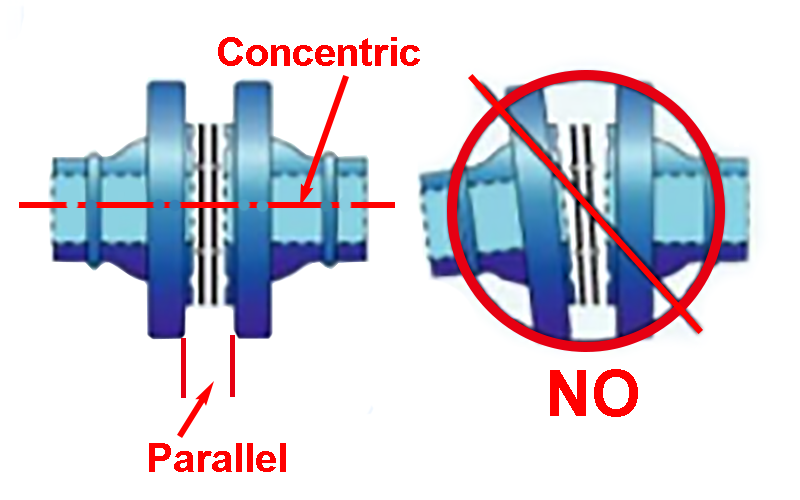
- Flange Alignment Check: Ensure the two flange faces are parallel and concentric; misalignment can cause uneven load distribution.
Step 1: Pre-Check – The Foundation of Successful Fastening
Before tightening any bolts, the following critical checks must be completed:
- Flange Alignment Check: Ensure the two flange faces are parallel and concentric; misalignment can cause uneven load distribution.
Before tightening any bolts: Ensure the two flange faces are parallel and concentric, Avoiding the non-parallelism of the flange
- Component Integrity Check:
- Bolts/Studs: Undamaged, threads intact, appropriate length.
- Nuts: Threads match, no cracks.
- Gasket: Correct type, no defects, centered placement.
- Cleaning: Remove all contaminants from flange faces, bolts, and gaskets.
- Bolts/Studs: Undamaged, threads intact, appropriate length.
- Nuts: Threads match, no cracks.
- Gasket: Correct type, no defects, centered placement.
- Cleaning: Remove all contaminants from flange faces, bolts, and gaskets.

The surface should be clean and free from any defects
Step 2: Crisscross Tightening Method – Ensuring Uniform Load Distribution
The industry-standard crisscross sequence is key to ensuring even compression of the gasket:
The industry-standard crisscross sequence is key to ensuring even compression of the gasket:
Example for a standard 8-hole flange:
1. First, tighten the bolt at the 12 o'clock position (marked as 1).
2. Then the 6 o'clock position (diagonally opposite, marked as 2).
3. Next, the 3 o'clock position (marked as 3).
4. Then the 9 o'clock position (marked as 4).
5. Continue with the remaining bolts, always maintaining a diagonal pattern.
1. First, tighten the bolt at the 12 o'clock position (marked as 1).
2. Then the 6 o'clock position (diagonally opposite, marked as 2).
3. Next, the 3 o'clock position (marked as 3).
4. Then the 9 o'clock position (marked as 4).
5. Continue with the remaining bolts, always maintaining a diagonal pattern.
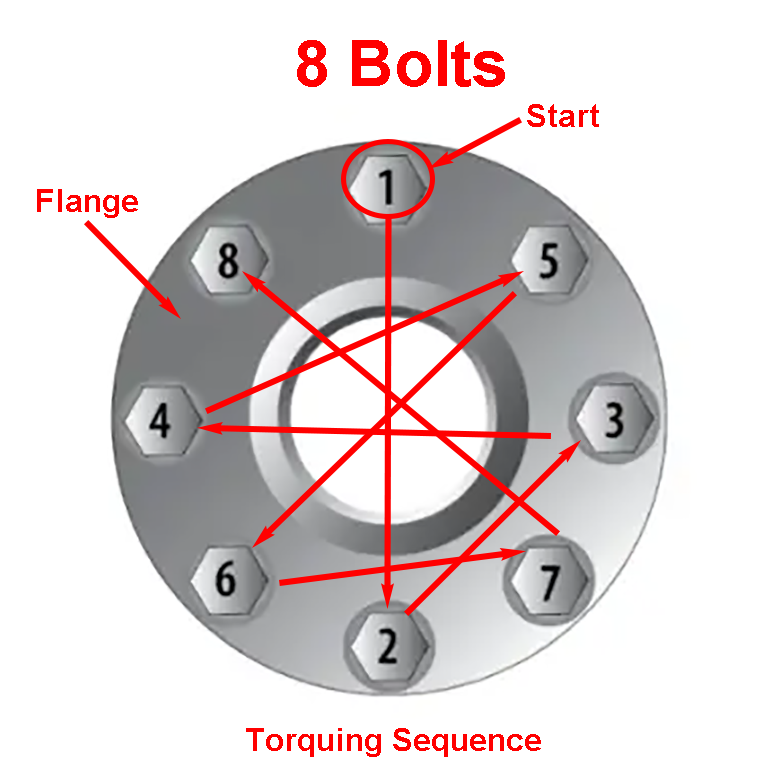
The tightening sequence of the bolts should follow the numerical order shown in the diagram.
For flanges with different numbers of bolts, the principle remains the same: always start from the center and work outward in a diagonal pattern to ensure symmetrical force distribution.
Step 3: Multi-Stage Torque Loading – Preventing Deformation and Leaks
Stage 1: Pre-Tightening (30% of Final Torque)
- Use a torque wrench to tighten all bolts in a crisscross sequence to 30% of the final torque value.
- Purpose: Initially secure the gasket and check flange alignment.
- Key Action: Check if the gasket is evenly compressed with no lateral extrusion.
Stage 1: Pre-Tightening (30% of Final Torque)
- Use a torque wrench to tighten all bolts in a crisscross sequence to 30% of the final torque value.
- Purpose: Initially secure the gasket and check flange alignment.
- Key Action: Check if the gasket is evenly compressed with no lateral extrusion.
Stage 2: Intermediate Tightening (60% of Final Torque)
- Again, in a crisscross sequence, increase torque to 60%.
- Purpose: Further compress the gasket and eliminate most uneven stress.
- Minor adjustments can be made at this stage to address any alignment issues.
- Again, in a crisscross sequence, increase torque to 60%.
- Purpose: Further compress the gasket and eliminate most uneven stress.
- Minor adjustments can be made at this stage to address any alignment issues.

Flange bolts Tightening Steps
Stage 3: Final Tightening (100% of Final Torque)
- Complete tightening to 100% torque in the same sequence.
- Use a calibrated torque wrench to ensure accuracy.
- Avoid over-tightening to prevent bolt stretching or flange deformation.
- Complete tightening to 100% torque in the same sequence.
- Use a calibrated torque wrench to ensure accuracy.
- Avoid over-tightening to prevent bolt stretching or flange deformation.
Step 4: Final Verification
- After completing the three-stage tightening, recheck all bolts in a crisscross pattern. - Confirm that the nuts cannot be turned further.
- If necessary, perform a re-check and re-tightening after the system has been in operation for a period (e.g., 24–48 hours).
- After completing the three-stage tightening, recheck all bolts in a crisscross pattern. - Confirm that the nuts cannot be turned further.
- If necessary, perform a re-check and re-tightening after the system has been in operation for a period (e.g., 24–48 hours).
Qishine is ideal choice for EPC companies and project contractors.
Website: www.qishine.com
Email: qishine@qishine.com
Tel: 0592-5225595
Email: qishine@qishine.com
Tel: 0592-5225595
WhatsApp: +86 15985833169
Serious Consequences of Incorrect Tightening Sequence
1. Gasket Damage and Medium Leakage
Tightening out of sequence causes uneven compression of the gasket, leading to:
- Localized permanent deformation and loss of resilience in the gasket.
- Formation of leakage paths, especially in high-pressure or high-temperature systems.
- For hazardous media (toxic, flammable, corrosive), leaks can lead to safety incidents.
1. Gasket Damage and Medium Leakage
Tightening out of sequence causes uneven compression of the gasket, leading to:
- Localized permanent deformation and loss of resilience in the gasket.
- Formation of leakage paths, especially in high-pressure or high-temperature systems.
- For hazardous media (toxic, flammable, corrosive), leaks can lead to safety incidents.
2. Flange Deformation and Stress Concentration
Disordered tightening can cause flange warping:
- Localized high-stress areas may lead to permanent deformation of the flange face.
- Uneven sealing surfaces, making repairs difficult.
- Increased risk of fatigue failure during long-term operation.
Disordered tightening can cause flange warping:
- Localized high-stress areas may lead to permanent deformation of the flange face.
- Uneven sealing surfaces, making repairs difficult.
- Increased risk of fatigue failure during long-term operation.
3. Bolt Overloading and Early Failure
Incorrect tightening sequences cause some bolts to bear disproportionately high loads:
- Some bolts may experience stress 2–3 times the design load.
- This can lead to bolt stretching, thread damage, or breakage.
- Remaining bolts may be under-loaded, creating weak points.
Incorrect tightening sequences cause some bolts to bear disproportionately high loads:
- Some bolts may experience stress 2–3 times the design load.
- This can lead to bolt stretching, thread damage, or breakage.
- Remaining bolts may be under-loaded, creating weak points.
4. System Vibration and Loosening Risks
Uneven bolt loads alter the dynamic characteristics of the flange system:
- In vibrating environments, unevenly loaded bolts are more prone to loosening.
- May lead to cascading failures—if one bolt fails, the load shifts to others, triggering a domino effect.
Uneven bolt loads alter the dynamic characteristics of the flange system:
- In vibrating environments, unevenly loaded bolts are more prone to loosening.
- May lead to cascading failures—if one bolt fails, the load shifts to others, triggering a domino effect.
5. Significant Increase in Maintenance Costs
Incorrect tightening practices result in:
- Frequent leak repairs and downtime.
- Premature replacement of gaskets and bolts.
- Costly repairs or replacement of damaged flange faces.
Incorrect tightening practices result in:
- Frequent leak repairs and downtime.
- Premature replacement of gaskets and bolts.
- Costly repairs or replacement of damaged flange faces.
Professional Tips and Best Practices
Key Points for Torque Control
- Always use a calibrated torque wrench.
- Consider the impact of bolt lubrication: Lubricated bolts typically require a 15–25% reduction in torque value.
- Note for high-temperature applications: Re-tightening may be required after high-temperature operation.
Key Points for Torque Control
- Always use a calibrated torque wrench.
- Consider the impact of bolt lubrication: Lubricated bolts typically require a 15–25% reduction in torque value.
- Note for high-temperature applications: Re-tightening may be required after high-temperature operation.
Handling Special Flanges
- Non-Circular Flanges: Follow the manufacturer’s specific guidelines, but the crisscross principle still applies.
- Large-Diameter Flanges: May require a four-stage or more tightening process.
- High-Pressure Flanges: Consider using hydraulic tensioners to ensure more uniform bolt loading.
- Non-Circular Flanges: Follow the manufacturer’s specific guidelines, but the crisscross principle still applies.
- Large-Diameter Flanges: May require a four-stage or more tightening process.
- High-Pressure Flanges: Consider using hydraulic tensioners to ensure more uniform bolt loading.
Recording and Documentation
Maintain detailed tightening records, including:
- Torque values used.
- Tightening sequence diagram.
- Operator information.
- Tools used and calibration dates.
Maintain detailed tightening records, including:
- Torque values used.
- Tightening sequence diagram.
- Operator information.
- Tools used and calibration dates.
Summary
Tightening flange bolts is far more than just "tightening bolts"—it is a scientific process requiring precise execution. The correct crisscross sequence and multi-stage torque loading are core technologies for ensuring the safety and reliability of flange connections. Incorrect tightening methods can lead to leaks, equipment damage, or even safety incidents, resulting in significant economic and safety costs.
Tightening flange bolts is far more than just "tightening bolts"—it is a scientific process requiring precise execution. The correct crisscross sequence and multi-stage torque loading are core technologies for ensuring the safety and reliability of flange connections. Incorrect tightening methods can lead to leaks, equipment damage, or even safety incidents, resulting in significant economic and safety costs.
Remember the golden rule of flange tightening: "Uniform, Symmetrical, Gradual." Investing in the right tools, training, and time, and strictly adhering to standard procedures, will yield substantial returns in equipment reliability, safety, and long-term operational costs. In the industrial field, details determine success, and the flange bolt tightening sequence is one of those critical details that cannot be overlooked.
If you want to learn more about flange-related knowledge, please follow us. In the next issue, we will introduce the suitable torque values for various gaskets.
Website: www.qishine.com
Email: qishine@qishine.com
Phone: 0592-5225595
Email: qishine@qishine.com
Phone: 0592-5225595
WhatsApp: +86 15985833169
Flange Bolt Torque Setting The Practical Guide for Engineers and Maintenance Teams
V-Basic Ring vs W-Basic Ring for Spiral Wound Gaskets
Related Article

Insights from a Case Study on Exporting B8M Fasteners.Recently, during our final outgoing inspection of a batch of B8M stainless steel fasteners destined for Portugal, we discovered varying degrees of burrs on the edges of the bolt hex heads.
How to Efficiently Remove Burrs from Bolt Edges

Insulating Gasket Procurement Pitfalls: From "Price Traps" to "Supplier Selection"
What pitfalls should you watch out for when purchasing insulating gaskets

As a classic modified PTFE gasket material from Garlock, Gylon 3500 is widely used in petrochemical, chemical, and other industries for its excellent resistance to strong acids, solvents, and anti-creep properties.
How to Buy Genuine Gylon 3500 Insulating Gaskets at Competitive Prices in China

