
How do we determine the filler material by the color of the color band in spiral wound gasket
author: www.qishine.com
2026-03-02

Continuing from the previous discussion on how to identify the material of spiral wound gaskets through the outer ring color coding,
we will now reveal the answers from the previous installment.
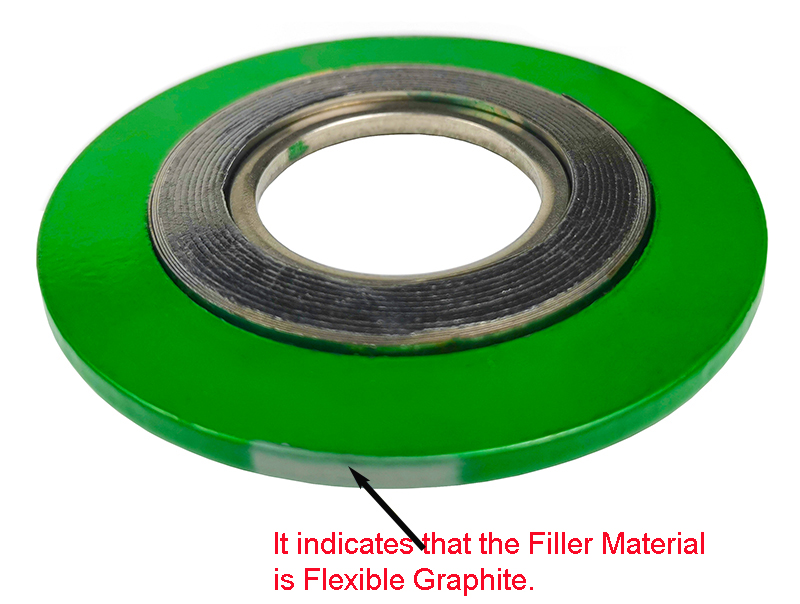
Gray Color Bar indicates that the filler material is Flexible Graphite
The color band on spiral wound gaskets is typically used to identify the type of filler material for quick recognition and selection.
Below are the four common filler materials we encounter.
Complete Color Coding Chart
| Stripe Color | Filler Material | Temperature Limit | Typical Applications |
| Gray | Flexible Graphite | 450 °C | High-temperature steam, hot oil |
| White | Polytetrafluoroethylene (PTFE) | 260 °C | Strong acids, strong alkalis |
| Pink | Mica Paper | 800 °C | Flue gas, high-temperature gases |
| Light Green | Ceramic Fiber | 1000 °C | Extreme high temperatures, incinerators |
Filler Materials
| Material | Minimum | Maximum COT | Abbreviation | Stripe Color Code | ||
| F | C | F | C | |||
| Flexible Graphite | -350 | -212 | 950 | 510 | F.G. | Gray |
| FTFE | -400 | -240 | 500 | 260 | PTFE | White |
| Ceramic | -350 | -212 | 2000 | 1090 | CER | Light Green |
| Mica Graphite | -350 | -212 | 1100 | 590 | MICA-GRA | Pink |
*According to ASME B 16.20 Standard
Why is the stripe color on spiral wound gaskets so important?
In petrochemical plant emergency repair scenarios, an engineer can determine in just 2 seconds
In petrochemical plant emergency repair scenarios, an engineer can determine in just 2 seconds
whether a gasket is suitable for the current operating conditions by simply glancing at the 4 mm wide stripe on its outer edge.
Gray graphite can withstand 450 °C steam, white PTFE is suitable for strong acids but limited to 260 °C,
and pink mica is designed for high-temperature flue gas—choosing the wrong one could mean leaks, production shutdowns, or even accidents.

The white stripes indicate that the filling material is PTFE.
Why do we use such stripe colors?
Amid the roar of petrochemical plants, a 4 mm wide colored stripe is an engineer’s "Morse code."
Amid the roar of petrochemical plants, a 4 mm wide colored stripe is an engineer’s "Morse code."
It originated from a disaster in the 1960s—when an incorrect filler caused a flange leak leading to an explosion—prompting the industry to realize
that color must be used to establish an absolutely reliable visual identification system for materials.

Gray Color Bar indicates that the filler material is Flexible Graphite
A Standard Born from Disaster
Investigations into a 1960s refinery accident in Texas, USA, revealed that 73% of seal failures were due to incorrect filler material usage.
Investigations into a 1960s refinery accident in Texas, USA, revealed that 73% of seal failures were due to incorrect filler material usage.
Engineers found that traditional labels failed in the following scenarios:
- High temperatures causing labels to carbonize and fall off
- Chemical corrosion making text illegible
- No time to consult documentation during emergency repairs
- High temperatures causing labels to carbonize and fall off
- Chemical corrosion making text illegible
- No time to consult documentation during emergency repairs
As a result, the ASME B16.20 committee introduced permanent color coding for the ASME B16.20 Spiral Wound Gasket in 1977, embedding material information directly into the gasket’s structure.
Why are these specific colors chosen?
Primarily, they are based on the natural color characteristics of the filler materials.
Primarily, they are based on the natural color characteristics of the filler materials.
? Application of Industrial Psychology
- Gray → Association with the metallic luster of graphite
- White → Reflects the pure nature of PTFE
- Pink → Represents the mineral hue of mica
- Light Green → Symbolizes the high-temperature resistance of ceramics
- Gray → Association with the metallic luster of graphite
- White → Reflects the pure nature of PTFE
- Pink → Represents the mineral hue of mica
- Light Green → Symbolizes the high-temperature resistance of ceramics
Qishine is ideal choice for EPC companies and project contractors.
Website: www.qishine.com
Email: qishine@qishine.com
Tel: 0592-5225595
Email: qishine@qishine.com
Tel: 0592-5225595
WhatsApp: +86 15960259563
+86 15985833169

The types of high-strength bolts commonly used in industrial applications
Gasket Color Code Secrets: What Yellow and Green Really Mean for Your Piping
Related Article

Insights from a Case Study on Exporting B8M Fasteners.Recently, during our final outgoing inspection of a batch of B8M stainless steel fasteners destined for Portugal, we discovered varying degrees of burrs on the edges of the bolt hex heads.
How to Efficiently Remove Burrs from Bolt Edges

Insulating Gasket Procurement Pitfalls: From "Price Traps" to "Supplier Selection"
What pitfalls should you watch out for when purchasing insulating gaskets

As a classic modified PTFE gasket material from Garlock, Gylon 3500 is widely used in petrochemical, chemical, and other industries for its excellent resistance to strong acids, solvents, and anti-creep properties.
How to Buy Genuine Gylon 3500 Insulating Gaskets at Competitive Prices in China

