
Electrogalvanized Fastener Quotes Vary by thirty percent - The Money Is Saved in These Unseen Areas
author: www.qishine.com
2026-03-16

As a purchaser, have you ever encountered this confusion: For seemingly identical specifications and requirements for electrogalvanized fasteners, why can quotes from different manufacturers vary by as much as 30%, or even double? Where is that extra money actually going? And where exactly is the cheaper supplier cutting costs?
Today, as a fastener supplier with over ten years of industry experience, we will peel back the layers and reveal the secrets behind quote differences from five key aspects. This will help you purchase wisely and use with confidence.
1. Raw Materials: Zinc Ingot Purity and Procurement Channels
This is one of the fundamental factors in cost differences, and the basis of quality.
This is one of the fundamental factors in cost differences, and the basis of quality.
Zinc Ingot Purity: Reputable manufacturers typically use No. 0 zinc ingots with a purity of up to 99.995% to ensure Galvanized fasteners coating purity and corrosion resistance. However, some small workshops may use miscellaneous zinc or recycled zinc to cut costs. Zinc with impurities leads to coatings that are prone to blackening, white spotting, and have significantly compromised anti-corrosion performance.
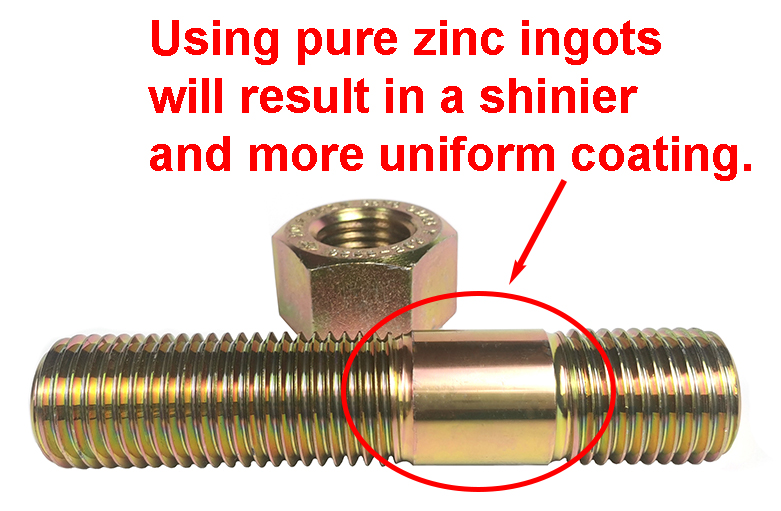
Using pure zinc ingots will result in a shinier and more uniform coating
Procurement Channels: Large factories maintain long-term cooperation with branded zinc suppliers, ensuring stable and transparent costs. Smaller players might source cheap zinc of questionable origin to lower costs. While the initial cost is lower, the quality is difficult to guarantee, posing high risks.

Zinc with impurities leads to coatings that are prone to blackening, white spotting
2. Pre-Treatment: Cost and Environmental Impact of Pickling
The rust removal step before plating is essential and critical for adhesion and preventing damage to the base metal, but it's hard to distinguish with the naked eye.
The rust removal step before plating is essential and critical for adhesion and preventing damage to the base metal, but it's hard to distinguish with the naked eye.
Correct Process: Compliant companies use environmentally friendly acids with added corrosion inhibitors and mist suppressants. This removes rust slowly and gently while protecting the steel substrate from damage.
Simplified Operation: To pursue speed and save money, low-cost suppliers might use highly concentrated waste acid for quick cleaning. This can easily lead to "over-pickling" of the screws, resulting in undersized dimensions and reduced mechanical properties. Moreover, the cost of treating the waste generated from this process is extremely low (or non-existent) for them, posing significant environmental risks.
3. Galvanized fasteners Coating Thickness and Passivation: Key to Corrosion Resistance
This is a common area where many unscrupulous manufacturers cut corners to reduce costs. Coating thickness and passivation treatment are critical factors determining how long a screw lasts before rusting.
This is a common area where many unscrupulous manufacturers cut corners to reduce costs. Coating thickness and passivation treatment are critical factors determining how long a screw lasts before rusting.
Coating Thickness: The national standard requires 8 micrometers, which might take 20 minutes of plating time to achieve. A low-cost factory might only plate for 5 minutes, resulting in an actual thickness of only 2-3 micrometers. It's difficult to tell by eye, but you can differentiate by requesting a salt spray test – thick coatings can withstand over 72 hours, while thin ones might show red rust within half a day.
Passivation Treatment: Electroplated parts must undergo passivation (e.g., yellow zinc, blue/white zinc) to form a stable protective film. Reputable manufacturers use qualified passivation solutions to ensure a dense film layer. Low-cost suppliers might shorten the passivation time or use inferior solutions. This can result in products that look bright and shiny straight from the factory but develop "white rust" (zinc hydroxide, an early corrosion product) after just a few days in the warehouse, severely impacting appearance and lifespan.

Insufficient galvanization can result in red rust or white rust within a short period of time.
> What Is White Rust on Galvanized Steel?
> White rust appears as a bulky, white or grayish powdery deposit. It is essentially zinc hydroxide, a corrosion product that forms on the surface of galvanized steel. It typically occurs when galvanized steel is stored or transported for extended periods in humid, poorly ventilated conditions, allowing the surface zinc layer to react with oxygen or other elements in the air.
> White rust appears as a bulky, white or grayish powdery deposit. It is essentially zinc hydroxide, a corrosion product that forms on the surface of galvanized steel. It typically occurs when galvanized steel is stored or transported for extended periods in humid, poorly ventilated conditions, allowing the surface zinc layer to react with oxygen or other elements in the air.
4. Hydrogen Embrittlement Relief: The "Safety Lock" for High-Strength Screws
For high-strength fasteners of grade 8.8 and above, this process is a matter of safety and a "hidden" source of cost differences.
For high-strength fasteners of grade 8.8 and above, this process is a matter of safety and a "hidden" source of cost differences.
Correct Process: Hydrogen atoms absorbed during plating are a "silent killer," potentially causing screws to suddenly fracture under stress (hydrogen embrittlement). Therefore, after plating, parts must undergo a baking process (around 200°C / 400°F) for 4 hours or more to relieve hydrogen. This consumes significant energy and time but is a necessary cost to ensure safety.
Omission or Reduction: To save money, low-cost suppliers might completely omit the hydrogen embrittlement relief process, or just perform a symbolic bake. This drastically reduces their cost, but the products carry a "ticking time bomb" – they could fail without warning during use, leading to serious safety hazards.
5. Environmental Compliance Costs: The "Bottom Line" of Corporate Responsibility
While environmental investments don't directly appear on the product, they are necessary costs that compliant companies must bear, and they are ultimately reflected in the quoted price.
While environmental investments don't directly appear on the product, they are necessary costs that compliant companies must bear, and they are ultimately reflected in the quoted price.
Compliant Factories: They invest heavily in building wastewater treatment facilities to treat electroplating effluent to meet discharge standards. The cost of treating each ton of water can be tens or even hundreds of RMB (or equivalent currency).
Non-Compliant Workshops: They might discharge wastewater illegally, even directly into the environment. Their environmental treatment costs are virtually zero. This low price, achieved at the expense of the environment, is not only illegal but also signals potential instability – the supplier could be shut down at any time due to environmental enforcement actions, jeopardizing your supply chain.
Conclusion: How to "Avoid Pitfalls" and "Ask the Right Questions" as a Purchaser?
When faced with vastly different quotes, asking a few more questions can help you quickly identify reliable suppliers:
When faced with vastly different quotes, asking a few more questions can help you quickly identify reliable suppliers:
Can you provide a third-party salt spray test report? (Verifies corrosion resistance)
Have these high-strength screws undergone hydrogen embrittlement relief? For how long? (Confirms critical safety process)
Is it convenient to visit your factory for an on-site inspection? Or can you provide your pollutant discharge permit? (Verifies production capability and environmental compliance)
Remember, in the surface finishing industry, the principle "you get what you pay for" holds true based on years of experience. Behind a low price often lies cost savings in areas you cannot see—like reduced salt spray hours, omitted safety treatments, and ignored environmental responsibilities.
Qishine is ideal choice for EPC companies and project contractors.
Website: www.qishine.com
Email: qishine@qishine.com
Tel: 0592-5225595
WhatsApp: +86 15960259563
+86 15985833169
Website: www.qishine.com
Email: qishine@qishine.com
Tel: 0592-5225595
WhatsApp: +86 15960259563
+86 15985833169
What is the difference between a hex nut and a heavy hex nut
The Difference Between Chrome-Plated and Zinc-Plated Fasteners
Related Article

Insights from a Case Study on Exporting B8M Fasteners.Recently, during our final outgoing inspection of a batch of B8M stainless steel fasteners destined for Portugal, we discovered varying degrees of burrs on the edges of the bolt hex heads.
How to Efficiently Remove Burrs from Bolt Edges

Insulating Gasket Procurement Pitfalls: From "Price Traps" to "Supplier Selection"
What pitfalls should you watch out for when purchasing insulating gaskets

As a classic modified PTFE gasket material from Garlock, Gylon 3500 is widely used in petrochemical, chemical, and other industries for its excellent resistance to strong acids, solvents, and anti-creep properties.
How to Buy Genuine Gylon 3500 Insulating Gaskets at Competitive Prices in China

