
Comparison Between ASTM A453 Gr.660 Alloy and Similar High-Temperature Alloy Inconel 718
author: www.qishine.com
2025-10-03

In the selection of high-temperature fasteners, both ASTM A453 Gr.660 (commonly known as A-286) and Inconel 718 are highly regarded materials. To help you make the most cost-effective and performance-driven decision, our company offers a detailed comparison—from core properties to practical applications.
Core Characteristics Overview
The table below provides a quick summary of the key properties of both alloys:
The table below provides a quick summary of the key properties of both alloys:
| Comparison Dimension | ASTM A453 Gr.660 (A-286) | Inconel 718 |
| Material Type | Precipitation-hardened Fe-Ni-based superalloy (iron-based) | Precipitation-hardened Ni-based superalloy (nickel-based) |
| Max. Typical Service Temp. | ~704°C | ~650°C (long-term) |
| Room-Temp Strength | Tensile ≥895 MPa, Yield ≥585 MPa (Class D up to 725 MPa) | Tensile ≥1000–1400 MPa, Yield ≥850–1100 MPa |
| High-Temp Strength | High yield and creep strength below 650°C | Highest yield strength among wrought superalloys below 650°C |
| Corrosion Resistance | Excellent oxidation resistance (>700°C); aqueous corrosion similar to 316/316L stainless steel | Outstanding overall corrosion resistance; especially resistant to chloride stress corrosion cracking |
| Machinability | Good plasticity in solution-treated state; suitable for various forming and manufacturing processes | More difficult to machine, but better hot/cold workability than most superalloys; excellent weldability |
| Relative Cost | Lower (due to lower Ni and higher Fe content) | Higher (due to high Ni and valuable alloying elements like Nb) |

ASTM A453 Gr.660 Alloy stud bolt
In-Depth Performance Analysis
Understanding the numbers is just the beginning. Let’s explore the reasons behind the differences and their practical implications.
Understanding the numbers is just the beginning. Let’s explore the reasons behind the differences and their practical implications.
1. Temperature Adaptability: Heat vs. Stress Resistance
- Gr.660 is specifically designed to retain excellent oxidation and creep resistance at temperatures up to 704°C. This makes it ideal for static fastening applications such as steam turbine bolts and boiler flange fasteners, where the environment is hot but not extremely high in stress.
- Inconel 718 Fastener, on the other hand, excels below 650°C, where its primary strengthening phase (γ'' phase) remains stable, offering unmatched strength and creep resistance. However, above 650–700°C, this phase begins to dissolve or coarsen, leading to significant strength loss. Therefore, it is the go-to choice for high-stress, moderate-temperature environments.
- Inconel 718 Fastener, on the other hand, excels below 650°C, where its primary strengthening phase (γ'' phase) remains stable, offering unmatched strength and creep resistance. However, above 650–700°C, this phase begins to dissolve or coarsen, leading to significant strength loss. Therefore, it is the go-to choice for high-stress, moderate-temperature environments.
2. Corrosion Resistance: Broad Protection vs. Specific Resistance
- Thanks to its higher content of Ni, Cr, and Mo, Inconel 718 is a corrosion-resistant all-rounder. It performs exceptionally well in oxidizing and reducing acids, seawater, and H₂S-containing environments, with superior resistance to chloride stress corrosion cracking—a critical advantage in offshore and petrochemical applications.
- Thanks to its higher content of Ni, Cr, and Mo, Inconel 718 is a corrosion-resistant all-rounder. It performs exceptionally well in oxidizing and reducing acids, seawater, and H₂S-containing environments, with superior resistance to chloride stress corrosion cracking—a critical advantage in offshore and petrochemical applications.
- Gr.660 also offers reliable corrosion resistance, comparable to 316 stainless steel, and is suitable for most industrial atmospheres and aqueous environments. However, it falls short in extremely aggressive chemical environments compared to Inconel 718.
3. Machinability and Manufacturing
- Both alloys are relatively workable in the solution-treated condition. However, Inconel 718 is more difficult to machine due to its high strength, which leads to high cutting forces and rapid tool wear, requiring specialized tooling and processes.
- Both alloys are relatively workable in the solution-treated condition. However, Inconel 718 is more difficult to machine due to its high strength, which leads to high cutting forces and rapid tool wear, requiring specialized tooling and processes.
- A key advantage of Inconel 718 is its excellent weldability, which is crucial for large or complex structural components. Gr.660 is also weldable but typically requires post-weld aging treatment to restore mechanical properties.
Cost and Selection Strategy
Cost is an unavoidable factor in engineering decisions.
Cost is an unavoidable factor in engineering decisions.
- Gr 660A Flange Bolt is significantly more economical, thanks to its lower nickel content (24–27%) and iron-based matrix, and the absence of expensive elements like niobium.
- Inconel 718, with its high nickel (50–55%) and niobium content, is considerably more expensive, often several times the price of Gr.660.
- Inconel 718, with its high nickel (50–55%) and niobium content, is considerably more expensive, often several times the price of Gr.660.
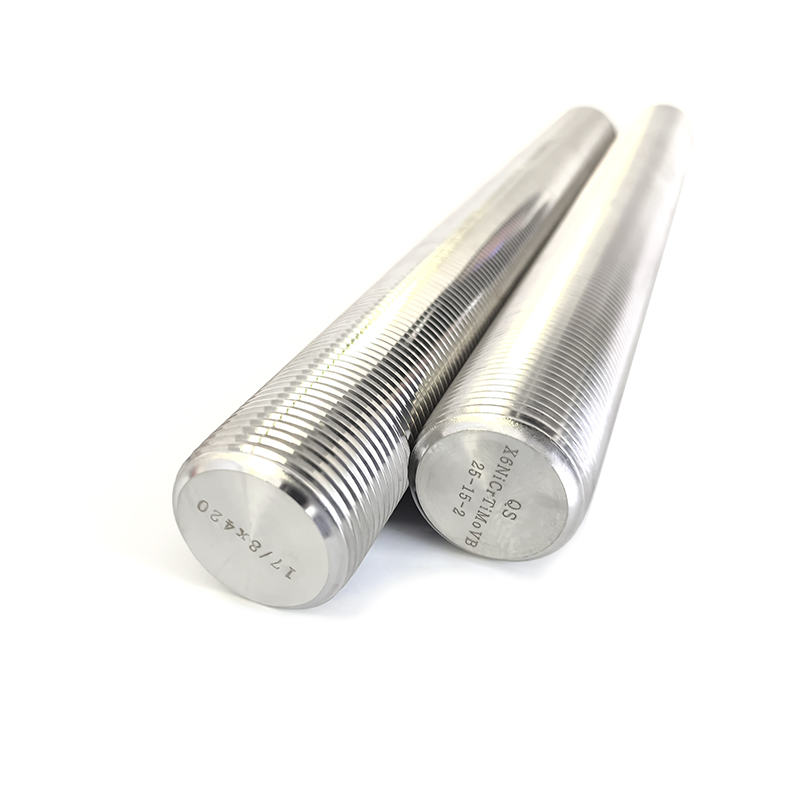
ASTM A453 Gr.660 Alloy stud bolt
Selection Guidelines
| Application Scenario | Recommended Material | Rationale |
| Power plant steam turbine/boiler fasteners, general chemical reactor flange bolts (temp <700°C, mild corrosion) | ASTM A453 Gr.660 | Adequate performance at high temperatures, excellent cost-effectiveness, proven reliability. |
| Aerospace turbine disc bolts, deep-sea drilling equipment exposed to H₂S, nuclear critical components | Inconel 718 | Requires high mechanical strength, vibration resistance, or harsh corrosion resistance—performance outweighs cost. |
| Intermediate conditions (e.g., high stress around 650°C) | Case-by-case evaluation | If corrosion is mild, Gr.660 may suffice; if absolute reliability or corrosion is a concern, Inconel 718 is preferred. |
How to Make the Right Choice?
In short, choosing between ASTM A453 Gr.660 and Inconel 718 is not about which is “better”, but about which is more suitable for your specific application.
In short, choosing between ASTM A453 Gr.660 and Inconel 718 is not about which is “better”, but about which is more suitable for your specific application.
- If your application operates below 700°C, in a non-extreme corrosive environment, and budget is a key concern, then Gr.660 is a cost-effective and reliable choice.
- If your application involves extreme stress, thermal cycling, aggressive corrosion, or zero-tolerance for failure, then the performance margin and reliability offered by Inconel 718 justify its higher cost.
- If your application involves extreme stress, thermal cycling, aggressive corrosion, or zero-tolerance for failure, then the performance margin and reliability offered by Inconel 718 justify its higher cost.
Qishine is ideal choice for EPC companies and project contractors.
Website: www.qishine.com
Email: qishine@qishine.com
Tel: 0592-5225595
WhatsApp: +86 15960259563
+86 15985833169
Website: www.qishine.com
Email: qishine@qishine.com
Tel: 0592-5225595
WhatsApp: +86 15960259563
+86 15985833169
Applications of Steel Tubes in Modular and Prefabricated Steel Structures
Material Performance and Technical Innovations of Gylon 3500 Insulating Gaskets
Related Article

Insights from a Case Study on Exporting B8M Fasteners.Recently, during our final outgoing inspection of a batch of B8M stainless steel fasteners destined for Portugal, we discovered varying degrees of burrs on the edges of the bolt hex heads.
How to Efficiently Remove Burrs from Bolt Edges

Insulating Gasket Procurement Pitfalls: From "Price Traps" to "Supplier Selection"
What pitfalls should you watch out for when purchasing insulating gaskets

As a classic modified PTFE gasket material from Garlock, Gylon 3500 is widely used in petrochemical, chemical, and other industries for its excellent resistance to strong acids, solvents, and anti-creep properties.
How to Buy Genuine Gylon 3500 Insulating Gaskets at Competitive Prices in China

