
6 Common Types of Pipe Fittings Explained in Detail
author: www.qishine.com
2026-02-28

The common pipe fittings we use daily include three-way joints, reducers, 180° elbows, 90° elbows, 45° elbows, pipe caps, etc.
1. Tee Fitting
This is the core connecting component for diverting or converging flow in a pipeline, shaped like the letter "T".
This is the core connecting component for diverting or converging flow in a pipeline, shaped like the letter "T".

Equal Tee vs Reducing Tee (The interface diameters are inconsistent.)
Types:
Equal Tee: All three ports have the same diameter.
Reducing Tee: The branch port diameter differs from the run (main) ports, used to divert flow to a smaller or larger line.
Equal Tee: All three ports have the same diameter.
Reducing Tee: The branch port diameter differs from the run (main) ports, used to divert flow to a smaller or larger line.
Features:
One inlet, two outlets (or vice versa), creating a 90° branch.
Allows a branch line to be taken off without interrupting the main flow path.
Experiences complex stresses and is a stress concentration point in the piping system, requiring reinforcement attention.
One inlet, two outlets (or vice versa), creating a 90° branch.
Allows a branch line to be taken off without interrupting the main flow path.
Experiences complex stresses and is a stress concentration point in the piping system, requiring reinforcement attention.
Typical Applications:
Main Line Diversion: Branching off from a main water/gas supply line to a subsidiary building or equipment.
Instrument Connection: Tapping into a main line to connect pressure gauges, thermometers, etc.
Fire Sprinkler Systems: Connecting branch lines in spray systems.
Chemical Process Piping: Introducing reactants into a main pipeline.
Main Line Diversion: Branching off from a main water/gas supply line to a subsidiary building or equipment.
Instrument Connection: Tapping into a main line to connect pressure gauges, thermometers, etc.
Fire Sprinkler Systems: Connecting branch lines in spray systems.
Chemical Process Piping: Introducing reactants into a main pipeline.
2. Reducer
Specifically used to connect two pipes of different diameters, enabling a transition in the piping system size.
Specifically used to connect two pipes of different diameters, enabling a transition in the piping system size.

Concentric Reducer(concentric) VS Eccentric Reducer(Center axis eccentricity)
Types:
Concentric Reducer: The transition zone is symmetrical around the centerline, shaped like a conical frustum. Used for vertical pipes or where maintaining top/bottom alignment is necessary.
Eccentric Reducer: One side of the transition is straight/flat, the other is tapered. Primarily used for horizontal pipelines to achieve:
Flat Top (Top Straight): Prevents gas accumulation at the reducer (installed with flat side on top).
Flat Bottom (Bottom Straight): Prevents liquid pooling at the reducer (installed with flat side at bottom).
Concentric Reducer: The transition zone is symmetrical around the centerline, shaped like a conical frustum. Used for vertical pipes or where maintaining top/bottom alignment is necessary.
Eccentric Reducer: One side of the transition is straight/flat, the other is tapered. Primarily used for horizontal pipelines to achieve:
Flat Top (Top Straight): Prevents gas accumulation at the reducer (installed with flat side on top).
Flat Bottom (Bottom Straight): Prevents liquid pooling at the reducer (installed with flat side at bottom).
Features:
Primary function is to change the flow rate and velocity in the piping system.
Provides a gradual transition, reducing turbulence and pressure drop caused by sudden diameter changes.
A common fitting at pump inlets/outlets, before/after flow meters, etc., to match equipment connections.
Primary function is to change the flow rate and velocity in the piping system.
Provides a gradual transition, reducing turbulence and pressure drop caused by sudden diameter changes.
A common fitting at pump inlets/outlets, before/after flow meters, etc., to match equipment connections.
Typical Applications:
Pump Suction and Discharge: Matching pipe size to pump flanges.
Connection point between main and branch lines (as an alternative to a reducing tee).
Upstream and downstream of instruments to meet straight-run and flow velocity requirements.
Process Requirements: Piping where fluid velocity needs to be gradually decreased or increased.
Pump Suction and Discharge: Matching pipe size to pump flanges.
Connection point between main and branch lines (as an alternative to a reducing tee).
Upstream and downstream of instruments to meet straight-run and flow velocity requirements.
Process Requirements: Piping where fluid velocity needs to be gradually decreased or increased.
3. 180° Elbow / Return Bend
A fitting that allows a pipeline to make a complete U-turn, reversing the flow direction, shaped like the letter "U".
A fitting that allows a pipeline to make a complete U-turn, reversing the flow direction, shaped like the letter "U".


180° LR Elbow(Larger bend radius) VS 180° SR Elbow(Smaller bend radius)
Types:
Long Radius (LR) 180° Elbow: Larger bend radius (typically 1.5x pipe diameter or more). Lower flow resistance, less erosion/wear.
Short Radius (SR) 180° Elbow: Smaller bend radius (typically 1x pipe diameter). Saves space but causes higher pressure drop and wear.
Long Radius (LR) 180° Elbow: Larger bend radius (typically 1.5x pipe diameter or more). Lower flow resistance, less erosion/wear.
Short Radius (SR) 180° Elbow: Smaller bend radius (typically 1x pipe diameter). Saves space but causes higher pressure drop and wear.
Features:
Provides the maximum change in direction.
Often used to form "U"-shaped expansion loops to absorb thermal expansion/contraction.
Very common in the pipe routing for heat exchangers, boilers, etc.
Provides the maximum change in direction.
Often used to form "U"-shaped expansion loops to absorb thermal expansion/contraction.
Very common in the pipe routing for heat exchangers, boilers, etc.
Typical Applications:
Heat Exchanger/Boiler Tube Bundles: Connecting parallel tubes to form a continuous flow path.
Pipe Thermal Compensation: Fabricating "U" or "Ω" shaped natural expansion loops.
Confined Space Piping Runs: When inlet and outlet need to be on the same side.
Turning blowdown or vent lines to direct flow downward.
Heat Exchanger/Boiler Tube Bundles: Connecting parallel tubes to form a continuous flow path.
Pipe Thermal Compensation: Fabricating "U" or "Ω" shaped natural expansion loops.
Confined Space Piping Runs: When inlet and outlet need to be on the same side.
Turning blowdown or vent lines to direct flow downward.
Qishine is ideal choice for EPC companies and project contractors.
Website: www.qishine.com
Email: qishine@qishine.com
Tel: 0592-5225595
Email: qishine@qishine.com
Tel: 0592-5225595
WhatsApp: +86 15960259563
4. 90° Elbow
The most commonly used fitting for changing pipeline direction, achieving a perpendicular turn.
The most commonly used fitting for changing pipeline direction, achieving a perpendicular turn.

SR 90° Elbow(1.0D) vs LR 90° Elbow(1.5D), D: Pipe diameter
Types:
Long Radius (LR) 90° Elbow: Standard type, bend radius R=1.5D. Low flow resistance, smooth flow, preferred choice.
Short Radius (SR) 90° Elbow: Bend radius R=1.0D. Used where space is extremely tight.
90° Elbow with Tangents: Has short straight pipe segments at ends for ease of welding.
Threaded 90° Elbow, Socket Weld 90° Elbow: Classified by connection method.
Long Radius (LR) 90° Elbow: Standard type, bend radius R=1.5D. Low flow resistance, smooth flow, preferred choice.
Short Radius (SR) 90° Elbow: Bend radius R=1.0D. Used where space is extremely tight.
90° Elbow with Tangents: Has short straight pipe segments at ends for ease of welding.
Threaded 90° Elbow, Socket Weld 90° Elbow: Classified by connection method.
Features:
The most numerous and widely used elbow type.
SR elbows cause greater pressure drop and wall erosion than LR elbows.
A key focus in pipe support design and stress analysis.
The most numerous and widely used elbow type.
SR elbows cause greater pressure drop and wall erosion than LR elbows.
A key focus in pipe support design and stress analysis.
Typical Applications:
Piping Around Obstacles: Such as beams, columns, or other pipes.
Equipment Nozzle Connections: Connecting to equipment ports in perpendicular directions.
Building Piping Layout: Connecting vertical risers to horizontal pipes between floors.
Process Lines: Changing flow direction as required by the process.
Piping Around Obstacles: Such as beams, columns, or other pipes.
Equipment Nozzle Connections: Connecting to equipment ports in perpendicular directions.
Building Piping Layout: Connecting vertical risers to horizontal pipes between floors.
Process Lines: Changing flow direction as required by the process.
5. 45° Elbow
Used to achieve a gentle, non-perpendicular change in pipeline direction.
Used to achieve a gentle, non-perpendicular change in pipeline direction.
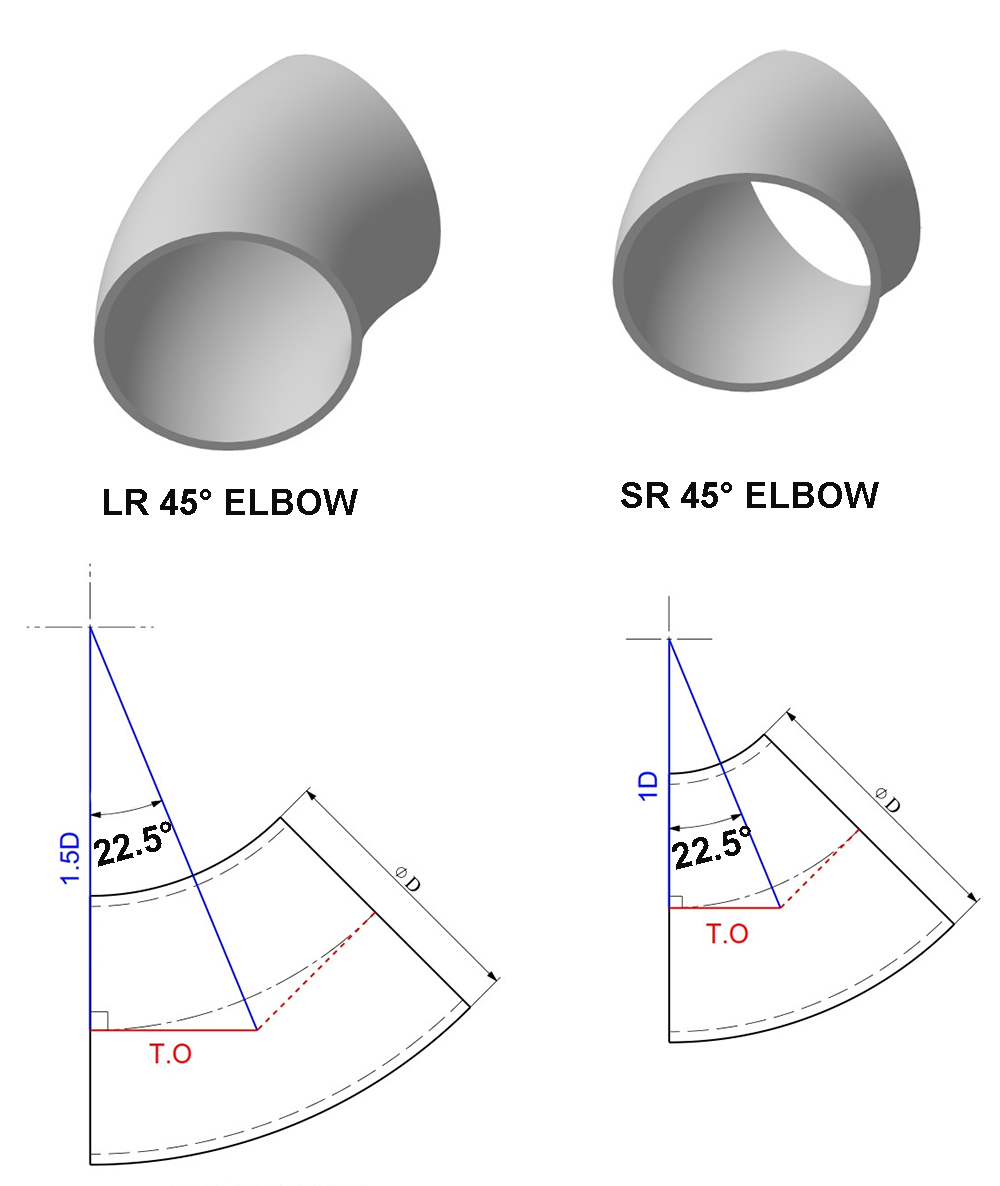
LR 45° Elbow(1.5D) VS SR 45° Elbow(1.0D)
Types:
Long Radius (LR) 45° Elbow: Mainstream type, bend radius R=1.5D.
Short Radius (SR) 45° Elbow: Bend radius R=1.0D.
Two 45° elbows can sometimes be combined to replace one 90° elbow for a gentler turn or specific pipe offset.
Long Radius (LR) 45° Elbow: Mainstream type, bend radius R=1.5D.
Short Radius (SR) 45° Elbow: Bend radius R=1.0D.
Two 45° elbows can sometimes be combined to replace one 90° elbow for a gentler turn or specific pipe offset.
Features:
Compared to 90° elbows, they offer lower flow resistance/pressure drop and smoother fluid flow.
Exert less impact force on the piping, resulting in lower vibration and noise.
Often used where a gradual change in flow direction is needed.
Compared to 90° elbows, they offer lower flow resistance/pressure drop and smoother fluid flow.
Exert less impact force on the piping, resulting in lower vibration and noise.
Often used where a gradual change in flow direction is needed.
Typical Applications:
Pump Discharge Piping: To reduce impact force and water hammer on the piping system.
Material Conveyance Piping (e.g., slurries, granules) requiring gentle turns to prevent clogging and wear.
Oblique connections in piping systems for specific layout angles.
Creating "offsets" to bypass minor obstacles or for fine adjustments.
Pump Discharge Piping: To reduce impact force and water hammer on the piping system.
Material Conveyance Piping (e.g., slurries, granules) requiring gentle turns to prevent clogging and wear.
Oblique connections in piping systems for specific layout angles.
Creating "offsets" to bypass minor obstacles or for fine adjustments.
6. Pipe Cap
Used to permanently or temporarily seal the end of a pipe, serving purposes of isolation and sealing.
Used to permanently or temporarily seal the end of a pipe, serving purposes of isolation and sealing.

Pipe Cap
Types:
Butt Weld Cap: Welded seal, high strength, for permanent closure.
Threaded Cap: Screwed seal, easy to remove, for sealing access points, instrument ports.
Socket Weld Cap: For permanent sealing of small-bore pipes.
Blind Flange (Flange Cover): Bolted to a mating flange, provides reliable and reusable sealing/closure, used for pipe ends or equipment manholes.
Butt Weld Cap: Welded seal, high strength, for permanent closure.
Threaded Cap: Screwed seal, easy to remove, for sealing access points, instrument ports.
Socket Weld Cap: For permanent sealing of small-bore pipes.
Blind Flange (Flange Cover): Bolted to a mating flange, provides reliable and reusable sealing/closure, used for pipe ends or equipment manholes.
Features:
Good pressure-bearing capacity, especially hemispherical or elliptical butt weld caps.
Threaded caps and blind flanges are removable connections, facilitating future expansion or maintenance.
Essential components for pressure testing (hydro-test/pneumatic test) of pressure vessels and piping systems.
Good pressure-bearing capacity, especially hemispherical or elliptical butt weld caps.
Threaded caps and blind flanges are removable connections, facilitating future expansion or maintenance.
Essential components for pressure testing (hydro-test/pneumatic test) of pressure vessels and piping systems.
Typical Applications:
Sealing Pipe Ends: At the terminus of pipelines intended for future expansion.
Equipment Nozzle Protection: Sealing equipment nozzles during shipment or idle periods to prevent ingress of foreign matter.
Sealing Pipe Ends: At the terminus of pipelines intended for future expansion.
Equipment Nozzle Protection: Sealing equipment nozzles during shipment or idle periods to prevent ingress of foreign matter.
Isolation for Instrument/Valve Removal: Temporarily sealing open connections after removing a pressure gauge or valve.
Terminal end of blowdown or vent lines (sometimes an open elbow is used instead of a cap).
Summary Comparison Table
| Fitting Name | Core Function | Key Features | Typical Application Scenarios |
| Tee | Flow Division / Convergence | 90° branch, equal/reducing | Branching from main lines, instrument tap points |
| Reducer | Diameter Transition | Concentric (vertical), Eccentric (horizontal) | Pump inlets/outlets, matching pipes to different sized equipment |
| 180° Elbow | Complete Flow Reversal | U-shape, Long/Short Radius | Heat exchanger tube bundles, U-shaped expansion loops |
| 90° Elbow | Perpendicular Turn | Most common, Long/Short Radius, significant pressure drop | Routing around obstacles, connecting to vertical equipment nozzles |
| 45° Elbow | Gentle Direction Change | Lower pressure drop, less impact force | Pump discharge for vibration reduction, gentle turns in material conveyance lines |
| Pipe Cap | End Sealing | Permanent (welded) or Temporary (threaded/flanged) | Pipeline terminus, equipment nozzle protection, pressure test closure |
Selecting the correct pipe fitting requires comprehensive consideration of factors such as medium, pressure, temperature, flow velocity, spatial layout, future maintenance, and cost. In critical and high-stress locations, it is essential to adhere to relevant engineering design codes and standards.
Website: www.qishine.com
Email: qishine@qishine.com
Phone: 0592-5225595
Email: qishine@qishine.com
Phone: 0592-5225595
WhatsApp: +86 15960259563
How to Choose Fastener Materials
How to Choose Between Coarse-Threaded and Fine-Threaded Bolts
Related Article

Insights from a Case Study on Exporting B8M Fasteners.Recently, during our final outgoing inspection of a batch of B8M stainless steel fasteners destined for Portugal, we discovered varying degrees of burrs on the edges of the bolt hex heads.
How to Efficiently Remove Burrs from Bolt Edges

Insulating Gasket Procurement Pitfalls: From "Price Traps" to "Supplier Selection"
What pitfalls should you watch out for when purchasing insulating gaskets

As a classic modified PTFE gasket material from Garlock, Gylon 3500 is widely used in petrochemical, chemical, and other industries for its excellent resistance to strong acids, solvents, and anti-creep properties.
How to Buy Genuine Gylon 3500 Insulating Gaskets at Competitive Prices in China

