
4 Common Industrial Valves
author: www.qishine.com
2026-03-02

In industrial piping systems, municipal engineering, and building facilities, valves serve as critical fluid control equipment. The correct selection of valve types directly impacts the system's operational efficiency, safety, and cost-effectiveness. Among the numerous valve types, globe valves, ball valves, butterfly valves, and gate valves are the four fundamental valve categories in fluid control due to their extremely high frequency of use. However, these four valves differ fundamentally in structure, operating principles, and applicable working conditions. Incorrect selection may lead to poor valve performance, reduced lifespan, or even system failures.

4 Common Industrial Valves
This article aims to provide a professional and systematic explanation of the working principles, typical structures, performance characteristics, and core application areas of these four key valve types. Through comparative analysis, you will be able to quickly establish a precise selection logic, ensuring optimal technical decisions for various working conditions such as shut-off, regulation, throttling, or full-bore flow.
Introduction to the Four Valve Types
1. Globe Valve
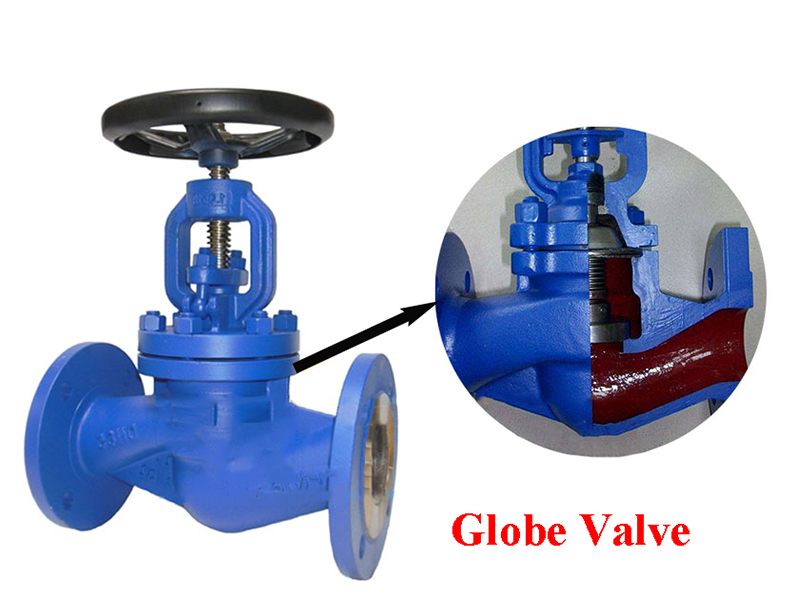
Core Principle: Similar to an old-fashioned faucet, a disc (or plug) moves vertically up and down to press against or lift away from the valve seat, thereby cutting off or regulating flow like "turning off a faucet."
Appearance Features: The valve body is typically "Z"-shaped or spherical, with inlet and outlet not in a straight line and often at different heights. The handwheel requires many turns to operate.
1. Globe Valve
Core Principle: Similar to an old-fashioned faucet, a disc (or plug) moves vertically up and down to press against or lift away from the valve seat, thereby cutting off or regulating flow like "turning off a faucet."
Appearance Features: The valve body is typically "Z"-shaped or spherical, with inlet and outlet not in a straight line and often at different heights. The handwheel requires many turns to operate.
Globe Valve
Primary Uses: Precise flow regulation and complete shut-off. Commonly used in pipelines requiring frequent adjustment or strict shut-off, such as in front of radiators or chemical regulation systems. Offers relatively high fluid resistance.
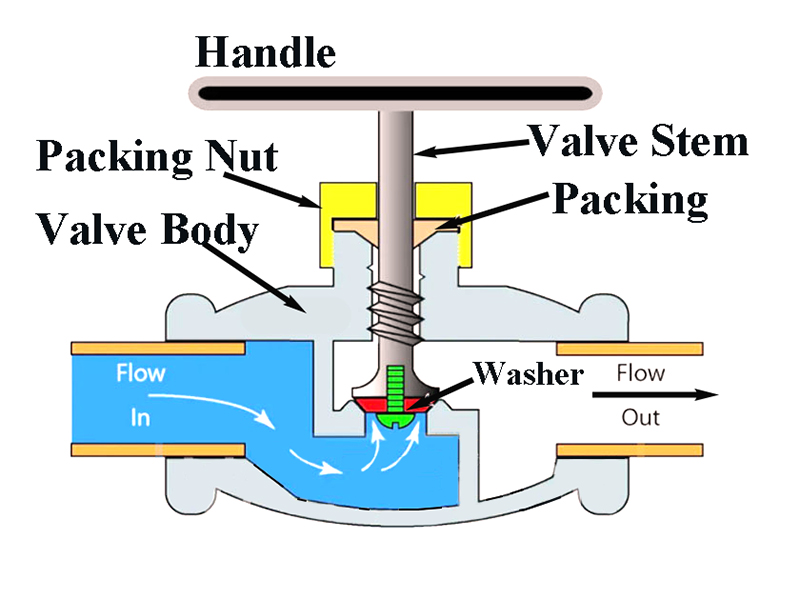
Globe Valve operation schematic diagram
Action Characteristics: Opens slowly, closes tightly, and allows fine adjustments.
2. Ball Valve
Core Principle: The core is a ball with a hole. Rotating it 90 degrees aligns the hole with the pipeline (fully open) or positions it perpendicular (fully closed), functioning like "switching tracks."
Appearance Features: The valve body is usually compact, with a simple lever or wrench handle that requires only a 90-degree rotation to operate.
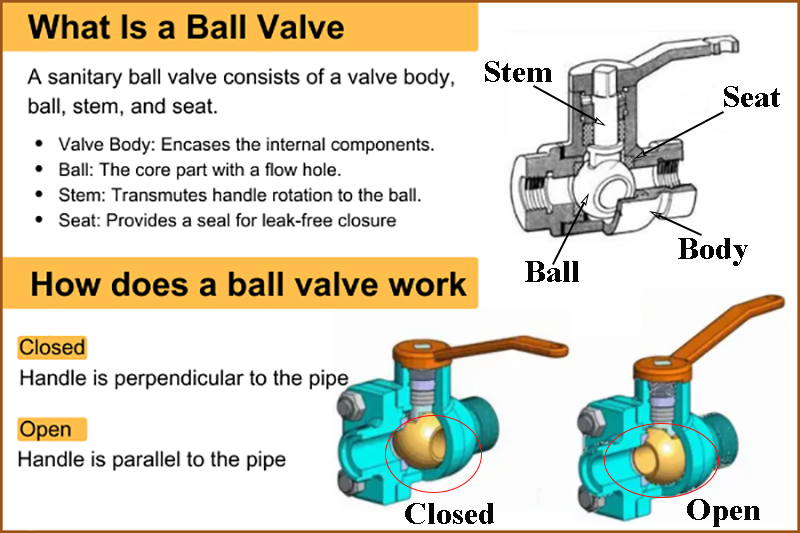
Core Principle: The core is a ball with a hole. Rotating it 90 degrees aligns the hole with the pipeline (fully open) or positions it perpendicular (fully closed), functioning like "switching tracks."
Appearance Features: The valve body is usually compact, with a simple lever or wrench handle that requires only a 90-degree rotation to operate.
What is a ball valve? and how does a ball valve work?
Primary Uses: Quick opening and closing, and shut-off. Widely used in almost all applications requiring rapid switching, from household water pipes to petroleum pipelines. Provides excellent sealing and minimal resistance but is unsuitable for fine flow regulation.
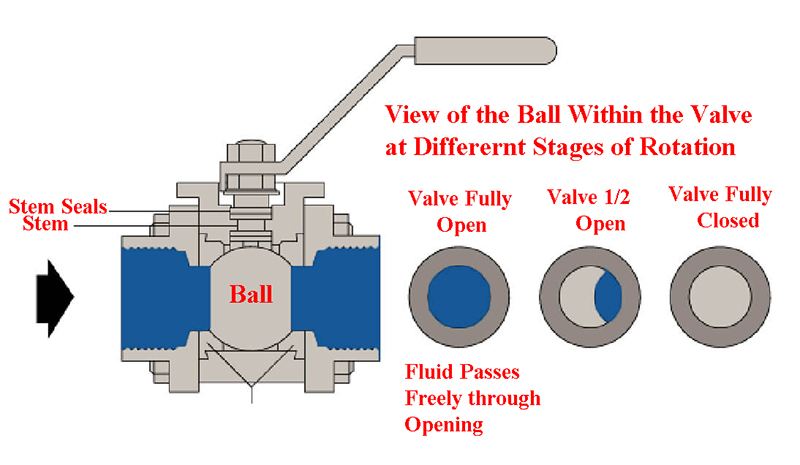
Ball Valve: view of the ball within the valve at different stages of rotation
Action Characteristics: Opens quickly, closes tightly, and operates with a simple turn.
3. Butterfly Valve
Core Principle: The core is a disc (butterfly plate) fixed to a central valve stem. Rotating the handle turns the disc like a "baffle," aligning it parallel to the flow direction for full opening or perpendicular for full closing.
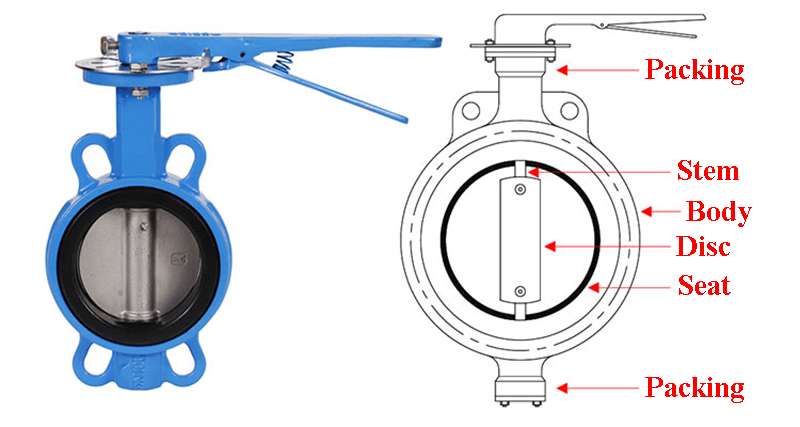
Core Principle: The core is a disc (butterfly plate) fixed to a central valve stem. Rotating the handle turns the disc like a "baffle," aligning it parallel to the flow direction for full opening or perpendicular for full closing.
Butterfly Valve
Appearance Features: The valve body is very thin, resembling a "clamp" in the pipeline. Typically operated by a worm gear handwheel or a lever handle with a positioning plate.
Primary Uses: Opening, closing, and general regulation in large-diameter pipelines. Commonly used in water treatment, ventilation, air conditioning, and other high-flow systems with moderate pressure. Advantages include low cost and compact design.
Primary Uses: Opening, closing, and general regulation in large-diameter pipelines. Commonly used in water treatment, ventilation, air conditioning, and other high-flow systems with moderate pressure. Advantages include low cost and compact design.
Action Characteristics: Opens quickly, lightweight, and commonly used for large diameters.
4. Gate Valve
Core Principle: The core is a "gate" (like a wedge-shaped blade). Rotating the handwheel raises or lowers the gate vertically, functioning like "ancient city gates" to allow fluid passage or block it.
Core Principle: The core is a "gate" (like a wedge-shaped blade). Rotating the handwheel raises or lowers the gate vertically, functioning like "ancient city gates" to allow fluid passage or block it.

Gate Valve
Appearance Features: The valve body is tall (to accommodate vertical movement) but has a straight flow path. The handwheel requires many turns, and the valve stem rises or lowers with operation (rising stem type is most common).
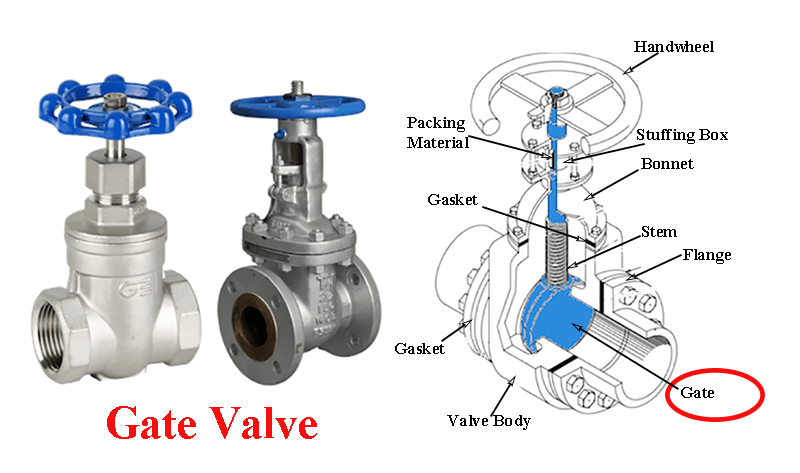
Gate Valve: Handwheel, Packing material, stuffing box, Bonnet, Gasket, Stem, Valve Body, Gate
Primary Uses: Fully open or fully closed operation, not for regulation. Often used in applications requiring a straight flow path, minimal resistance, and infrequent operation, such as main valves in municipal water pipelines. Typically remains fully open or closed for extended periods.
Action Characteristics: Zero resistance when fully open, operates slowly, and cannot be used for throttling as a regulating valve.
You can remember and distinguish them like this:
For flow regulation, choose the one like a faucet — Globe Valve. (Z-shaped flow path, opens slowly)
For quick switching, choose the one that turns with a flick — Ball Valve. (90-degree handle, fastest operation)
For large, thin pipelines, choose the one with a big handwheel — Butterfly Valve. (Thin valve body, large handwheel)
For tall, straight valves used only for full open/close, not regulation — Gate Valve. (Tall valve body, rising stem)
For flow regulation, choose the one like a faucet — Globe Valve. (Z-shaped flow path, opens slowly)
For quick switching, choose the one that turns with a flick — Ball Valve. (90-degree handle, fastest operation)
For large, thin pipelines, choose the one with a big handwheel — Butterfly Valve. (Thin valve body, large handwheel)
For tall, straight valves used only for full open/close, not regulation — Gate Valve. (Tall valve body, rising stem)
I hope this explanation helps you quickly understand and differentiate these four valve types!
Qishine is ideal choice for EPC companies and project contractors.
Website: www.qishine.com
Email: qishine@qishine.com
Tel: 0592-5225595
Email: qishine@qishine.com
Tel: 0592-5225595
WhatsApp: +86 15960259563
6 Commonly Used Butterfly Valves in the Petroleum Industry Pipeline
How to Choose Fastener Materials
Related Article

Insights from a Case Study on Exporting B8M Fasteners.Recently, during our final outgoing inspection of a batch of B8M stainless steel fasteners destined for Portugal, we discovered varying degrees of burrs on the edges of the bolt hex heads.
How to Efficiently Remove Burrs from Bolt Edges

Insulating Gasket Procurement Pitfalls: From "Price Traps" to "Supplier Selection"
What pitfalls should you watch out for when purchasing insulating gaskets

As a classic modified PTFE gasket material from Garlock, Gylon 3500 is widely used in petrochemical, chemical, and other industries for its excellent resistance to strong acids, solvents, and anti-creep properties.
How to Buy Genuine Gylon 3500 Insulating Gaskets at Competitive Prices in China

