
Why is it not recommended to use spring washers for anti-loosening in high-strength bolts
author: www.qishine.com
2026-03-03

In the fields of mechanical engineering and structural assembly, high-strength bolts are critical load-bearing connectors, and their anti-loosening performance directly affects equipment safety and service life. However, many engineers still habitually use spring washers as an anti-loosening measure. In reality, for high-strength bolts of grade 8.8 and above, spring washers are not only ineffective but may also pose a safety risk.
Anti-Loosening Mechanism and Limitations of Spring Washers
The anti-loosening principle of spring washers relies on the axial pressure generated by their elastic deformation, creating additional friction between the thread pairs to resist loosening. In general applications, this method is simple, cost-effective, and somewhat effective. However, when it comes to high-strength bolts, the limitations of this design become apparent:
The anti-loosening principle of spring washers relies on the axial pressure generated by their elastic deformation, creating additional friction between the thread pairs to resist loosening. In general applications, this method is simple, cost-effective, and somewhat effective. However, when it comes to high-strength bolts, the limitations of this design become apparent:
- Insufficient Elastic Limit: The installation torque of high-strength bolts is usually above 200 N·m., far exceeding the elastic limit of ordinary spring washers. Under such high preload, spring washers are often flattened, losing their elastic recovery capacity entirely, rendering their anti-loosening function ineffective.
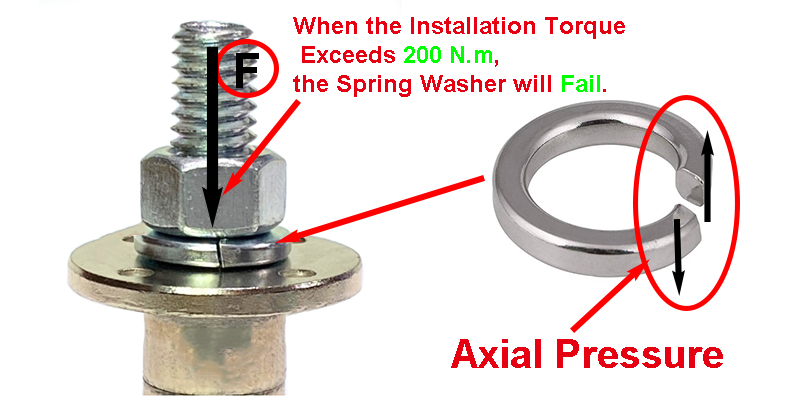
Spring washer: When the Installation Torque exceeds 200 N.m, the spring washer will fall.
- Risk of Stress Concentration: The sharp edges of spring washers may damage the connection surface under high stress, even causing micro-cracks and reducing fatigue strength.
- Regulatory Provisions: Domestic industry standards such as "JG/T5057" explicitly state that spring washers are not recommended for anti-loosening in high-strength bolts of grade 8.8 and above.
- Regulatory Provisions: Domestic industry standards such as "JG/T5057" explicitly state that spring washers are not recommended for anti-loosening in high-strength bolts of grade 8.8 and above.
So, how are anti-loosening measures implemented during the installation of high-strength bolts?
Anti-Loosening Strategies for High-Strength Bolts: Why Can They Dispense with Additional Components?
1. Self-Locking Through High Preload
High-strength bolts are inherently designed with excellent anti-loosening foundations:
- By applying a preload far exceeding that of ordinary bolts, immense clamping force is generated between the connection surfaces, creating strong static friction that can resist vibration and lateral displacement in most working conditions.
- Their high-strength material and precise thread structure ensure stable friction coefficients between thread pairs, further reducing the likelihood of spontaneous loosening.
1. Self-Locking Through High Preload
High-strength bolts are inherently designed with excellent anti-loosening foundations:
- By applying a preload far exceeding that of ordinary bolts, immense clamping force is generated between the connection surfaces, creating strong static friction that can resist vibration and lateral displacement in most working conditions.
- Their high-strength material and precise thread structure ensure stable friction coefficients between thread pairs, further reducing the likelihood of spontaneous loosening.

Self-locking through high preload: By applying a preload far exceeding that of ordinary bolts, immense clamping force is generated between the connection surfaces, creating strong static friction
2. Double-Nut Anti-Loosening Method: An Efficient and Reliable Active Solution
In particularly demanding conditions (such as continuous vibration, impact loads, or drastic temperature changes), the double-nut method is a proven optimal solution:
- Working Principle: First, tighten the lower nut to the specified torque, then install the upper nut and tighten it, causing the two nuts to press against each other. This process generates additional tension between the two nuts, forming axial pressure locking within the threads, effectively resisting rotational loosening.
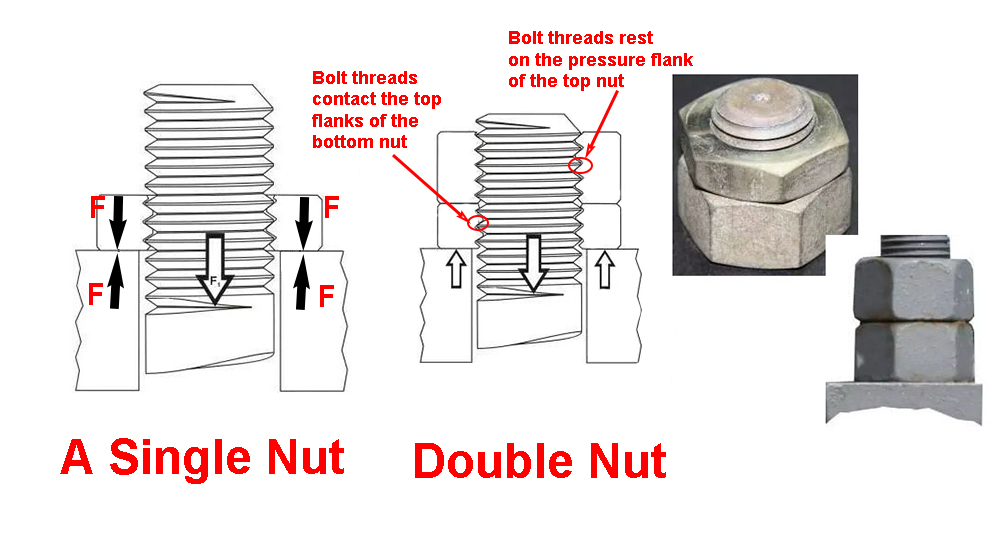
In particularly demanding conditions (such as continuous vibration, impact loads, or drastic temperature changes), the double-nut method is a proven optimal solution:
- Working Principle: First, tighten the lower nut to the specified torque, then install the upper nut and tighten it, causing the two nuts to press against each other. This process generates additional tension between the two nuts, forming axial pressure locking within the threads, effectively resisting rotational loosening.
A Single Nut vs Double Nuts
- Advantages:
- No special components are required; standard nuts can be used.
- The anti-loosening effect is significant, particularly outperforming single nuts with washers under dynamic loads.
- Easy disassembly, reusable, and low maintenance costs.
- Applications: Widely used in high-demand fields such as heavy machinery, bridge structures, wind turbine towers, and rail transit.
- No special components are required; standard nuts can be used.
- The anti-loosening effect is significant, particularly outperforming single nuts with washers under dynamic loads.
- Easy disassembly, reusable, and low maintenance costs.
- Applications: Widely used in high-demand fields such as heavy machinery, bridge structures, wind turbine towers, and rail transit.
Engineering Practice Recommendations
1. Proper Selection:
- Choose bolt grades and anti-loosening methods based on load type, vibration frequency, and environmental conditions.
- For general static or low-vibration loads, relying solely on the standard preload of high-strength bolts is sufficient.
1. Proper Selection:
- Choose bolt grades and anti-loosening methods based on load type, vibration frequency, and environmental conditions.
- For general static or low-vibration loads, relying solely on the standard preload of high-strength bolts is sufficient.
2. Process Control:
- Always use a torque wrench or hydraulic stretcher to ensure the preload meets the design value.
- If using the double-nut method, follow the "tighten first, lock later" sequence and avoid over-tightening, which may damage the threads.
- Always use a torque wrench or hydraulic stretcher to ensure the preload meets the design value.
- If using the double-nut method, follow the "tighten first, lock later" sequence and avoid over-tightening, which may damage the threads.
3. Regular Inspections:
- Even with the best anti-loosening solutions, the preload of critical connection bolts should be inspected during maintenance cycles.
- Even with the best anti-loosening solutions, the preload of critical connection bolts should be inspected during maintenance cycles.
Conclusion
While spring washers may serve a purpose in ordinary bolt connections, they have become a "pseudo-solution" for high-strength bolts. Engineers should adopt a mechanics-based approach, selecting anti-loosening strategies that truly match the characteristics of high-strength bolts—either relying on their own high preload for reliable locking or adopting mechanically validated active anti-loosening methods such as the double-nut technique.
While spring washers may serve a purpose in ordinary bolt connections, they have become a "pseudo-solution" for high-strength bolts. Engineers should adopt a mechanics-based approach, selecting anti-loosening strategies that truly match the characteristics of high-strength bolts—either relying on their own high preload for reliable locking or adopting mechanically validated active anti-loosening methods such as the double-nut technique.
Abandoning habitual thinking and embracing scientific design will ensure that every connection point remains as secure as ever, safeguarding the safe operation of equipment and structures.
Qishine is ideal choice for EPC companies and project contractors.
Website: www.qishine.com
Email: qishine@qishine.com
Tel: 0592-5225595
Email: qishine@qishine.com
Tel: 0592-5225595
WhatsApp: +86 15960259563
5 Bolt Locking Designs: Which One Prevents 80% of Failures?
Four Common Types of Pipe Flange Fastener Torque Wrenches
Related Article

Insights from a Case Study on Exporting B8M Fasteners.Recently, during our final outgoing inspection of a batch of B8M stainless steel fasteners destined for Portugal, we discovered varying degrees of burrs on the edges of the bolt hex heads.
How to Efficiently Remove Burrs from Bolt Edges

Insulating Gasket Procurement Pitfalls: From "Price Traps" to "Supplier Selection"
What pitfalls should you watch out for when purchasing insulating gaskets

As a classic modified PTFE gasket material from Garlock, Gylon 3500 is widely used in petrochemical, chemical, and other industries for its excellent resistance to strong acids, solvents, and anti-creep properties.
How to Buy Genuine Gylon 3500 Insulating Gaskets at Competitive Prices in China

