
What parameters are needed for fasteners to be quoted
author: www.qishine.com
2026-03-02

Essential Parameters for Fastener Quotation: A Comprehensive and Professional Guide
As a seasoned supplier in the fastener industry, we deeply understand that accurate quotations require comprehensive and professional information support. An incomplete list of parameters often leads to quotation deviations, delivery delays, or even quality disputes. This article systematically elaborates on the ten key parameters required for fastener quotations, helping you obtain accurate quotes efficiently.
As a seasoned supplier in the fastener industry, we deeply understand that accurate quotations require comprehensive and professional information support. An incomplete list of parameters often leads to quotation deviations, delivery delays, or even quality disputes. This article systematically elaborates on the ten key parameters required for fastener quotations, helping you obtain accurate quotes efficiently.
I. Detailed Explanation of Core Parameters
1. Product Name & Type
Must Specify: Specific names such as Hex Head Bolt, Socket Head Cap Screw, Stud Bolt, Countersunk Head Bolt, Threaded Rod, Nut, Washer, etc.
Additional Notes: Special features (e.g., with hole, groove, flange face, locking teeth) must be explicitly stated, as they directly affect tooling and manufacturing processes.
1. Product Name & Type
Must Specify: Specific names such as Hex Head Bolt, Socket Head Cap Screw, Stud Bolt, Countersunk Head Bolt, Threaded Rod, Nut, Washer, etc.
Additional Notes: Special features (e.g., with hole, groove, flange face, locking teeth) must be explicitly stated, as they directly affect tooling and manufacturing processes.

Product Name & Type: Hex head bolt, Double end stud, Stud bolt, Nut, Washer, etc.
2. Product Standard
Common International Standards: American Standard (ASTM/ANSI/ASME), European Standard (EN/DIN),
German Standard (DIN), International Standard (ISO), Japanese Standard (JIS), Chinese National Standard (GB), etc.
Key Point: Dimensions, tolerances, and mechanical property requirements for the same specification may differ across standards. The standard number must be specified (e.g., DIN 933, DIN 931, ASTM B18.2.1).
Common International Standards: American Standard (ASTM/ANSI/ASME), European Standard (EN/DIN),
German Standard (DIN), International Standard (ISO), Japanese Standard (JIS), Chinese National Standard (GB), etc.
Key Point: Dimensions, tolerances, and mechanical property requirements for the same specification may differ across standards. The standard number must be specified (e.g., DIN 933, DIN 931, ASTM B18.2.1).
3. Dimensions & Specifications
Basic Parameters: Diameter (e.g., M12, 1/2"), Length (thread length or overall length—measurement method varies by fastener type and must be specified), Width Across Flats, Head Height/Thickness, Shank Type (fully threaded, partially threaded), etc. Provide drawings for non-standard sizes.
Basic Parameters: Diameter (e.g., M12, 1/2"), Length (thread length or overall length—measurement method varies by fastener type and must be specified), Width Across Flats, Head Height/Thickness, Shank Type (fully threaded, partially threaded), etc. Provide drawings for non-standard sizes.

Length of the bolt
4. Thread Requirements
Thread Form: Metric includes coarse thread (regular) and fine thread (for thin walls or precision adjustment); Imperial includes UNC, UNF, etc.
Tolerance Class: e.g., 6g, 6H, etc., which affects fit and machining cost.
Thread Form: Metric includes coarse thread (regular) and fine thread (for thin walls or precision adjustment); Imperial includes UNC, UNF, etc.
Tolerance Class: e.g., 6g, 6H, etc., which affects fit and machining cost.

Thread Requirements: Coarse thread or Fine thread
5. Material & Mechanical Properties
Common Material Categories:
Carbon Steel: e.g., Class 4.8, 8.8, 10.9, or US Grades like GR.2, GR.5, GR.8.
Stainless Steel: 304, 316, 316L (increasing corrosion resistance); 2507 (duplex stainless steel, good strength and corrosion resistance).
Common Material Categories:
Carbon Steel: e.g., Class 4.8, 8.8, 10.9, or US Grades like GR.2, GR.5, GR.8.
Stainless Steel: 304, 316, 316L (increasing corrosion resistance); 2507 (duplex stainless steel, good strength and corrosion resistance).
Special Alloys: High-Temperature Alloys: Inconel 600/718 (good oxidation resistance and high-temperature strength).
Corrosion-Resistant Alloys: Monel 400 (resistant to seawater, acids, alkalis), Hastelloy C276.
Precipitation-Hardening Materials: 17-4PH, Incoloy 901.
Must Specify: Material grade, property class (e.g., A2-70, B7), and any necessary chemical composition or mechanical property report requirements.
Corrosion-Resistant Alloys: Monel 400 (resistant to seawater, acids, alkalis), Hastelloy C276.
Precipitation-Hardening Materials: 17-4PH, Incoloy 901.
Must Specify: Material grade, property class (e.g., A2-70, B7), and any necessary chemical composition or mechanical property report requirements.
6. Surface Treatment
Corrosion Protection & Decoration: Zinc plating (blue-white, yellow chromate, black), Hot-dip galvanizing, Dacromet, Phosphating, Black oxide, Nickel plating, Passivation (stainless steel natural color), Teflon coating, etc.
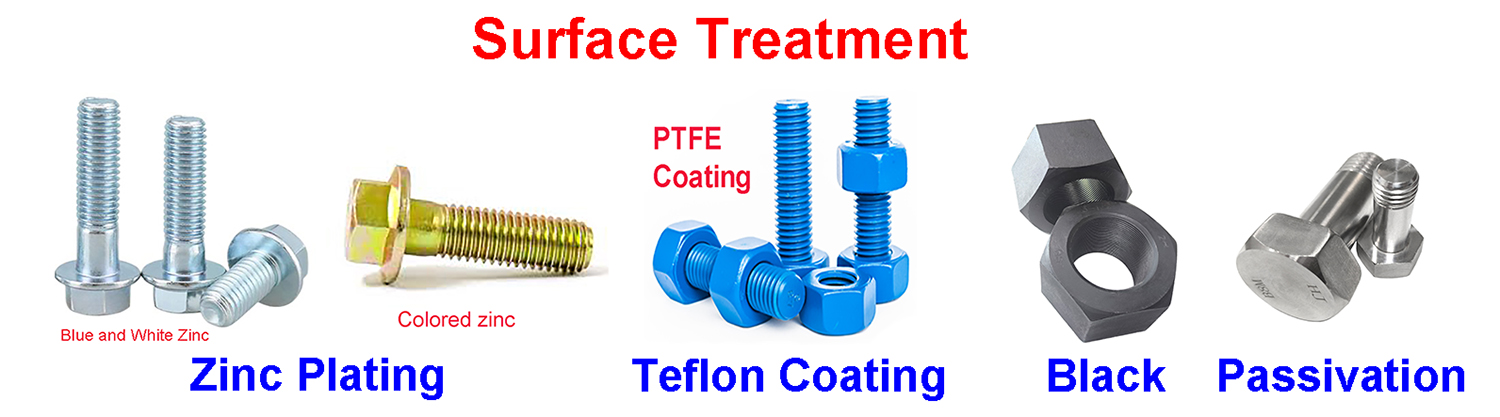
Corrosion Protection & Decoration: Zinc plating (blue-white, yellow chromate, black), Hot-dip galvanizing, Dacromet, Phosphating, Black oxide, Nickel plating, Passivation (stainless steel natural color), Teflon coating, etc.
Surface Treatment: Zinc Plating, PTFE Coating, Black, Passivation, etc.
Key Note: Different treatments affect corrosion life, hydrogen embrittlement risk (dehydrogenation needed for high-strength fasteners), and cost. Environmental requirements (e.g., salt spray test hours) must be clarified upfront.
7. Purchase Quantity
Quantity Tiers: Prototype/samples, small batch, pilot run, mass production. Quantity directly affects raw material procurement, production efficiency allocation, and tooling amortization costs.
Suggestion: Providing an annual forecast often helps secure more competitive tiered pricing.
Quantity Tiers: Prototype/samples, small batch, pilot run, mass production. Quantity directly affects raw material procurement, production efficiency allocation, and tooling amortization costs.
Suggestion: Providing an annual forecast often helps secure more competitive tiered pricing.
8. Delivery Requirements
Lead Time Start Point: From receipt of deposit, order confirmation, or when all information/documents are complete?
Production Cycle: Standard items typically 7-30 days; special materials or non-standard parts may require 45-90 days. Rush orders usually incur additional charges.
Lead Time Start Point: From receipt of deposit, order confirmation, or when all information/documents are complete?
Production Cycle: Standard items typically 7-30 days; special materials or non-standard parts may require 45-90 days. Rush orders usually incur additional charges.
9. Packaging & Delivery Terms
Packaging Details: Bulk (bundled/bagged), boxed, cartoned, palletized; Is it necessary to affix labels, barcodes, or special protective measures (anti-rust paper, vacuum packaging)?
Delivery Terms: EXW, FCA, FOB, CIF, etc., along with destination port/location information.
Packaging Details: Bulk (bundled/bagged), boxed, cartoned, palletized; Is it necessary to affix labels, barcodes, or special protective measures (anti-rust paper, vacuum packaging)?
Delivery Terms: EXW, FCA, FOB, CIF, etc., along with destination port/location information.
10. Payment Terms
Payment Methods: T/T, L/C, D/P, etc.
Payment Schedule: Common terms like 30% deposit + 70% before shipment, or adjusted based on cooperation stage.
Payment Methods: T/T, L/C, D/P, etc.
Payment Schedule: Common terms like 30% deposit + 70% before shipment, or adjusted based on cooperation stage.
II. Often Overlooked but Critical Requirements
1. Testing & Certification Requirements: Is third-party inspection report (e.g., SGS, BV) needed? Material Test Certificate (MTC/COC) required? Special industry certifications (e.g., CE, API, railway, nuclear)?
2. Special Process Requirements: Surface lubrication needed (waxing, oiling)? Pre-assembly required (screw + washer + nut)? Non-standard head marking?
3. Application/Environment Information: e.g., "For offshore wind power platforms," "In contact with strong acids/alkalis," "High-temperature & high-pressure service," etc. This helps the supplier recommend more suitable materials and processes.
1. Testing & Certification Requirements: Is third-party inspection report (e.g., SGS, BV) needed? Material Test Certificate (MTC/COC) required? Special industry certifications (e.g., CE, API, railway, nuclear)?
2. Special Process Requirements: Surface lubrication needed (waxing, oiling)? Pre-assembly required (screw + washer + nut)? Non-standard head marking?
3. Application/Environment Information: e.g., "For offshore wind power platforms," "In contact with strong acids/alkalis," "High-temperature & high-pressure service," etc. This helps the supplier recommend more suitable materials and processes.
III. Recommendations for Buyers
Provide Drawings or Samples: For complex or non-standard parts, a clear drawing or a physical sample is the most effective communication tool, greatly avoiding misunderstandings.
Define Priorities: Balance budget, delivery time, quality, and special requirements. This helps the supplier provide the most suitable solution.
Establish Long-term Partnerships: Maintain stable communication with professional suppliers. Their experience can help you optimize selection, reduce costs, and mitigate risks.
Provide Drawings or Samples: For complex or non-standard parts, a clear drawing or a physical sample is the most effective communication tool, greatly avoiding misunderstandings.
Define Priorities: Balance budget, delivery time, quality, and special requirements. This helps the supplier provide the most suitable solution.
Establish Long-term Partnerships: Maintain stable communication with professional suppliers. Their experience can help you optimize selection, reduce costs, and mitigate risks.
Conclusion
An accurate and efficient fastener quotation starts with a clear and complete list of technical and commercial parameters. The ten parameters above form the foundational framework, but the details behind each parameter are key to precise pricing. As your supply chain partner, we recommend providing as much detailed information as possible during inquiry. We will also proactively communicate to clarify any ambiguities, ensuring every step from quotation to delivery is reliable.
An accurate and efficient fastener quotation starts with a clear and complete list of technical and commercial parameters. The ten parameters above form the foundational framework, but the details behind each parameter are key to precise pricing. As your supply chain partner, we recommend providing as much detailed information as possible during inquiry. We will also proactively communicate to clarify any ambiguities, ensuring every step from quotation to delivery is reliable.
Let's start with a complete parameter list to build the most trustworthy fastener supply solution for you.
Qishine is ideal choice for EPC companies and project contractors.
Website: www.qishine.com
Email: qishine@qishine.com
Tel: 0592-5225595
Email: qishine@qishine.com
Tel: 0592-5225595
WhatsApp: +86 15960259563
Fastener Zinc Plating vs PTFE Coating Comparison
5 Bolt Locking Designs: Which One Prevents 80% of Failures?
Related Article

Insights from a Case Study on Exporting B8M Fasteners.Recently, during our final outgoing inspection of a batch of B8M stainless steel fasteners destined for Portugal, we discovered varying degrees of burrs on the edges of the bolt hex heads.
How to Efficiently Remove Burrs from Bolt Edges

Insulating Gasket Procurement Pitfalls: From "Price Traps" to "Supplier Selection"
What pitfalls should you watch out for when purchasing insulating gaskets

As a classic modified PTFE gasket material from Garlock, Gylon 3500 is widely used in petrochemical, chemical, and other industries for its excellent resistance to strong acids, solvents, and anti-creep properties.
How to Buy Genuine Gylon 3500 Insulating Gaskets at Competitive Prices in China

